

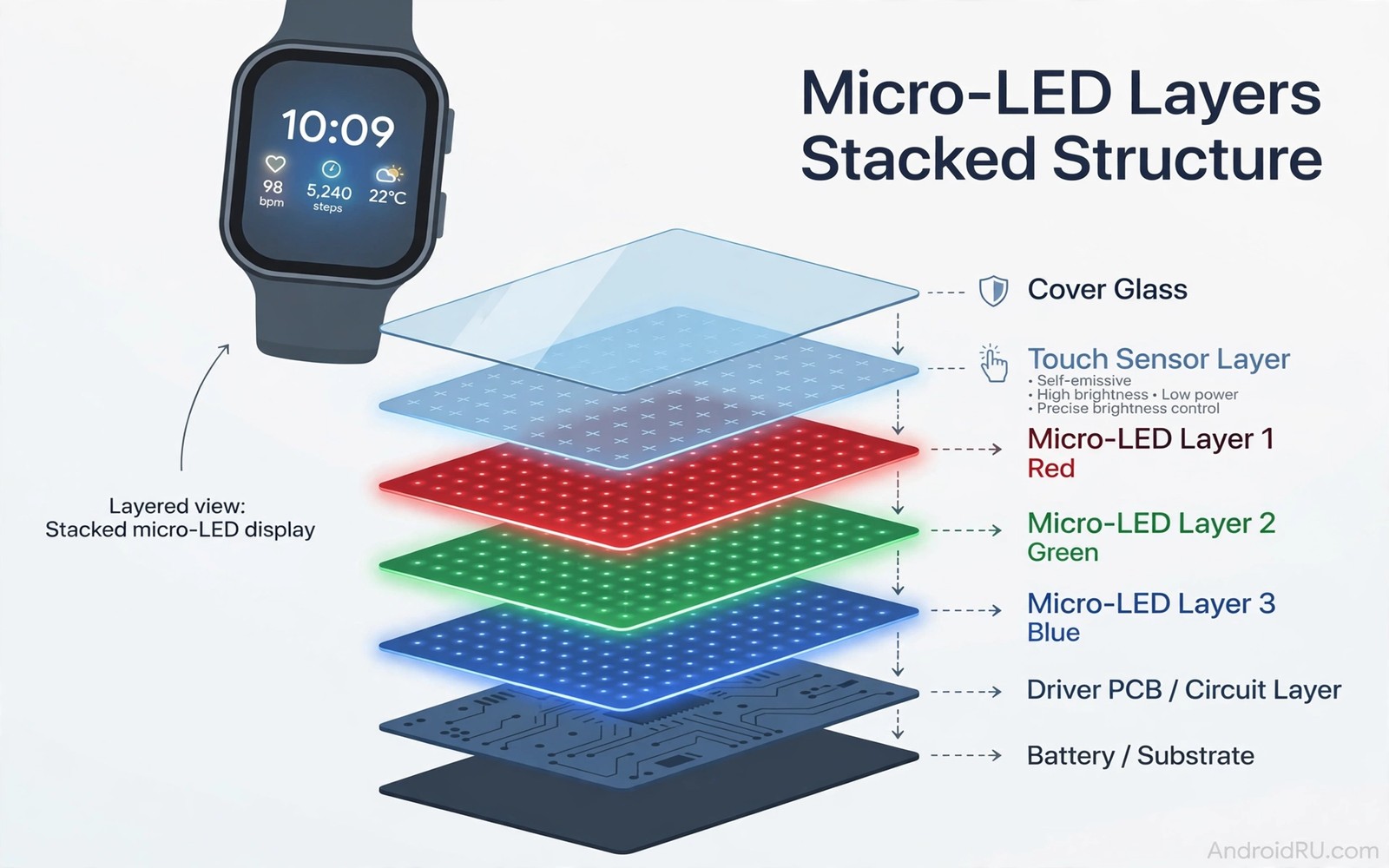
Smartwatches need a display that stays readable in sunlight and lasts for days on a tiny battery. Micro-LED technology promises both because it uses inorganic LEDs that are bright and efficient and durable. Each pixel produces its own light and can turn off completely for deep blacks. That combination suits a watch face that must stay visible during a run and during a meeting.
Current smartwatches use OLED or LCD displays that work well but face limits in brightness and lifespan. OLED can suffer burn in from static watch faces over years. LCD needs a backlight that wastes power for dark faces. Micro-LED avoids both problems in theory. The challenge is manufacturing millions of tiny LEDs at watch size without defects and at a reasonable price.
Brightness for outdoor use
Outdoor brightness is the most obvious Micro-LED advantage because a runner or cyclist needs to read pace and maps in direct sunlight. A Micro-LED watch can reach high brightness without the same power penalty as OLED. That brightness also helps older users and users with low vision who need strong contrast. A watch that stays readable outdoors becomes more useful as a standalone device.
Brightness must be balanced with battery life because a very bright screen can still drain a small watch battery quickly. Micro-LED efficiency helps because it produces more light per unit of power. Adaptive brightness that adjusts to ambient light will matter as much as peak brightness. A watch that brightens only when needed will last longer than a watch stuck at maximum.
Battery life and efficiency
Micro-LED efficiency comes from direct light emission without colour filters that waste light. OLED also emits directly but its organic materials lose efficiency over time. Micro-LED inorganic materials maintain efficiency longer. That stability means a watch display can stay bright for years without fading.
Efficiency also helps always on watch faces because a Micro-LED face can show time and complications with very low power. A watch that shows time continuously without a large battery drain feels more like a traditional watch. That always on experience is a key reason many users choose a smartwatch over a fitness band.
Durability and lifespan
Durability matters for a device worn on the wrist during sports and work and sleep. Micro-LED inorganic LEDs resist degradation better than organic OLED materials. That resistance reduces burn in from static faces and complications. A watch that keeps its display quality for five years offers better value than a watch that fades after two years.
Durability also includes resistance to heat and cold because watches face outdoor conditions. Micro-LED materials handle temperature extremes better than many OLED materials. That robustness suits outdoor workers and athletes who use a watch in harsh weather. A durable display reduces repair costs and electronic waste.
Colour and design possibilities
Micro-LED offers strong colour range and high contrast because each pixel can be controlled individually. A watch face can show vivid colours for complications and deep blacks for backgrounds. That contrast makes small text easier to read at a glance. Designers can create faces that use colour to highlight important information such as heart rate zones.
Micro-LED also enables new form factors because LEDs can be placed on flexible or curved surfaces. A future watch could wrap slightly around the wrist for a larger display area. That design would need flexible substrates and durable encapsulation. Early Micro-LED watches will likely use flat displays while flexible versions mature.
Manufacturing challenges
Manufacturing Micro-LED watches requires placing millions of tiny LEDs with high accuracy. A single defective LED can create a dead pixel that is visible on a small screen. Repairing a defective LED at watch scale is hard and expensive. Makers use mass transfer techniques to place many LEDs at once. Yield rates must improve before prices fall to mainstream levels.
Cost remains high for early Micro-LED watches because low yields increase price per unit. Premium buyers may accept that price for brightness and durability. Mainstream buyers will wait until yields improve and prices approach OLED levels. That timeline may take several years for watches and longer for phones.
How Micro-LED compares with OLED watches
OLED watches offer excellent contrast and thin designs at a lower price today. Micro-LED watches promise higher brightness and longer lifespan at a higher price tomorrow. A buyer who needs a watch now should choose OLED. A buyer who can wait and prioritises outdoor brightness should watch Micro-LED progress.
Compare real world tests rather than specification sheets because brightness in sunlight and battery life during always on use reveal practical differences. A Micro-LED watch that offers only a small brightness gain over OLED may not justify a large premium. A Micro-LED watch that doubles outdoor readability will justify its price for outdoor users.
Micro-LED for health and fitness watches
Health and fitness watches benefit from Micro-LED because outdoor workouts demand readable displays in sunlight. A runner who checks heart rate during a sprint needs a display that stays clear without shading the wrist. A cyclist who checks navigation on a bright road needs the same clarity. Micro-LED brightness helps both users stay safe and informed without stopping.
Fitness watches also benefit from always on displays that show time and workout data continuously. A Micro-LED always on face can stay visible with low power and high contrast. That combination helps athletes who train for hours without charging. It also helps users who want a watch that looks like a traditional timepiece between workouts.
Micro-LED and watch battery tradeoffs
Battery tradeoffs still matter because a brighter display can drain a small watch battery if brightness stays at maximum. Adaptive brightness and efficient pixels help manage that tradeoff. A watch that adjusts brightness to ambient light will last longer than a watch that stays bright indoors. Users should test battery life in always on mode rather than only in raise to wake mode.
Charging habits also affect watch usefulness because a watch that needs daily charging becomes a burden. A Micro-LED watch that lasts several days with always on display will feel more like a traditional watch. That longevity is a key selling point for users who dislike frequent charging. Battery life tests should reflect real always on use.
Micro-LED for children and older users
Children and older users benefit from a display that is easy to read at a glance. A Micro-LED watch face with strong contrast can show time and alerts clearly without requiring perfect vision. That clarity helps older users who may struggle with small dim text. It also helps children who use a watch for safety and communication during school and play.
Parents and carers should still check other features such as fall detection and emergency calling. A great display does not replace safety features. A watch that combines a readable Micro-LED display with strong safety tools offers the best value for vulnerable users. Display quality and safety features together matter more than either alone.
Common mistakes
People often assume that Micro-LED will immediately replace OLED in every watch. That assumption ignores manufacturing cost and yield challenges. Micro-LED will start in premium watches and expand gradually as production improves.
- Expecting Micro-LED watches to be cheap in their first generation.
- Judging a watch display only by peak brightness without checking battery life.
- Ignoring burn in and lifespan differences between OLED and Micro-LED.
- Assuming that a brighter display automatically means better readability in all light.
- Buying a premium Micro-LED watch without checking app and health features.
A careful buyer balances display technology with health features and battery life and price. A great display on a watch with poor health tracking is still a poor watch for many users.
Frequently asked questions
Will Micro-LED watches last longer than OLED watches?
Micro-LED watches should last longer in display quality because inorganic LEDs resist degradation better than organic OLED materials. That advantage reduces burn in and fading over years. Other components such as battery still limit total watch life.
Check battery replacement options as well because a durable display does not help if the battery cannot be replaced. Longevity depends on the whole device.
Are Micro-LED watches worth the premium price?
Micro-LED watches are worth a premium for users who need maximum outdoor brightness and long display life. Casual users who mainly use a watch indoors may not notice a large difference over OLED. Compare outdoor readability before paying extra.
Wait for independent reviews that test brightness and battery life in real outdoor conditions. Those tests reveal whether the premium delivers practical benefits.
When will Micro-LED watches become mainstream?
Micro-LED watches will become mainstream when manufacturing yields improve and prices fall close to OLED levels. That process may take several years. Premium models will lead and mainstream models will follow.
OLED watches will continue to improve in the meantime. Buyers should not delay a needed watch indefinitely while waiting for Micro-LED.
Conclusion
Micro-LED screens will revolutionize future smartwatches by offering brighter outdoor displays and better efficiency and longer lifespan. Manufacturing challenges and high initial prices will slow mainstream adoption. Outdoor users and long term buyers will benefit first. Other users can enjoy improving OLED watches while Micro-LED matures. Related coverage includes next generation display technologies and dynamic refresh rate displays and smart glasses and phone screens.
Take one concrete next step today. Test your current watch outdoors in sunlight and note whether you struggle to read it during a run or walk. That test will tell you whether Micro-LED brightness is worth waiting for.
A final check helps a buyer avoid paying for a display that does not match daily use. Ask whether outdoor readability or indoor battery life matters more for your routine. Choose a watch that excels in the area you use most.
# Check display brightness and battery on a connected Android device
adb shell settings get system screen_brightness
adb shell dumpsys battery | grep level
The commands above were written for this guide to show a simple way to check brightness and battery level on a connected device. They are general diagnostic examples and they do not modify the phone.

