

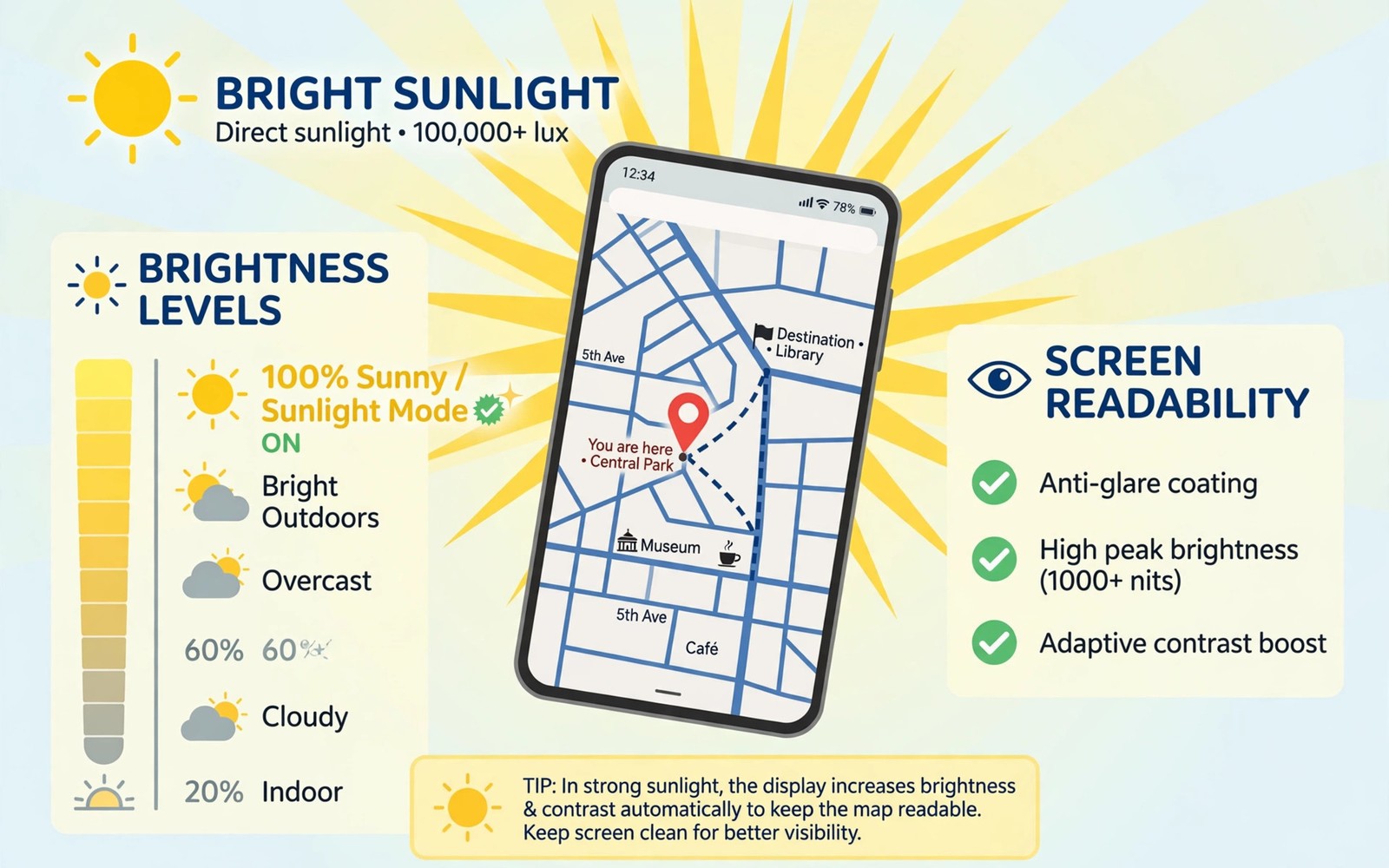
Reading a map in direct sun separates great phone screens from merely good ones. A dim screen forces you to shade it with your hand and squint. A truly bright screen stays readable while you walk and navigate. The difference comes from brightness and reflections and contrast working together. This guide explains which display traits predict sunlight readability and it highlights the type of phone that leads outdoors.
Peak brightness headlines mislead buyers badly. A maker may advertise 4000 nits for a tiny highlight area. That number says little about reading a full map screen. Full screen brightness matters far more outdoors. A phone that sustains 1500 nits across the whole screen beats a phone that flashes 3000 nits on a small white box. Always ask which brightness figure a review measured across the full screen.
Reflections matter just as much as brightness. A glossy screen reflects the sky and your face back at you. That reflection competes with the display light. A screen with a good anti reflective coating cuts that competition. Brightness plus low reflection wins outdoors. Brightness alone with a mirror like surface still struggles in harsh sun.
Brightness Numbers That Actually Matter
Learn three brightness concepts before you shop. Peak brightness describes a small highlight area for a short burst. Full screen brightness describes the whole panel under sustained load. Outdoor boost describes an automatic mode that raises brightness in sunlight. Reviews that measure full screen brightness in sunlight give you the most useful number. Marketing sheets rarely highlight that number because it is lower than the peak headline.
As a rough guide a full screen brightness near 800 nits feels usable in shade and overcast light. A figure near 1200 nits feels comfortable in bright daylight. A figure near 1800 nits or higher feels confident in direct midday sun. These figures assume a decent anti reflective coating. A phone at 1200 nits with a poor coating can feel worse than a phone at 1000 nits with a great coating. Judge the combination rather than one number alone.
Automatic brightness behaviour also matters. A good phone ramps brightness quickly when you step into sun. A slow phone leaves you squinting for seconds while it catches up. A phone that caps outdoor brightness to save battery will disappoint exactly when you need it most. Test this transition in a shop by walking near a bright window and watching the screen response. A fast confident ramp is a strong outdoor sign.
Panel Technology And Coatings Compared
Modern AMOLED panels dominate outdoor readability at the high end. They produce deep blacks that preserve contrast even as brightness rises. Their pixels emit light directly so contrast stays strong. High end LCD panels can reach good brightness too but their blacks look greyer in sun. That grey wash reduces perceived contrast. AMOLED contrast gives text an edge that raw brightness numbers miss.
Anti reflective coatings make a large difference that spec sheets understate. Some flagship phones now use etched glass that scatters reflections. Others use layered coatings that cut glare. These treatments reduce the mirror effect of the sky. A phone with such a coating can look dramatically clearer outdoors even at moderate brightness. Check reviews that photograph screens in sunlight rather than in a dark lab. Lab photos hide reflection problems completely.
Screen protectors can undo a good coating. A cheap glossy protector adds reflections back. A matte protector cuts reflections but can soften sharpness slightly. If outdoor readability tops your list then choose a protector designed for low glare. Test the phone with your protector on under bright light before a long outdoor trip. A protector change costs little and can transform sunlight usability.
Which Phones Lead Outdoors Today
Current flagship phones from the leading makers all reach strong outdoor brightness. The leaders sustain high full screen brightness with good coatings. They also ramp brightness fast in sunlight. Differences between top flagships outdoors are smaller than marketing suggests. A buyer choosing among current flagships should weigh cameras and battery and software more than a small brightness gap. Any top flagship will read well in sun.
The gap widens sharply in the midrange. Some midrange phones advertise high peak numbers but sustain far less full screen brightness. Others sustain good brightness but use reflective glass that hurts real world clarity. Budget phones vary most of all. A budget phone with a genuinely bright panel stands out immediately outdoors. A budget phone with a dim panel frustrates navigation on every sunny walk. Outdoor heavy buyers should prioritise this test above many other specs.
Rugged phones deserve a special note. Many rugged models advertise outdoor readability and use brighter panels with tougher glass. Their screens may not match flagship colour accuracy. Their brightness and reflection control often suit field work very well. Delivery riders and construction workers and hikers should shortlist rugged models alongside flagships. A brighter rugged screen can beat a prettier flagship screen in harsh light.
Foldable phones face an extra outdoor challenge. Their flexible inner screens use softer cover layers that reflect differently. Outdoor readability on an unfolded foldable can lag a slab flagship. The outer cover screen often reads better in sun because it uses rigid glass. If you work outdoors and love foldables then test the inner screen in sun before you buy. Do not assume flagship brightness claims apply equally to both screens.
Real World Tests You Can Run Yourself
Take your shortlisted phone outdoors at midday if a shop allows it. Open a map app and a web article with small text. Stand with the sun behind you and then with the sun facing you. Note whether small text stays readable without shading the screen. Note whether colours wash out badly. Note how fast auto brightness ramps when you step from shade into sun. These three observations beat any spec sheet.
Test with sunglasses on too if you wear them. Polarised sunglasses can dim some screens dramatically at certain angles. OLED panels vary in how they interact with polarised lenses. A screen that looks great naked may look dark through sunglasses in landscape orientation. Rotate the phone and check both orientations. Outdoor workers who wear polarised sunglasses daily should treat this test as essential.
Test battery drain during outdoor use as well. Sustained high brightness drains battery fast. A phone that stays readable but empties by afternoon may still fail your day. Note the battery drop during a thirty minute outdoor navigation test. Pair that result with brightness. The best outdoor phone balances readability with enough battery to last the whole outing. Readers comparing display value can also check whether megapixel headlines mislead buyers for a similar lesson on headline specs.
full_screen_nits = 1500
peak_nits = 3000
reflection = low
auto_brightness_speed = fast
# full screen brightness predicts sunlight reading
# peak alone does not predict sunlight reading
The snippet above is an original example written for this guide. It shows generic display notes you can adapt to your own shortlist. It does not copy code from any outside source.
Use the notes when you read reviews. Look for the full screen figure first. Look for reflection comments second. Look for auto brightness speed third. A phone that scores well on all three will serve you outdoors far better than a phone that leads only on peak brightness.
Ambient light sensors decide how well auto brightness works outdoors. A good sensor samples light frequently and ramps brightness smoothly. A poor sensor reacts slowly or jumps in steps that distract you. Test sensor behaviour by moving from shade into sun repeatedly. The screen should brighten within a couple of seconds each time. A sensor that takes ten seconds to react will leave you squinting on every transition. Manual brightness override helps in that case but it defeats the convenience of automatic mode.
Manual control still matters for outdoor specialists. Photographers and surveyors often lock brightness at maximum outdoors regardless of battery cost. That lock guarantees readability during critical work. It also drains battery fast so carry a power bank on long outdoor days. A phone that allows a quick manual maximum through a slider or a shortcut serves outdoor workers better than a phone that buries the control deep in settings. Test that shortcut before a field trip rather than discovering its absence on site.
Common Mistakes
Many buyers trust peak brightness headlines alone. Full screen brightness matters more. A second mistake is testing screens only indoors. Shop lighting hides reflection problems. A third mistake is ignoring sunglasses interaction. Polarised lenses can dim a screen sharply at some angles.
A fourth mistake is forgetting battery drain at maximum brightness. A fifth mistake is adding a glossy protector that ruins a good coating. A sixth mistake is assuming foldable inner screens match slab screens outdoors. Flexible layers behave differently in sun.
Frequently Asked Questions
Question: How many nits do I need for direct sun?
Answer: Aim for full screen brightness near 1500 nits or higher for confident direct sun reading. Phones near 1000 nits still work with a good coating. Phones below 800 nits full screen will struggle at midday.
Question: Does a brighter screen always drain battery fast?
Answer: Sustained maximum brightness drains battery noticeably. Adaptive brightness limits the cost by raising brightness only in sun. Expect faster drain on long sunny outings and carry a power bank for all day navigation.
Question: Do matte screen protectors help outdoors?
Answer: Yes for glare reduction. Matte protectors cut reflections but can soften fine text slightly. Choose a quality matte protector if glare matters more than maximum sharpness to you.
Conclusion
The brightest outdoor phone combines high full screen brightness with low reflections and fast auto brightness. Top flagships all perform well outdoors. Midrange and budget phones vary widely so testing matters more there. Your concrete next step is to take two shortlisted phones outside at midday and read a map and small text with sunglasses on. The phone that stays readable without hand shading wins. Then check its battery drain during that test before you commit. For broader display buying help read compact phones that fit one hand well and phones with the best tested battery lifespan.

