

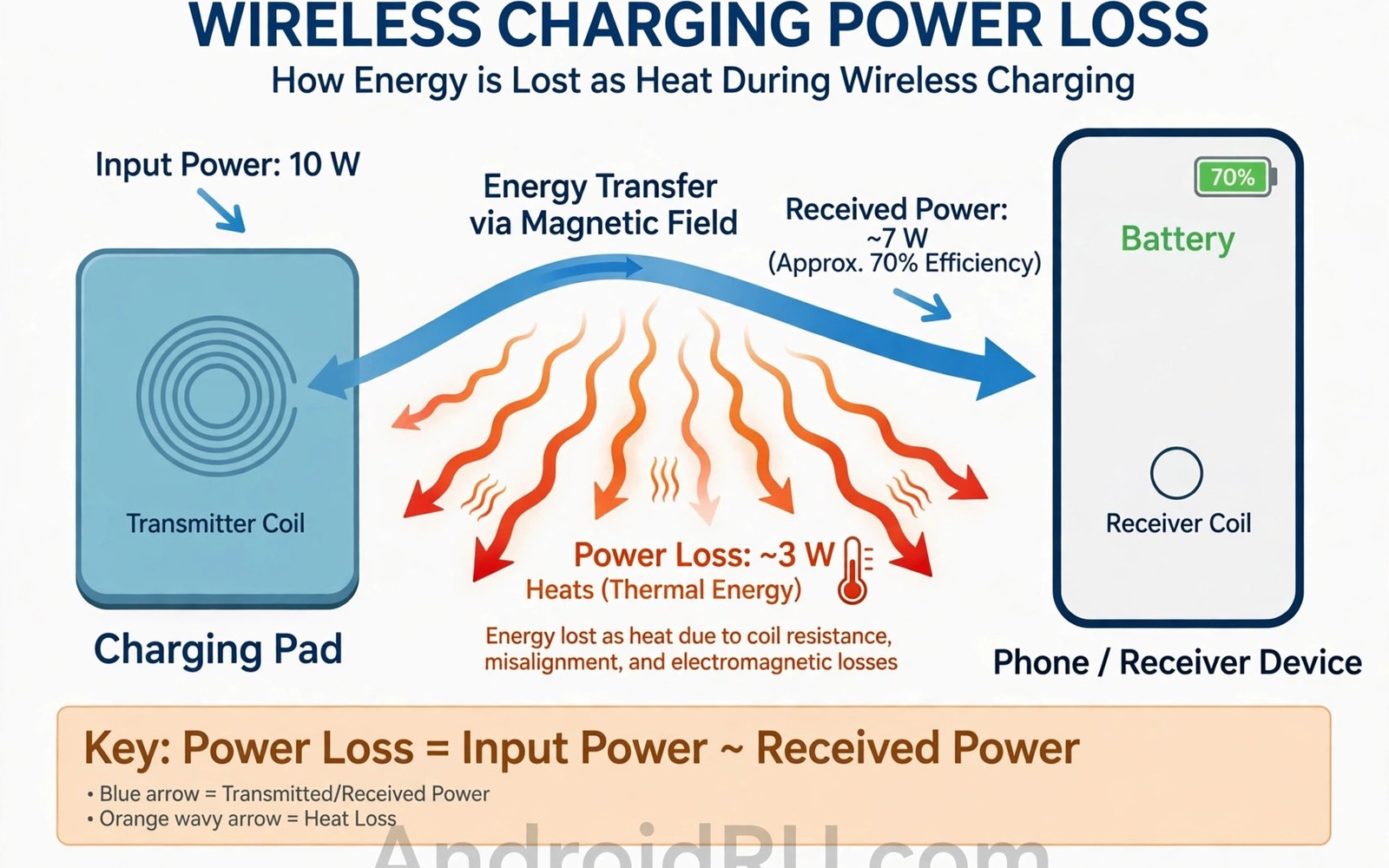
Wireless charging trades efficiency for convenience. A cable delivers most of its power to the phone battery. A wireless link loses a larger share along the way. That loss matters for speed and for heat and for electricity use. Understanding each loss stage helps users cut waste. It also explains why two pads can give very different results.
Power loss starts before the phone coil even receives energy. The pad electronics convert mains power for the transmitting coil. That conversion wastes a small share as heat. The coil itself resists current and wastes more. The magnetic field then spreads beyond the phone coil. Only part of the field reaches the receiving coil to become useful power.
The phone side adds further losses. Its coil and circuits convert the caught field back into battery power. That conversion wastes another share as heat. The battery itself loses a little during chemical storage. Each stage seems modest alone. Together they can waste a quarter or more of the input power. This analysis follows power from wall to battery step by step.
Power Flow From Wall To Battery
Wall power first passes through the pad power brick. The brick converts mains voltage to a level the pad can use. Conversion efficiency varies by brick quality. A weak brick wastes more power before wireless transfer even starts. A matched brick from the pad maker usually performs best. Mixing a weak brick with a strong pad caps the whole chain.
The pad coil then turns electrical power into a magnetic field. Copper resistance in the coil turns part of that power into heat. Field spread wastes another part that never reaches the phone. The phone coil catches the remaining field and turns it back into current. Phone circuits then regulate that current for the battery. Battery chemistry stores the final share with a small loss.
- Use the brick matched to the pad
- Keep the phone centred on the coil
- Charge in a cool room for stable efficiency
Coil Resistance And Field Spread
Coil resistance is a basic physics cost. Current through copper always creates some heat. Thicker coil wire lowers resistance but it adds size and cost. Pad makers balance coil size against pad thickness. A thin stylish pad may use thinner coils with higher losses. A slightly thicker pad with better coils can waste less energy overall.
Field spread is the larger loss in many setups. Magnetic fields weaken fast with distance. A gap of a few millimetres cuts the caught field sharply. That gap comes from cases and from misalignment. Metal objects in the gap absorb field energy as heat. A clean close alignment is the best defence against field losses.
Alignment Loss In Numbers Sense
Perfect alignment gives the strongest link and the lowest loss. A small shift still charges but at a lower rate. A large shift can drop the rate to a trickle. The phone may also draw power for its own use while trickling. Net battery gain can then approach zero during heavy use. Users may think the pad is broken when alignment is the real fault.
Multi-coil pads reduce alignment loss by offering several coil positions. The phone can lock onto the nearest coil rather than one fixed spot. That flexibility helps on busy desks where placement is casual. It does not remove the need for roughly central placement. A phone at the pad edge still misses the coil field. Central placement remains the habit that matters most.
Heat Loss And Thermal Throttling
Heat loss feeds back into further loss. Wasted energy heats the pad and the phone. Hot electronics convert power less efficiently than cool ones. Hot batteries also accept charge more slowly for safety. The phone may cut wireless input sharply when temperature rises. That cut extends charging time and it increases total energy use for the same gain.
Cooling breaks that feedback loop. A pad with airflow keeps the phone back cooler. A hard cool desk surface helps more than a soft warm bed. Removing a thick case lets heat escape from the phone back. Charging overnight at a modest rate creates less heat than a fast daytime session. Cooler charging is therefore more efficient charging.
Case And Accessory Losses
Cases add distance and they add loss. A thin case adds a small gap with a small penalty. A thick case adds a larger gap with a larger penalty. Cases with metal plates for mounts absorb field energy directly. Cards stored behind the phone can also absorb energy and heat up. A wallet case with cards is a poor partner for wireless charging.
Accessories on the phone back can tilt the phone. A raised camera ring or a grip can break flat contact. Tilt creates an uneven gap across the coil. One side of the coil then receives far less field. Remove grips before a long wireless session when possible. Flat contact gives the most even field across the whole coil.
Cutting Losses In Daily Use
Start with placement and case choice because they cost nothing. Centre the phone and use a thin wireless-friendly case. Use the matched brick and a short quality cable to the pad. Charge overnight at a modest rate when time allows. Use a cable for urgent top-ups when efficiency and speed matter. That mix gives convenience without constant waste.
Measure the result with a timed test. Compare wireless gain with cable gain over thirty minutes. A large gap points to alignment or case problems. Fix those problems before buying a new pad. A new pad cannot fix a thick case or a weak brick. Free fixes first save money and they cut losses fast.
Measuring Wireless Loss At Home
Home measurement of wireless loss needs only a meter and patience. Use a plug meter to measure wall power during a wireless session. Note wall power and phone battery gain over thirty minutes. Compare the same test with a cable charge. The gap between wall power and battery gain shows total loss. Wireless sessions should show a larger gap than cable sessions.
Control test conditions for meaningful comparisons. Start both tests from the same battery level. Keep the phone idle and the room temperature similar. Use the same wall brick for both tests when possible. Different bricks add their own efficiency differences. Controlled tests isolate wireless loss from brick loss.
Repeat tests across several days to smooth variation. Temperature and battery state shift results between days. An average across three tests beats a single test. Note alignment and case conditions for each test. A test with a thick case will show higher loss than a thin case test. Record conditions alongside numbers for honest conclusions.
Share test results with household members to guide pad use. A pad that wastes heavily may suit overnight use only. A pad that wastes modestly may suit daily desk use. Data guides placement of pads around the home. Efficient pads earn desk spots while wasteful pads move to nightstands. Measurement turns vague wireless complaints into decisions.
Wireless Loss And Electricity Costs
Wireless loss costs little per session but adds up yearly. A daily wireless charge wastes a small amount of electricity each day. Over a year that waste equals several full phone charges worth of power. The cost in money remains small for one phone. The environmental cost grows across millions of wireless users. Efficiency still matters at scale even when bills look tiny.
Standby power adds another wireless cost. A pad plugged in without a phone may draw power idly. That idle draw continues all day and night. Unplug pads when not in use for long periods. A switched power strip makes idle control easy. One switch can cut idle draw for a whole desk setup.
Charging habits can cut yearly waste substantially. Use cable charging for most sessions and wireless for convenience moments. That mix keeps wireless waste to a small share of total charging. Use efficient pads with good alignment for wireless sessions. Each efficient session wastes less than a misaligned session. Small habit changes compound across a year.
Future pads may cut loss through better coils and smarter control. Improved coil materials reduce resistance losses. Smarter power control reduces field spread waste. Those gains will narrow the cable gap over time. Current buyers should still judge pads by present efficiency. Future improvements do not excuse present waste.
Centre the phone on the pad coil
Remove metal and cards from the case
Use the matched power brick
Test thirty minute gain versus cable
Switch to cable for urgent top-ups
Readers who want more context on portable power can read Pass-Through Charging in Power Banks: Charging Phone and Bank Together for a related view on the same topic.
Readers who want more context on portable power can read Solar Power Banks for Camping: How Effective Are Integrated Panels? for a related view on the same topic.
Readers who want more context on portable power can read Understanding Quick Charge (QC) Protocols Across Generations for a related view on the same topic.
The steps above follow the approach described in the official developer documentation and standard industry guidance for safe charging practice.
Wireless power loss comes from conversion and coils and field spread and heat. No single stage explains the whole gap versus cable charging. Alignment and case distance amplify every stage. Cooling and matched power supplies limit the damage. Users control the biggest losses with placement habits alone.
Treat wireless charging as a convenience tool with known costs. Use it for overnight and desk charging where time is plentiful. Use cable charging when speed and efficiency matter most. That balance keeps the convenience without accepting needless waste. A centred phone on a cool pad is the efficient wireless setup.
Measuring loss at home turns wireless theory into personal numbers. Controlled tests reveal case and alignment effects clearly. Yearly waste remains modest for one phone but matters at scale. Efficient habits and efficient pads cut that waste further. Wireless convenience need not mean careless energy use.
Run a simple thirty minute comparison test this week. Compare wireless gain with cable gain under similar conditions. Fix alignment and case issues revealed by the test. Unplug idle pads to cut standby waste. Those steps make wireless charging both convenient and responsible. Efficiency is a habit as much as a pad feature.
Wireless charging in public places adds another efficiency question. Cafes and airports increasingly offer wireless pads. Those pads vary in quality and alignment design. A public pad may waste more energy than a home pad. Users cannot control public pad quality. Personal pads remain the efficient choice for daily use.
Wireless charging for electric vehicles uses the same principles at larger scale. Vehicle pads face larger alignment and loss challenges. Efficiency matters more at vehicle power levels. Lessons from phone wireless apply to vehicle wireless too. Alignment and cooling dominate both scales. Phone users understand vehicle wireless trade-offs intuitively.
Research into resonant wireless charging may improve future efficiency. Resonant systems tolerate larger gaps than inductive systems. That tolerance could ease alignment pain greatly. Commercial phone systems still rely mainly on inductive transfer. Resonant advances may reach phones in future generations. Present buyers should judge current pads by current performance.

