

Comparing Dynamic Drivers vs Balanced Armature Audio Hardware
I bought my first pair of serious earbuds after a long commute where my old pair made every bass line sound like a dull thud and every cymbal sound like a hiss. I blamed the phone, then the streaming app, then the recording. The real answer sat inside the earbuds themselves: the type of driver moving the air in my ears. Once I learned how a dynamic driver and a balanced armature driver each make sound, the reviews I read finally made sense, and my next purchase sounded right on the first listen.
This guide compares dynamic drivers vs balanced armature audio hardware in plain language, with real earbuds you can buy, a head-to-head table, and a verdict for each kind of listener. You will learn how each driver works, where each one shines, where each one falls short, and how hybrid designs mix the two. By the end you will know which driver type fits your music, your calls, and your budget, and you will know how to test a pair in a shop or at home before the return window closes.
Before you change any setting or buy a new pair, it helps to see a neighbouring topic such as why headphone jacks were removed and how dongles fare, because the way your phone delivers sound shapes what any driver can do with it.
What a Dynamic Driver Does Inside Your Earbuds
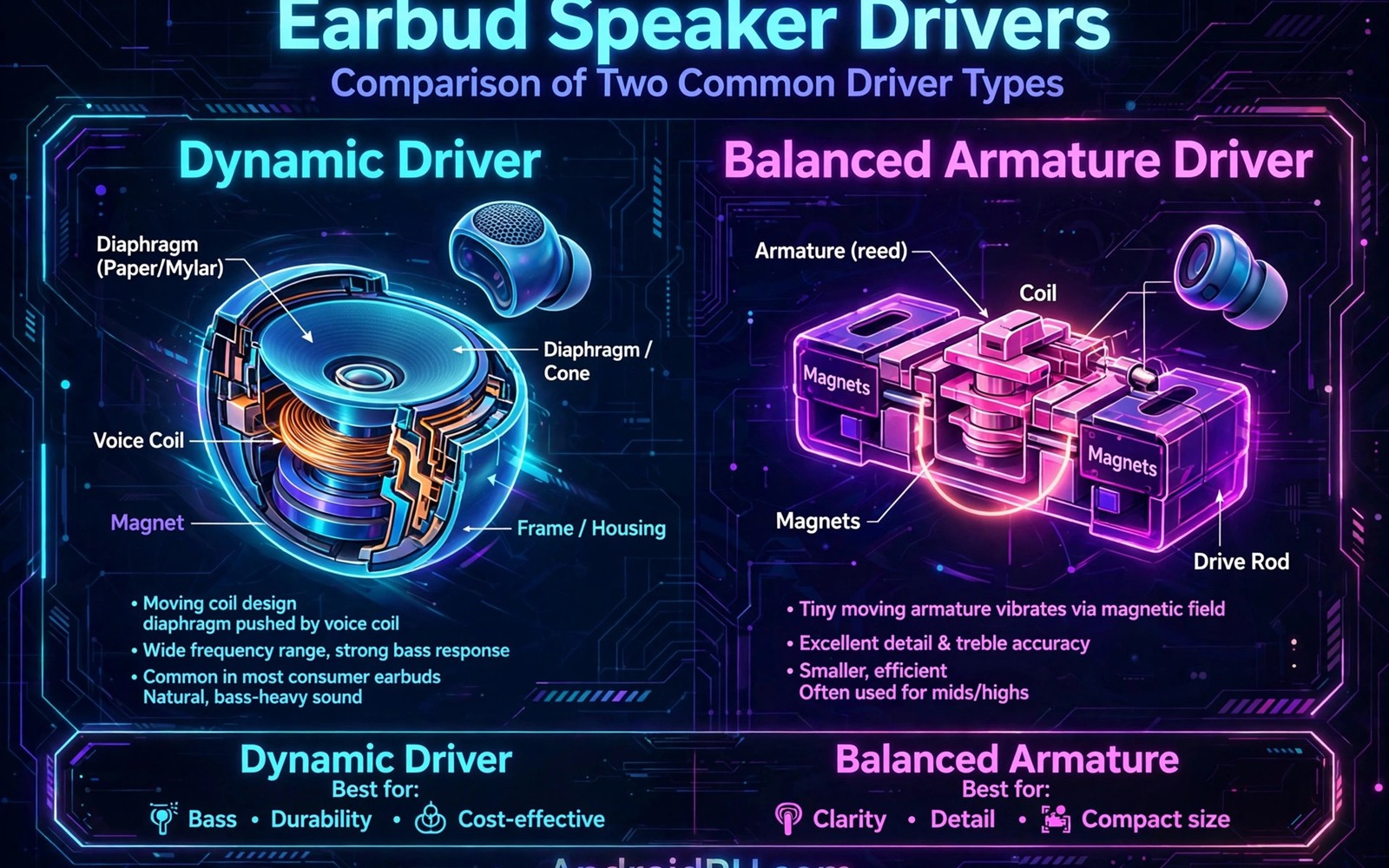
A dynamic driver works like a tiny loudspeaker squeezed into an earbud shell. A voice coil sits inside a magnet, and when the audio signal flows through the coil it moves back and forth, pushing a thin diaphragm with it. That diaphragm moves air, and moving air is what your ear hears as sound. The whole design has been refined for nearly a century, from room speakers down to the 6 mm to 13 mm drivers in modern earbuds, and that long history is why it still sounds so natural.
The size of the diaphragm matters more than most spec sheets admit. A larger diaphragm moves more air with each stroke, which gives bass notes real weight and body. A kick drum feels like a thump in your chest rather than a tap on a table. Vocals gain warmth because the same diaphragm reproduces the lower harmonics of a voice along with the main tone. That said, one diaphragm has to cover everything from deep bass near 20 Hz up to treble past 15 kHz, and that shared job is where the design shows its limits.
How a voice coil and diaphragm move air
The voice coil is a winding of fine copper wire glued to the back of the diaphragm. When current flows, the magnetic field pushes the coil, and the coil drags the diaphragm forward; when the current reverses, the diaphragm pulls back. This happens thousands of times per second, and the shape of that movement is the sound wave. Because the diaphragm is light and the coil is strong, a well built dynamic driver tracks the signal closely, and the result is a smooth, coherent sound where bass, mids and treble all come from the same point in space.
Diaphragm material changes the character of the sound in ways you can hear. Paper and mylar diaphragms sound warm and forgiving, which suits long sessions and older recordings. Beryllium coated and diamond like carbon diaphragms are stiffer and lighter, so they start and stop faster, and treble detail improves without losing bass weight. Titanium coated drivers sit in the middle, with a crisp edge that suits pop and electronic music. None of these materials rescue a bad fit, though: if the ear tip does not seal in your ear canal, bass leaks away no matter how good the diaphragm is.
Why diaphragm size changes bass depth
A 10 mm or 11 mm driver in a pair of earbuds moves roughly twice the air of a 6 mm driver at the same excursion, and your ears notice that difference most below 100 Hz, where bass lives. This is why the Sony WF-1000XM5, with its 8.4 mm driver, and the Samsung Galaxy Buds2 Pro, with its coaxial two way driver, both deliver bass that feels full without an equalizer boost. Smaller drivers can still sound good, but they need a perfect seal and often a bass lift in software to keep up.
Size also shapes the shell. Big drivers need bigger housings, and a big housing can press against a small ear after an hour. I learned this on a long flight with a pair of large shelled earbuds that sounded superb for the first forty minutes and hurt for the next three hours. Comfort is part of sound quality, because an earbud you take out early gives you no music at all. Try the fit for a full hour before you judge the bass.
What a Balanced Armature Driver Does Differently
A balanced armature driver looks nothing like a loudspeaker. Inside a tiny metal box, about the size of a grain of rice, sits a reed balanced between two magnets. When current flows through a coil wrapped around the reed, the reed vibrates, and a thin drive rod links that vibration to a small diaphragm that makes the sound. The moving mass is far smaller than a dynamic diaphragm, so it starts and stops with remarkable speed.
That speed is the whole point. A balanced armature driver reacts to tiny, fast changes in the signal that a heavier diaphragm smooths over, so fine detail in treble and upper mids comes through with striking clarity. A brushed cymbal keeps its shimmer, a violin keeps the scrape of the bow, and a singer keeps the breath between words. This is why the design began in hearing aids, where speech clarity matters more than bass, and why it later moved into in ear monitors for musicians who need to hear every note on a loud stage.
How the armature reed and drive rod work
The reed sits balanced, hence the name, between the poles of a magnet, so it needs only a small current to move. The drive rod is a stiff wire that transfers the reed motion to the diaphragm without flexing, which keeps timing tight. Because the whole assembly is sealed inside its metal case, outside air and earwax affect it less than an open dynamic driver, and the sound stays consistent from day to day.
Each armature is tuned to a narrow frequency band, often by the shape of its sound outlet, called a spout, and by a tiny acoustic filter inside it. One armature might cover treble only, another might cover mids, and a third might be tuned for bass. That narrow tuning is a strength and a weakness at once: it gives precise control over each part of the sound, but a single armature on its own can only cover part of the range well.
Why one armature sounds thin on bass
A balanced armature moves very little air. Its diaphragm is small and its excursion is short, so it simply cannot push the volume of air that a 40 Hz bass note needs. A single armature earbud, such as the classic Etymotic ER4SR, sounds superbly detailed and honest, yet bass light, and fans of hip hop or electronic dance music often call it thin. Makers fix this by adding a second armature tuned for bass, by venting the shell so the driver breathes a little more, or by pairing the armature with a dynamic driver in a hybrid design.
The other trade off is cost and complexity. Each armature is a precision part, and fitting two, three or four of them into one earbud, with a crossover network to split the signal between them, takes careful assembly and testing. That is why a dual armature earbud such as the Shure SE425 costs several times more than a good single dynamic driver pair, and why the extra money buys detail and separation rather than raw bass power.
Dynamic Driver vs Balanced Armature Full Comparison Table
The table below puts the two designs side by side on the criteria that matter in daily listening. Read it as a map, not a scoreboard: no row has a winner for every listener, and the right choice depends on which rows matter most to you.
| Feature | Dynamic Driver | Balanced Armature |
|---|---|---|
| Bass depth and weight | Deep, full and natural; moves lots of air for real sub bass | Light and tight; needs a second driver or vent for deep bass |
| Treble detail and clarity | Smooth and warm; fine detail can soften at the top end | Sharp and fast; cymbals, strings and breath stay clear |
| Soundstage and imaging | Wide and open; instruments feel placed in a room | Precise and close; instruments feel placed in a line |
| Price at similar quality | Lower; simple build keeps good pairs near 20 to 80 dollars | Higher; precision parts push good pairs past 100 dollars |
| Power and sensitivity | Needs a bit more power; bass drops first on weak sources | Very efficient; sounds loud and clear from a phone dongle |
| Comfort and shell size | Can be bulky with large drivers; fit varies by ear | Tiny drivers allow slim shells; easy fit for small ears |
| Best for | Bass heavy music, warm vocals, long relaxed sessions | Detail, classical, jazz, podcasts and stage monitoring |
Reading the comparison table the right way
Start with the rows that match your most played music. If you live on hip hop, drum and bass, and pop, the bass row outweighs the treble row, and a dynamic driver pair will make you happier for less money. If you live on acoustic guitar, strings, and spoken word, the treble and detail rows matter more, and an armature pair will show you things a dynamic driver smooths over. The price row matters too, but only after the sound rows: a cheap pair that matches your taste beats an expensive pair that fights it.
Notice that the table says nothing about tuning, and tuning is the hidden column. Two earbuds with the same driver type can sound nothing alike because the maker chose a different frequency curve. A dynamic driver tuned bright can out detail a dull armature pair, and a warm tuned armature pair can sound fuller than a lean dynamic pair. Use the table to narrow the field, then listen to the finalists with your own tracks.
Dynamic Driver Bass Detail and Soundstage in Real Listening
On my daily commute I reach for a dynamic driver pair almost every time. The low rumble of the train fades behind a bass line that still has shape, and a podcast host sounds like a person in the room rather than a voice on a phone line. That warmth is the dynamic driver doing what it does best: reproducing the whole sound from one diaphragm, so nothing feels split or stitched together.
The soundstage helps too. Because the sound comes from a single point and the diaphragm moves a real volume of air, instruments feel spread out in front of you rather than stacked inside your head. A live recording keeps the applause wide and the stage deep, and a film soundtrack keeps dialogue centred while effects sit at the edges. This sense of space is hard to measure on a spec sheet, yet it is the first thing I notice when I switch back from an armature pair.
Bass weight and slam on a dynamic driver
Bass on a good dynamic driver has two parts: depth, which is how low it goes, and slam, which is how hard each note hits. Depth comes from diaphragm size and seal, while slam comes from how fast the diaphragm can start moving. A well tuned 10 mm driver gives both, so a kick drum lands with a clean thump and a bass guitar keeps its growl. If the bass sounds boomy instead, the cause is usually a loose tip or a bass boost that is set too high, not the driver itself.
Testing bass with real tracks you know well
Pick three tracks you have heard a hundred times: one with a deep electronic bass line, one with an acoustic double bass, and one with a male vocal. Listen to each on the new pair at your normal volume, and ask whether the bass line stays separate from the vocal or swallows it. On a good dynamic driver the bass sits under the music like a floor, not on top of it like a blanket. If the vocal turns muddy when the bass enters, try a smaller tip for a deeper seal before you blame the earbuds.
Soundstage and imaging on a single dynamic driver
Imaging is the ability to tell where each instrument sits, and a single dynamic driver is strong here because every frequency leaves the same diaphragm at the same time. There is no crossover handing the signal from one driver to another, so timing stays coherent and the stereo image stays stable when you turn your head. Open back style tuning in some earbuds widens the stage further, though it leaks sound to people nearby, so it suits home listening more than a quiet office.
The weak spot is treble air. Above 10 kHz a single diaphragm struggles to move fast enough while also handling bass, so the very top of a cymbal or a hi hat can lose its sparkle. Some makers fix this with a stiffer diaphragm or a second tweeter style driver, which is how hybrid designs were born. If you rarely notice that top octave, a pure dynamic driver will never leave you wanting.
Balanced Armature Detail Treble and Soundstage in Real Listening
The first time I tried a dual armature pair on a quiet evening, I heard a guitar string buzz I had never noticed in a song I had owned for years. That is the armature promise: detail that was always in the recording, finally delivered to your ear. The sound is not louder, it is clearer, and once you hear that clarity it is hard to go back to a driver that smooths it away.
Vocals benefit most. A singer’s consonants stay crisp without turning harsh, and backing harmonies separate into distinct voices instead of blurring into one warm chord. Podcast listeners gain too: two hosts talking over each other stay understandable, and a quiet guest does not vanish under a loud one. For spoken word and acoustic music, this separation is worth more than extra bass.
Treble detail and vocal clarity on balanced armature
Treble on an armature driver sounds fast because the reed stops moving the instant the signal stops, with almost no ringing after the note. That clean stop is what makes a piano note sound like a hammer hitting a string rather than a bell fading away. The risk is sharpness: a bright tuning can make sibilants, the sss sounds in speech, feel spiky on a long call. A foam tip tames that edge by absorbing a little treble energy, and it costs almost nothing to try.
Listening fatigue on long sessions with detailed drivers
Detail is exciting for an hour and tiring for four if the tuning is too bright. My rule is to test an armature pair for a full workday before I keep it: a morning of music, an afternoon of calls, and an evening podcast. If my ears feel tired by dinner, the pair is too forward for daily use, no matter how impressive the first ten minutes felt. A slightly warmer armature tuning, or a hybrid with a dynamic bass driver, usually solves the problem without giving up the detail.
Soundstage on multi armature earbuds
Multi armature earbuds place instruments with striking precision, yet the stage often feels narrower and closer than a dynamic driver stage. Each driver handles its own band, so the image is built from separate pieces, and a poor crossover can leave a small gap where one driver hands over to the next. Good designs hide that handover so well that you never notice it, and the reward is a layered sound where you can follow a bass line, a vocal, and a hi hat at the same time without effort.
The Shure SE425, with two armatures per side, is a classic example of this character: clean, balanced, and honest, with bass that is tight rather than heavy. The Etymotic ER4SR, with a single armature and a deep fit, goes further toward accuracy, and it is loved by audio engineers who need to hear mistakes in a mix. Neither pair tries to sound fun in the way a bass rich dynamic driver does, and that is a fair trade for the detail they deliver.
Hybrid Earbuds That Combine Dynamic and Balanced Armature Drivers
Hybrid earbuds put a dynamic driver in charge of bass and one or more armatures in charge of mids and treble, with a crossover network splitting the signal between them. The idea is simple: let each driver do the job it does best, and the listener gets deep bass plus fine detail in one shell. In practice the crossover is the hard part, because the handover between drivers must be smooth or the sound develops a dip or a peak that no equalizer fully fixes.
When a hybrid is tuned well, the result is the most versatile sound in this whole comparison. The FiiO FH3 pairs one 10 mm beryllium coated dynamic driver with two armatures, and it delivers bass you can feel plus treble you can follow, at a price that sits near the middle of the market. The KZ ZS10 Pro takes the same idea further with one dynamic driver and four armatures per side, and it has become a favourite for listeners who want a lot of detail for very little money. The 1MORE Triple Driver in ear pair uses the same recipe in a slimmer shell, and the Moondrop Blessing 2, with one dynamic driver and four armatures, is often held up as the reference for what a hybrid can do when tuning comes first and driver count comes second.
How crossovers split bass mids and treble
A crossover is a small network of capacitors and resistors that sends low frequencies to the dynamic driver and high frequencies to the armatures, with a chosen handover point, often near 200 Hz for bass and near 3 kHz for treble. The slope of that handover decides how much overlap the drivers share: a gentle slope sounds natural but risks both drivers playing the same note, while a steep slope keeps them separate but can sound abrupt. Makers tune the slope by ear as much as by measurement, which is why two hybrids with the same driver count can sound so different.
You can hear a bad crossover as a hollow spot in the middle of the sound, usually where a vocal should sit. Play a track with a strong male vocal and a bass guitar, and check whether the voice sounds thin while the bass sounds full. If it does, the crossover may be handing over too high, leaving a gap. A good hybrid keeps the vocal solid while the bass stays deep, and that test takes less than a minute in a shop.
Real hybrid earbuds worth hearing before you decide
Start with the FiiO FH3 if you want a balanced hybrid that works for most music without fuss. Try the KZ ZS10 Pro if your budget is tight and you enjoy tweaking tips and cables, since its detail rewards a good seal. Consider the Moondrop Blessing 2 if you want a reference style hybrid and you listen mostly at home, where its larger shell and neutral tuning shine. Each of these proves the same point: hybrid driver tuning matters more than the number of drivers printed on the box, and a well tuned two driver hybrid can beat a careless five driver one.
Codecs and sources matter to hybrids as well, because a detailed armature will reveal a poor Bluetooth codec faster than a warm dynamic driver will. Reading about high-resolution audio codecs for Android helps you match your earbuds to a codec such as LDAC or aptX Adaptive, so the detail you paid for survives the wireless trip from phone to ear.
Which Driver Type Fits Your Music Calls and Workouts
The honest answer is that your routine picks the driver, not the other way around. A runner who needs bass to keep pace and a shell that stays put will love a dynamic driver pair. A commuter who reads podcasts and takes calls in a noisy train will love an armature pair for its vocal clarity. A listener who plays a bit of everything will love a hybrid. Write down your two most common listening places and your most played style before you browse, and the choice narrows fast.
Best driver type for bass heavy music and gym sessions
For hip hop, electronic dance music, and rock, a dynamic driver is the natural pick. The bass stays physical, the sound stays coherent when you move, and the price leaves money for spare tips and a good case. The Samsung Galaxy Buds2 Pro and the Sony WF-1000XM5 both use dynamic drivers, and both survive workouts because their shells are compact and their seal is secure. Check the fit by shaking your head gently: if the seal breaks, the bass goes with it, whatever the driver type.
Best driver type for vocals podcasts and calls
For podcasts, audiobooks, and long calls, a balanced armature pair earns its keep. Voices stay clear at low volume, which saves your ears on a long day, and the low power draw means the battery lasts longer on the same charge. The Etymotic ER4SR is the purist choice here, while the Shure SE425 adds a little more body for music between calls. If you take calls in a noisy place, pair the earbuds with good noise cancelling, and read how active noise cancellation mutes background noise so you know what the microphones and the processor can and cannot do for you.
Best driver type for classical jazz and acoustic detail
For classical, jazz, and acoustic music, detail and separation matter more than bass weight, and that points toward armature or hybrid designs. A string quartet needs each instrument to keep its own space, and a jazz trio needs the ride cymbal to shimmer without drowning the double bass. A hybrid such as the Moondrop Blessing 2 handles this best, because the dynamic driver carries the double bass while the armatures carry the cymbal and the piano. A pure armature pair is the second choice, and a warm dynamic driver is the third, though a well tuned dynamic pair such as the Moondrop Aria still pleases many classical listeners who prefer a natural, relaxed presentation.
Price discipline keeps the choice honest. Set a ceiling before you browse, and remember that tips, a case, and a cable are part of the real cost. A pair that needs a new tip set to seal properly costs more than its sticker price, and a pair with cheap replacement tips costs less over two years. Judge total ownership cost rather than launch price alone, and check earbud battery life and charging case cycles before you buy, because a pair with a dying case battery is a pair you will replace early no matter how good its drivers sound.
Dynamic Driver vs Balanced Armature FAQ
These are the questions I hear most often when friends ask me which earbuds to buy, and each answer adds something the comparison above did not cover.
What is the main difference between a dynamic driver and a balanced armature driver?
The main difference is how they move air: a dynamic driver uses a voice coil and a diaphragm, like a tiny loudspeaker, to push a large volume of air, while a balanced armature driver uses a tiny vibrating reed linked to a small diaphragm, which moves far less air but reacts much faster. That single difference explains the bass weight of a dynamic driver and the treble detail of an armature, and it explains why hybrids mix the two.
Do more drivers always sound better than one?
No, and this is the most expensive myth in earbuds. More drivers give the maker more control, but they also add crossover complexity, and a careless multi driver design can sound uneven next to a well tuned single driver. A single dynamic driver such as the one in the Sennheiser IE 200, or a single armature such as the one in the Etymotic ER4SR, can beat a sloppy five driver pair. Judge the sound, not the count.
Can a single dynamic driver beat a multi armature earbud?
Yes, when the music and the listener favour warmth, bass, and a wide soundstage over fine detail. A well tuned single dynamic driver sounds coherent because every frequency comes from one diaphragm, and that coherence suits rock, pop, and electronic music. The multi armature pair will still win on treble detail and separation, so the answer depends on what you listen to most, not on which design is better in the abstract.
Are hybrid earbuds worth the extra money?
Hybrids are worth the money when you listen to many styles and you want one pair that handles them all, because they combine bass weight with treble detail in a way neither pure design can match. They are not worth it if you listen to one style only, since a pure dynamic or pure armature pair tuned for that style will cost less and sound just as good. Try a hybrid such as the FiiO FH3 side by side with a pure dynamic pair on your own tracks, and let your ears make the call.
Final Verdict for Dynamic Drivers vs Balanced Armature Audio Hardware
There is no single winner here, and that is the honest verdict. Pick a dynamic driver pair when bass, warmth, and value matter most, and when your playlist leans toward hip hop, pop, rock, or electronic music. Pick a balanced armature pair when detail, vocal clarity, and separation matter most, and when your day is full of podcasts, calls, classical, or jazz. Pick a hybrid when you play a bit of everything and you want one pair that never feels wrong, and remember that ear tip seal and crossover tuning shape the result more than any spec sheet promise.
Your next step is simple and it costs nothing: take the three tracks you know best, put on the pair you own now, and listen for what is missing. If the bass feels thin, a dynamic driver may be your next step. If the detail feels blurred, an armature or a hybrid may be the answer. Test one change at a time, keep notes for a week, and buy the pair that wins on your music in your places, not the pair that wins a review written for someone else.

