

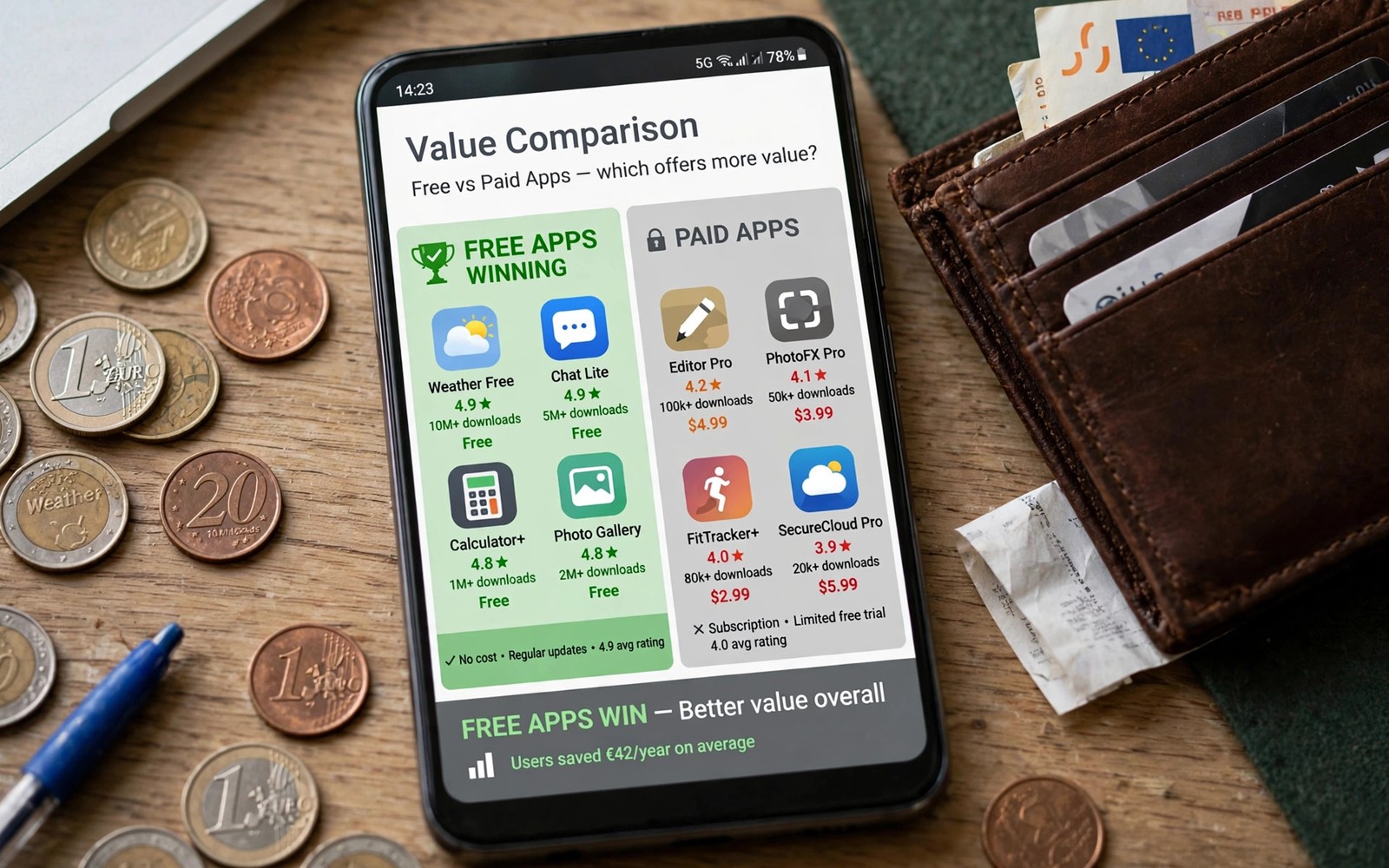
Top free Android apps that perform better than paid ones prove that price alone never measures quality. A free notes app with fast sync can beat a paid suite with slow menus. A free open tool with no ads can beat a paid app that still tracks usage. This article shows how to judge free apps fairly and how to spot the traps that hide behind a free label.
Judge a free app by the job it performs and not by its price tag. Test speed and reliability and export options for a week before you compare it with a paid rival. A free app that exports your data freely respects you more than a paid app that locks you in. Also compare privacy habits with essential privacy apps for Android users before you trust a free tool with sensitive data. Performance and freedom together define a great free app.
The advice below focuses on daily use rather than feature lists. A useful app proves itself in real tasks and a weak app reveals itself just as fast.
Try one change at a time when you rebuild your phone setup. Install two or three apps first and use them for real tasks before you add more. A slow start reveals problems early while a rushed setup hides them until they hurt.
Test an app with your real routine before you judge it. A demo on a quiet afternoon hides problems that appear during a busy commute or a low battery day. Real use shows speed and reliability in a way that screenshots never can.
A simple home screen layout makes good apps easier to reach. Put daily tools on the first screen and move rarely used apps into folders. Fewer taps mean you finish tasks faster and you are less likely to open a distraction by accident.
Why free apps can win
Free apps funded by donations or public grants can focus on one job without pleasing advertisers. That focus often produces a cleaner interface and faster performance. Paid apps must justify a price with extra features which can bloat the core job. Simplicity funded by goodwill sometimes beats complexity funded by sales.
Community driven free apps also benefit from public feedback and rapid fixes. Users report bugs in the open and maintainers fix them visibly. That loop can outpace a paid team that hides its roadmap. Open feedback is a feature that money cannot always buy.
Try one change at a time when you rebuild your phone setup. Install two or three apps first and use them for real tasks before you add more. A slow start reveals problems early while a rushed setup hides them until they hurt.
Share a useful app with a friend only after you have used it for a week. A recommendation based on real use carries more weight than one based on a store page. Honest recommendations help friends avoid the same trial and error you already did.
Test an app with your real routine before you judge it. A demo on a quiet afternoon hides problems that appear during a busy commute or a low battery day. Real use shows speed and reliability in a way that screenshots never can.
Spot the free trap
A free trap app offers a basic feature free and charges for every useful step after install. Watch for paywalls on export and sync and basic editing. A fair free app lets you complete the core job without paying. Paywalls on core jobs signal a demo dressed as a free app.
Ads inside a free app can also erase its benefit when they slow the phone or track behaviour. Count how often ads interrupt a task during a week of use. An app that interrupts every task costs time even when it costs no money. Time is a price worth counting. A related free option is open-source Android apps alongside the tools above.
Test an app with your real routine before you judge it. A demo on a quiet afternoon hides problems that appear during a busy commute or a low battery day. Real use shows speed and reliability in a way that screenshots never can.
Protect your accounts with a second factor wherever the app offers it. A second factor blocks most automated attacks even when a password leaks. Enable it on mail and cloud and banking apps first because those guard the rest.
Compare two similar apps on the same task on the same day. A direct comparison shows speed and clarity differences that feature lists hide. Pick the winner promptly and remove the loser so data never splits across two tools.
Compare free and paid fairly
List the features you actually use weekly and compare only those features across free and paid options. A paid app with fifty features loses to a free app that nails your five. Ignore feature counts and focus on daily value. Your short list is the fair test.
Test both options side by side for the same task on the same day. Time the task and note errors and frustration. A timed test beats a feature table because it captures real experience. Keep the winner and remove the loser at once to avoid clutter.
A simple home screen layout makes good apps easier to reach. Put daily tools on the first screen and move rarely used apps into folders. Fewer taps mean you finish tasks faster and you are less likely to open a distraction by accident.
Storage and battery shape how well any app performs over time. Check storage use once a month and clear cached files that grow without adding value. A phone with free space runs smoother and updates install without errors.
Set a reminder to revisit a new app after thirty days. A month of use shows whether the app became a habit or a forgotten icon. Remove habits that faded and keep tools that proved their worth.
adb shell pm list packages -f
adb shell dumpsys package com.example.freeapp
adb shell cmd appops get com.example.freeapp
The package commands above follow the pattern used in Android developer guides for listing installed apps and checking their operations. The same guides explain that operation checks show which permissions an app actually used.
Free apps by category
Notes and files and media players offer strong free options because their core jobs are well understood. A free player that handles local files well needs no subscription. A free notes app with local storage and export can serve for years. Categories with mature open tools favour free winners. For planning work you may also add daily organization apps for the same routine.
Security and health categories deserve extra care when free. A free security app that sells data harms more than it helps. Check funding and privacy policy before you trust a free tool in those categories. Free is wonderful until it costs your data.
Write down the settings you change when you set up a new app. A short note helps you restore the setup after a reset or a new phone. Good notes turn a one time setup into a repeatable routine.
Try one change at a time when you rebuild your phone setup. Install two or three apps first and use them for real tasks before you add more. A slow start reveals problems early while a rushed setup hides them until they hurt.
Storage and battery shape how well any app performs over time. Check storage use once a month and clear cached files that grow without adding value. A phone with free space runs smoother and updates install without errors.
When paying still makes sense
Pay when a paid app saves hours monthly or protects critical work with support and backups. A professional editor that earns income deserves payment when it clearly outperforms free tools. Paying also sustains developers whose work you rely on daily. Fair payment is part of a healthy app ecosystem.
Choose a one time purchase over a subscription when the app job is stable and updates are modest. Subscriptions suit services with ongoing server costs such as cloud sync. Match the payment model to the ongoing cost behind the app. A matched model feels fair and lasts.
Check the data use of a new app during its first week. An app that syncs large files in the background can surprise you on a capped plan. Wi-Fi only sync for heavy apps keeps mobile data for urgent use.
Check how an app handles your data before you sign in. Read the privacy screen inside the app and look for clear controls to export or delete your content. Strong defaults beat long promises when you compare two similar apps.
Test an app with your real routine before you judge it. A demo on a quiet afternoon hides problems that appear during a busy commute or a low battery day. Real use shows speed and reliability in a way that screenshots never can.
Common mistakes
A common mistake is assuming free means low quality without testing the app. Another mistake is assuming paid means safe without checking privacy and export options. A third mistake is keeping both free and paid versions installed which splits data across two tools. Test fairly and pick one winner per job.
Check how an app handles your data before you sign in. Read the privacy screen inside the app and look for clear controls to export or delete your content. Strong defaults beat long promises when you compare two similar apps.
A good setup starts with a clear purpose for each app on your phone. Open the app once a day for a week and notice whether it saves time or adds noise. Keep the apps that earn their place and remove the ones that only fill space on the home screen.
Compare two similar apps on the same task on the same day. A direct comparison shows speed and clarity differences that feature lists hide. Pick the winner promptly and remove the loser so data never splits across two tools.
Frequently asked questions
Are free apps safe to use?
Free apps are safe when they show clear funding and sensible permissions and active updates. Avoid free apps that demand unrelated permissions or hide their funding.
Why do some free apps beat paid apps?
Free apps can focus on one job without adding paid features to justify price. That focus often yields speed and clarity that paid suites lose.
Should I ever pay for an app I use free?
Pay when the paid version adds a feature you use weekly or when you want to support a developer you rely on. Payment should follow proven value.
What to do next
Your concrete next step is to pick one paid app you use and test a strong free alternative for the same job this week. Time the same task in both apps and keep the winner. One fair test can save money without losing quality. Keep the winning app and remove the loser at once so your phone stays tidy and your data stays in one place.
Learn one advanced feature per month inside an app you already love. Small steady learning beats a weekend of tutorials that you forget by Monday. One feature per month compounds into mastery within a year.
A tidy phone setup is a habit and not a one time project. Revisit your apps each month and your choices will stay aligned with your life.

