

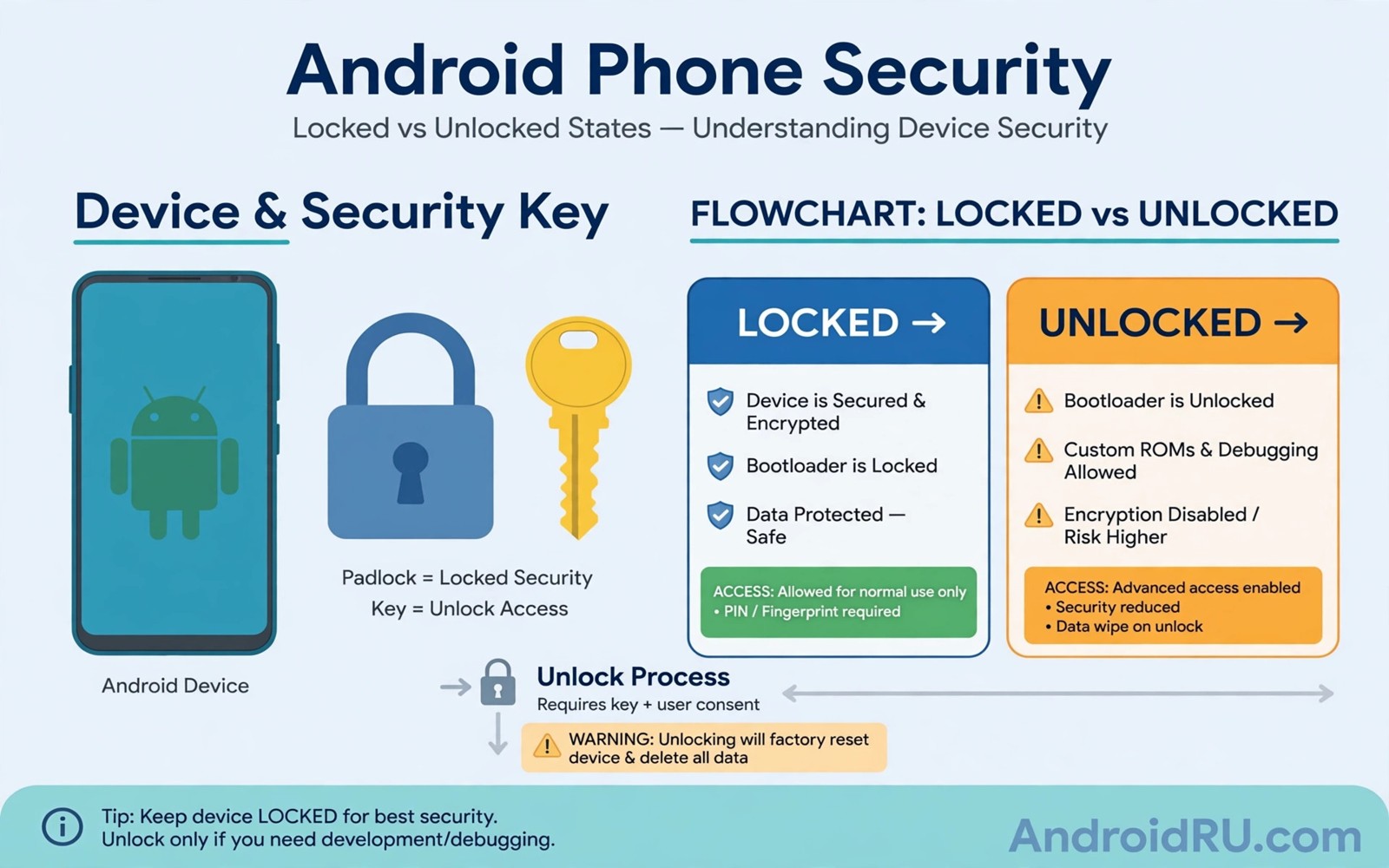
Understanding why smartphone makers make unlocking bootloaders harder for ROM users explains a frustrating trend. Unlocking once felt routine. Now it needs waits and approvals or faces refusal. Makers cite security and support costs. Critics cite control and profit. Both stories hold partial truth. This article weighs the real reasons.
Unlock policy shapes the whole ROM scene. See current state of custom ROM development for scene impact. Also read custom ROM warranty questions for repair effects. Policy and technology together decide ROM access.
Security arguments makers use
Unlocked bootloaders weaken verified boot chains. Attackers with physical access gain options. Theft protection weakens on unlocked phones. Banks demand trusted device states. Makers cite those risks when tightening policy.
Those risks are real but uneven. Most users never face physical attacks. Remote malware matters more for most people. Unlock policy trades user freedom for theft resilience. That trade suits mass markets. It frustrates power users.
Support costs of unlocking
Unlocked phones generate support tickets. Users brick phones and seek help. Repair centres diagnose modified software. Those costs fall on makers. Restricting unlock cuts that burden. That business logic is straightforward.
Warranty disputes add legal costs. Staff must judge software versus hardware faults. Clear unlock refusal simplifies that process. Simplicity saves money. Users lose freedom in that bargain.
Business and ecosystem control
Makers profit from services and app stores. Custom ROMs can bypass those services. Unlocking enables that bypass. Makers protect revenue by limiting unlock. That motive is rarely stated openly. It shapes policy quietly.
Carrier deals add another layer. Carriers want controlled devices for network services. Unlock restrictions serve carrier terms. Direct sale models face less pressure. That explains policy gaps between channels.
Regulation and regional differences
Regulators in some regions push for repair rights. Those rules may protect unlocking. Other regions impose security rules that favour locking. Makers navigate conflicting demands. Policies vary by region as a result.
Import markets complicate enforcement. A phone sold in one region may move elsewhere. Makers apply the strictest workable policy. Users face that patchwork daily. Research your region before purchase.
What users lose when unlock tightens
Users lose long term support options. Abandoned phones cannot gain community builds. Users lose privacy ROM choices. They lose repair flexibility. Those losses grow as stock support ends.
Electronic waste grows when revival dies. Good hardware retires early. That environmental cost deserves attention. Community support extends device life. Locking cuts that extension short.
Paths forward for ROM users
Buy unlock friendly models deliberately. Support makers that keep unlock programs. Also consider best privacy focused custom ROMs since privacy users feel locks most. Vote with purchases and feedback. Market signals shape future policy.
Advocate for repair rights in your region. Join community efforts for unlock access. Document your use case calmly. Makers respond to organized demand. Individual complaints fade faster.
fastboot flashing get_unlock_ability
adb shell getprop ro.boot.flash.locked
fastboot getvar unlocked
These commands follow the pattern shown in the official Android developer documentation for fastboot and adb. They read unlock state without changing the phone.
How to advocate for unlock friendly policies
Individual feedback to makers rarely changes policy alone. Organized feedback carries more weight. Join user groups that track unlock policy. Add your voice to petitions with concrete reasons. Concrete reasons beat angry slogans. Explain how unlocking extends device life. Explain how it reduces waste. Those arguments resonate beyond enthusiasts.
Purchase choices send the clearest market signal. Buy from makers with unlock programs when ROM use matters. Tell the maker why you chose them. That positive signal rewards good policy. Boycotts alone send weaker signals. Positive choices plus feedback work best together.
Regulatory advocacy offers a longer path. Repair right laws increasingly cover software locks. Support groups working on those laws. Share your story with them. Personal stories shape legislation. A single story rarely suffices. Many stories together move policy.
Stay honest about security trade-offs in advocacy. Acknowledge theft risks of unlocking. Propose safeguards like clear warnings. Balanced proposals earn maker attention. One sided demands get dismissed. Credible advocacy admits costs and seeks balance.
Repair rights and bootloader policy worldwide
Repair right laws grow stronger in several regions. The European Union leads with repairability rules. Those rules push makers toward longer support. They do not yet mandate unlocking. Future rules may cover software locks. Advocates watch that frontier closely. Legal change moves slowly but steadily. Slow change still changes markets.
United States repair laws vary by state. Some states passed strong repair bills. Others debate bills still. Federal action remains limited. That patchwork confuses buyers. A phone legal to repair in one state may differ elsewhere. Buyers should check state rules. State rules affect repair options directly. Patchwork law needs navigation.
Asian markets show mixed approaches to unlocking. Some makers keep unlock programs there. Others restrict heavily by carrier deals. Regional competition shapes policy. Strong local brands influence rules. Global policy rarely fits all regions. Regional research matters for buyers. Do not assume global uniformity. Uniformity is a myth in phone policy.
Environmental rules increasingly link to software support. Longer support reduces electronic waste. Regulators notice that link. They may tie support length to sales permission. That linkage could force longer stock support. Longer stock support reduces ROM need. It also improves sustainability overall. Environmental and ROM interests align here. Alignment strengthens both causes.
Consumer groups track unlock policy publicly. Their scorecards rank makers by openness. Scorecards influence buyer choices. Makers respond to public rankings. Public pressure works slowly. Check scorecards before buying. Your purchase amplifies scorecard signals. Informed buying is advocacy in action. Buy like policy matters because it does.
Future policy may separate hardware repair from software freedom. Hardware repair rights grow faster. Software freedom lags behind. That gap frustrates ROM users. Closing it needs targeted advocacy. Generic repair advocacy may not cover unlocking. Specific unlock advocacy fills the gap. Support both tracks for full freedom.
Unlock petitions and user campaigns
Petitions gather user voices for policy change. Effective petitions state concrete demands. Concrete demands include unlock time limits. Time limits give makers clear targets. Clear targets enable negotiation. Negotiation needs reasonable asks. Reasonable asks gain maker attention. Attention is the first victory. Victory starts with clarity. Clarity beats volume alone. Volume without clarity gets ignored.
Campaigns use social media to amplify petitions. Amplification reaches journalists and regulators. Journalists cover organised campaigns. Coverage pressures makers publicly. Public pressure complements private negotiation. Negotiation plus pressure works best. Best campaigns combine both tracks. Tracks reinforce each other. Reinforcement builds momentum. Momentum sustains long campaigns. Campaigns need stamina.
User stories personalise abstract policy debates. Stories about abandoned phones resonate. Resonance moves non technical audiences. Audiences include regulators and voters. Voters influence legislation eventually. Legislation changes markets slowly. Slow change still matters. Matters enough to persist. Persistence defines successful campaigns. Campaigns fail through quitting. Quitting is the only certain failure.
Coalitions with repair groups strengthen unlock campaigns. Repair groups share overlapping goals. Overlapping goals enable joint actions. Joint actions pool resources. Resources include legal expertise. Expertise improves campaign quality. Quality attracts media coverage. Coverage attracts supporters. Supporters attract makers. Makers listen to coalitions. Coalitions beat isolated groups.
Buying unlock friendly phones in 2026
Research unlock policy before any purchase. Policy pages hide in support sections. Sections mention bootloader terms. Terms vary by model. Model specific research matters. Matters more than brand reputation. Reputation generalises poorly. Poor generalisation misleads buyers. Buyers need model facts. Facts come from official pages. Pages plus forums give truth.
Direct unlocked models usually allow unlocking. Carrier models usually restrict it. Restriction differences justify price gaps. Gaps pay for freedom. Freedom includes ROM choice. Choice includes privacy ROMs. Privacy ROMs need unlock access. Access starts with purchase. Purchase decisions echo for years. Years of freedom reward research.
Community support follows popular unlocked models. Popular models attract maintainers. Maintainers need devices in hand. Hands on devices enable ports. Ports attract more buyers. Buyers attract maintainers cyclically. Cycles favour popular models. Popular models are safer bets. Bets on obscure models risk stagnation. Stagnation wastes purchase money.
Common mistakes
Assuming every maker shares one motive misleads. Security and cost and revenue all play roles. Assuming unlock will return soon also misleads. Trends point tighter for now.
Buying a phone without checking unlock policy wastes ROM plans. Check before purchase always. Ignoring regional differences causes surprises. Policy follows sale region often.
Blaming support staff for policy decisions wastes energy. Direct feedback to maker channels instead. Organized user demand carries more weight.
Frequently asked questions
Why did makers allow unlocking before?
Early Android valued openness and developer access. Unlock programs attracted enthusiasts. Scale and security concerns changed that calculus. Mass market priorities now dominate policy.
Will unlocking become impossible everywhere?
Probably not entirely. Some makers keep unlock programs. Niche and developer models persist. Mainstream phones will likely stay tighter. Research remains essential.
Can users force makers to allow unlocking?
Users can influence through purchases and regulation. Repair right laws help in some regions. Organized feedback matters. Individual pressure alone rarely reverses policy.
Conclusion
Makers tighten unlocking for security and support and business reasons. Users lose revival and privacy options in return. The trend favours caution and control over openness.
Your concrete next step is to check unlock policy before your next phone purchase and favour makers with clear unlock programs if ROM use matters to you.

