

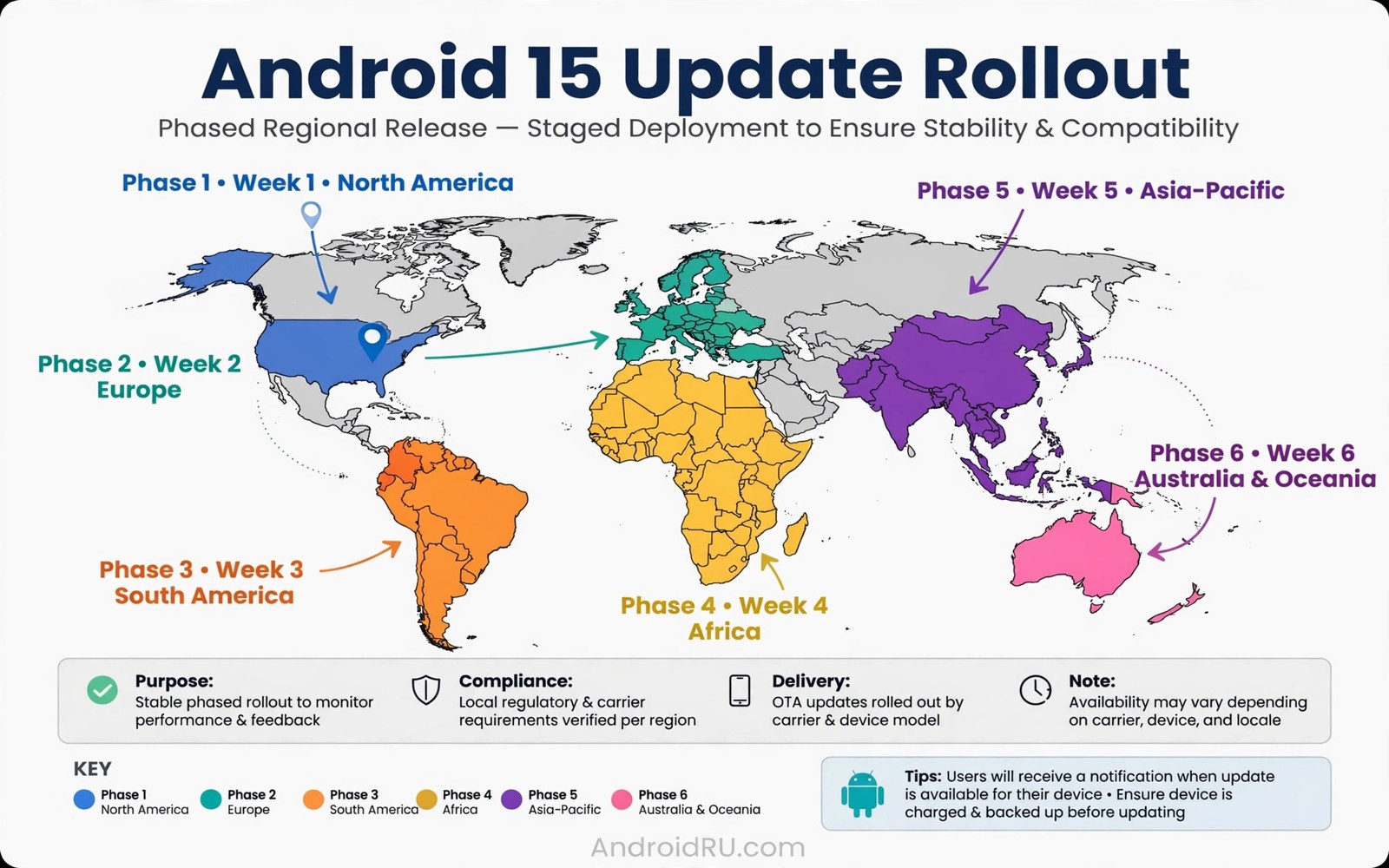
Why software update rollouts are phased by region puzzles owners who see friends abroad receive an update first. Phased rollouts are deliberate. Brands release an update to a small group first and watch for problems before widening the group. That caution protects millions of phones from a bad update reaching everyone at once.
Region phasing also reflects carrier testing and server capacity and local regulations. Each factor adds a step before a region joins the rollout. Understanding those steps turns frustration into a clearer timeline. If you want to check your own status then how carrier locked phones delay updates covers the carrier part of the same story.
Staged release protects users
A staged release starts with a small percentage of devices in selected regions. Engineers watch crash reports and battery reports and user feedback from that group. If a serious bug appears they can pause the rollout before most phones receive it. That pause may feel unfair to waiting owners but it prevents a wider failure.
Early groups often include phones with simpler configurations. Later groups add more variants and carriers and regions. Each widening step adds new data. A rollout that looks slow is often a rollout that is working as designed with careful checks at each stage.
Carrier testing by region
Carriers in each region test network features before approving an update. Calling and messaging and data services must work on local networks. A carrier may request fixes before it signs off. That testing schedule differs by carrier so two regions can diverge by weeks even for the same phone model.
Unlocked phones skip carrier approval in many cases and therefore receive updates sooner. Carrier locked phones wait for both brand and carrier approval. Owners who bought through a carrier should expect a longer wait as a normal part of that purchase choice.
Server load and support capacity
Releasing an update to hundreds of millions of phones at once would strain download servers. Phasing spreads the load across days and weeks. It also spreads support demand so help teams can handle early questions without overload. Server capacity is a practical reason rather than a marketing trick.
adb shell getprop ro.product.model
adb shell getprop ro.build.version.release
adb shell getprop persist.sys.locale
These commands follow the approach described in the official Android developer documentation for reading model and locale information from a device.
Support capacity matters after a major update because questions spike when new features appear. A phased release lets support teams learn the common issues from early groups. Later groups then benefit from clearer guidance and faster fixes for known problems.
Local rules and language testing
Some regions need extra testing for language and local services and legal requirements. An update may need to pass local certification for network or payment features. Those checks add time even when the software itself is ready. A region with stricter certification will naturally lag behind a region with lighter checks.
Language testing also matters for interface changes. A new feature may need translation and layout checks for many languages. Rushing that work risks broken text and confusing menus. Reading about Android seamless updates and AB partitioning shows how install safety also shapes rollout caution.
How to know when your turn arrives
Check the brand update page for your model and region when one exists. Community forums for your exact model variant can also show which regions already received the update. Those signals help you judge whether your wait is normal or unusual. A wait of a few weeks during a known rollout is normal.
If months pass without an update while most regions received it then investigate further. Check storage and run a manual check and confirm your variant. Learning what to do when an update breaks functionality prepares you for the install itself once your region finally receives it.
Rollout stages and user psychology
Waiting for a phased rollout creates frustration because owners compare their phone with friends phones constantly. Social media amplifies that frustration by showing early recipients prominently. Owners who received the update post about it while owners still waiting stay silent. That visibility bias makes a normal staged rollout feel like a personal delay. Recognising that bias helps owners stay calm during a rollout.
Brands could reduce frustration with clearer rollout communication. A simple status page showing which regions and variants already received an update would help owners judge their wait. Some brands publish such pages while others stay silent. Silence breeds rumours and risky workarounds. Clear communication therefore protects users as well as brand reputation. Owners should reward brands that communicate clearly with future purchases.
Update envy also drives risky behaviour such as installing firmware from unknown sources. Owners chase an early update and accept malware risk to gain a few weeks advantage. That trade off rarely makes sense because the over the air update arrives soon with safety checks. Patience protects the phone and the data on it. A few weeks of waiting cost far less than a bricked phone or a malware infection.
Community forums can help or harm rollout patience depending on their tone. Helpful forums share accurate variant information and realistic timelines. Toxic forums spread false claims and encourage risky shortcuts. Owners should choose forums that value evidence over excitement. A forum that asks for model numbers and build numbers before giving advice is usually more trustworthy than one that offers instant update tricks.
Business impact of phased rollouts
Businesses that manage many phones face planning challenges from phased rollouts. An IT team cannot update a whole fleet at once when rollouts arrive in stages. Some employees receive new features while others wait. That uneven state complicates support because help teams must support two versions simultaneously. IT teams therefore plan rollout windows rather than expecting a single update day.
Phased rollouts also affect app developers who support business customers. A developer may need to support both old and new Android versions during a long rollout. Testing must cover both versions until the rollout completes. That dual support period increases development cost. Developers therefore welcome predictable rollout schedules that let them plan testing windows.
Retail stores feel phased rollouts through customer questions. Shoppers ask why a display phone has a newer version than their own phone. Staff need clear explanations about staging and variants to answer confidently. Stores that train staff on rollout basics provide better service. Untrained staff may give wrong advice that leads customers to risky update attempts.
Regulators in some regions watch rollout practices for fairness and safety. A rollout that delays security patches for certain regions could raise concerns. Brands therefore try to keep security patch rollouts faster and more uniform than feature rollouts. That distinction matters because security delays carry higher risk than feature delays. Owners should judge a brand more harshly for patch delays than for feature delays.
Rollout communication done well
Rollout communication done well starts with a clear announcement that states which models and regions receive the update first. Owners can then judge whether their wait is expected. A vague announcement that says only that an update is rolling out globally creates confusion. Owners in later regions may assume something is wrong with their phone. Specificity in announcements prevents that confusion and it builds trust in the brand.
Brands should also update rollout status as stages widen. A status page that shows current stage and next stage helps owners plan. Owners who see their region listed as next can wait calmly. Owners who see their region delayed by a problem can understand the reason. Regular status updates therefore reduce support contacts and rumours. Silence during a rollout rarely helps anyone.
Carrier communication should match brand communication for carrier phones. A carrier that publishes its own test status helps owners understand the second approval stage. Owners who see carrier testing in progress understand why their phone waits. Owners who hear nothing may blame the brand unfairly. Coordinated communication between brand and carrier would improve the experience for carrier phone owners significantly.
Community managers can also improve rollout communication by answering common questions with model specific details. Generic replies that tell owners to wait frustrate users who already waited weeks. Replies that explain variant and region staging with examples help owners understand their specific situation. Good community management therefore turns a frustrating wait into an informed wait.
Common mistakes
Many owners change region settings to chase an early update and then face account and payment problems. Region tricks rarely work because the phone variant still identifies its real market. Another mistake is downloading firmware for another region. That firmware may lack local network support and may break carrier features.
- Changing region settings to chase an update rarely works and can disturb account and payment services.
- Installing firmware for another region risks losing local network features and carrier support.
- Assuming a phased delay means a broken phone leads to needless resets and wasted time.
Frequently asked questions
How long does a phased rollout usually take?
Most major rollouts take several weeks to reach all regions and variants. Some take a few months for older or carrier models. A few weeks of waiting is normal during an active rollout.
Can I skip the queue safely?
No safe official shortcut exists for a region queue. Manual checks help you catch your turn early. Firmware from another region carries variant and network risks.
Why did a neighbouring country get it first?
Neighbouring countries may use different carriers and certification paths. A small difference in testing can shift timing by weeks. Geography alone does not decide rollout order.
Conclusion
Phased rollouts protect users by catching bugs early and spreading server and support load. Carrier testing and local certification add region differences on top of staging. A delayed region is usually a normal stage rather than a personal failure.
Your next step is to confirm your model variant and check the brand rollout notes for your region. Then run a manual check once a week over Wi-Fi. When your turn arrives you will install a build that early groups already helped to prove.

