

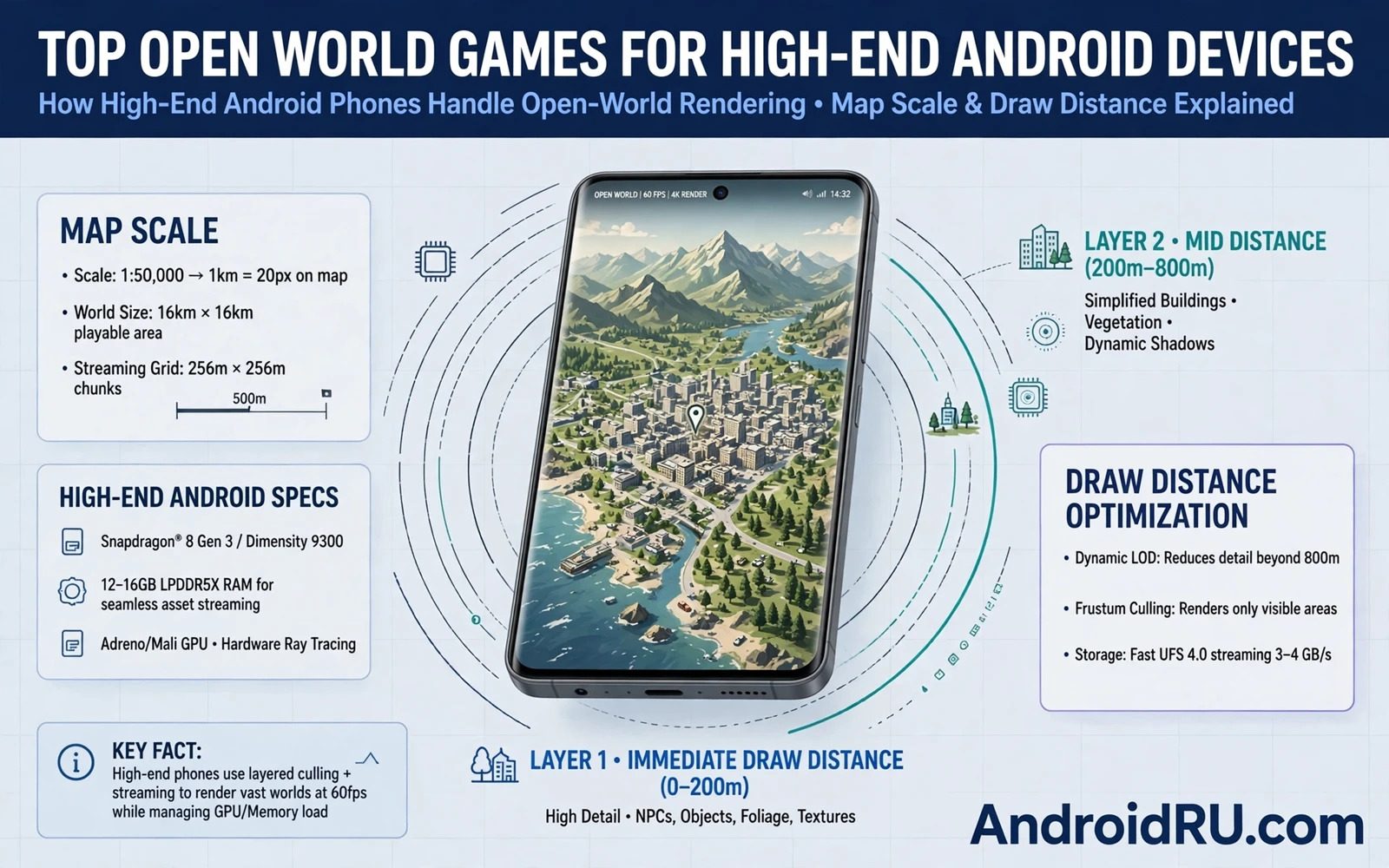
Top open world games for high end Android devices offer freedom that smaller games cannot match. You can cross a continent without a loading screen. You can climb a mountain to scout a valley. You can ignore the main quest for hours and still find stories. Scale creates wonder. Scale also creates hardware demands. This article explains what makes an open world feel great. It helps high end phone owners choose worlds worth their hardware.
Scale alone does not make a world good. A huge empty map feels worse than a smaller dense map. Density means interesting places per minute of travel. A dense world offers a village or a ruin or a mystery around every corner. A sparse world offers long travel with little reward. Judge a world by discovery rate and not by square kilometers. A world that surprises you often is a world worth exploring.
Draw distance shapes how scale feels. Draw distance is how far the game renders detail. Long draw distance shows mountains and cities from afar. Short draw distance hides the world behind fog. Fog can create mood. Fog can also hide a lack of detail. A high end phone should render distant landmarks clearly. Clear landmarks help navigation without constant map checks. Landmarks turn a map into a mental model.
Verticality adds a second dimension to exploration. Cliffs and towers and caves create layers. A layered world rewards climbing and diving. A flat world rewards only walking. Check whether high places offer views and secrets. A tower with only a view feels like decoration. A tower with a quest and a vista feels like design. Vertical rewards make exploration three dimensional.
World Systems Traffic And Life
Living systems make a world feel inhabited. Non player characters follow daily routines. Merchants open shops in the morning. Guards patrol roads at night. Wildlife hunts and grazes and flees. Traffic moves through cities with purpose. These routines create a sense of place. A world where everyone stands still feels like a museum. A world where life continues without you feels like a home.
Faction systems add political depth. Factions control territory and resources. Helping one faction changes border lines. Attacking a faction convoy triggers retaliation. Faction reputation opens or closes quest lines. A faction system turns exploration into strategy. You choose allies based on values and rewards. You live with the enemies you create. Consequences make travel meaningful.
Weather and time systems change the same place twice. A sunny village feels welcoming at noon. The same village feels tense during a night storm. Rain changes road grip in driving worlds. Fog changes visibility in stealth worlds. Time cycles change shop hours and enemy patrols. A world that changes with time rewards return visits. A static world rewards only first visits.
Random events break routine travel. A broken cart may need help on a road. A wandering merchant may offer rare goods. A rival hunter may challenge you near a ruin. Random events should feel plausible within the world. Implausible events break immersion fast. Well designed events feel like stories that found you. They reward players who travel off main roads.
Hardware Demands Of Large Worlds
Large worlds stream data constantly. The game loads new terrain as you move. The game unloads old terrain behind you. Streaming needs fast storage and enough memory. A phone with limited free storage stutters during fast travel. A phone with heavy background apps stutters during streaming. Close background apps before a long exploration session. Keep storage free for world data and updates.
Processor load rises with world complexity. More characters on screen means more calculations. More physics objects means more simulation. More weather particles means more rendering. High end processors handle this load with headroom. Mid range processors handle it with lower settings. A high end phone still throttles when heat builds. Cooling habits matter even on flagship hardware. A cool flagship outperforms a hot flagship.
Graphics settings for open worlds need balance. Draw distance deserves priority over minor effects. Distant landmarks aid navigation more than extra particles. Texture quality deserves priority over shadow detail. Sharp terrain aids reading the landscape. Shadow detail adds mood but costs much performance. Set draw distance high and shadows medium as a starting point. Adjust from there by genre and by phone behavior.
Battery life falls during open world exploration. Continuous streaming and rendering drain power fast. Lower brightness helps more than most settings. A brightness step down extends exploration noticeably. A power bank helps on long outdoor sessions. Pack a cable that matches the phone port. A dead battery ends exploration as surely as a closed world border.
Exploration Rewards And Quest Design
Exploration needs rewards that match effort. A hard climb should yield a vista or a secret. A hidden cave should yield lore or useful gear. A remote island should yield a unique quest. Rewards need not always be powerful gear. A beautiful view can reward a climb. A funny dialogue can reward a detour. A lore note can reward a ruin search. Variety in rewards keeps curiosity alive.
Quest design in open worlds faces a scale problem. Main quests must guide without railroading. Side quests must enrich without padding. A good main quest uses the world as a character. A good side quest reveals a corner of that character. A weak side quest repeats fetch tasks across the map. Count distinct side quest types in the first region. Distinct types signal careful design. Repeated types signal filler.
Collectibles can motivate or annoy. Meaningful collectibles tell a story piece by piece. Meaningless collectibles pad playtime with repetition. A collectible set that reveals world history feels rewarding. A collectible set that only counts numbers feels like work. Choose worlds where collectibles respect your time. Ignore collectible sets that feel like chores. Completion should be a choice and not an obligation.
Player housing and bases add a home to a large world. A base gives you a reason to return from exploration. A base lets you display trophies and store gear. A base can generate resources over time. Base building should stay optional for explorers. Forced base building can interrupt wandering. Optional base building enriches a world without constraining it. A home base turns a map into a territory.
Travel Fast Travel And Vehicles
Travel systems define the rhythm of an open world. Walking rewards detail and discovery. Riding rewards speed and range. Flying rewards vista and freedom. Each travel mode changes how you perceive scale. Walking makes a world feel huge. Flying makes a world feel manageable. A good world offers multiple travel modes for different moods. Mode choice lets you control pacing.
Fast travel saves time for busy players. Generous fast travel suits short sessions. Limited fast travel forces route learning. Route learning builds mental maps. Mental maps deepen immersion. Choose a travel system that fits your session length. Short sessions need generous fast travel. Long sessions can enjoy slow travel. Travel rules that frustrate early will frustrate more later.
Vehicles add physics and personality to travel. A sturdy off road vehicle handles rough terrain. A fast sports vehicle handles highways. A boat handles rivers and coasts. Vehicle variety should match terrain variety. A world with only one vehicle type wastes terrain diversity. Vehicle handling should feel distinct per type. Distinct handling makes vehicle choice meaningful.
Loading behavior matters during travel. Seamless travel preserves immersion. Frequent loading screens break immersion. High end phones should handle seamless travel well with enough free storage. Fast travel may still load a new region. Acceptable loading times stay short and infrequent. Long loads during every short trip signal optimization problems. Test travel loading early before a long campaign.
Multiplayer And Shared Worlds
Shared open worlds let friends explore together. Cooperative exploration adds shared discovery. A friend can point out a hidden cave you missed. A friend can help with a tough world boss. Shared worlds need stable connections for smooth co-op. Lag during co-op creates desync and frustration. Test co-op on a stable connection first. A stable home network beats a crowded public network for shared exploration.
Player versus player zones add risk to shared worlds. A contested zone may allow ambushes by other players. Risk zones suit players who enjoy tension. Risk zones frustrate players who prefer calm exploration. Check whether player versus player zones are optional. Optional risk respects different play styles. Forced risk in every zone narrows the audience. Choose shared worlds that match your risk tolerance.
Events in shared worlds rotate over time. Seasonal events add new quests and rewards. Limited events create urgency to return. Urgency can feel exciting or pressuring. A seasonal event that respects casual players offers generous windows. A seasonal event with narrow windows pressures busy players. Choose event schedules that fit your real life. A game should welcome returns and not punish absences harshly.
Choosing A World For Your Phone
Check minimum and recommended requirements before download. Recommended requirements describe the intended experience. Minimum requirements describe the barest playable experience. A high end phone should meet recommended requirements comfortably. A phone that barely meets minimum requirements will struggle in busy cities. Read recent feedback from owners of similar phones. Similar device feedback predicts your experience better than a generic score.
Test the opening region thoroughly. The opening region shows draw distance and density. The opening region shows travel feel and quest quality. The opening region shows performance in busy areas. A weak opening region rarely improves later. A strong opening region usually signals consistent design. Give a world at least a few hours before final judgment. First impressions in open worlds can mislead in both directions.
Story depth and world scale often rise together in large worlds. top Android RPGs with deep storylines and open worlds combine quest depth with huge maps for players who want both. A strong quest line gives you a reason to cross a beautiful map. A weak quest line leaves you wandering without purpose. Judge story and scale together and not separately.
Visual scale deserves a showcase comparison before a huge download. top 20 best graphics Android games you need to play compare visual scale and lighting across many styles. A world that looks stunning in screenshots may still stutter in busy cities. A world that looks modest may run flawlessly for hours. Balance beauty against sustained performance for your phone.
Travel readiness matters for huge worlds that you play on the move. best offline Android games that do not require Wi-Fi help players who explore without a reliable network. Some open worlds need a connection for shared events. Core exploration should work offline when possible. Test airplane mode early for a travel friendly world. A world that fails offline tests suits home play better than travel play.
Checklist For A Great Open World
- Test draw distance and density in the opening region
- Check travel modes and fast travel rules early
- Confirm storage size and data pack needs before download
- Set draw distance high and shadows medium first
- Keep the phone cool during long exploration sessions
- Judge side quest variety in the first region
- Test co-op stability on a home connection first
- Back up saves before major updates
Open world Android games for high end phones reward curiosity and patience. Judge density and systems and travel feel before you commit. Balance graphics settings for draw distance and cooling. Protect storage and saves across a long journey. A great open world feels like a place you return to and not only a map you finish.

