

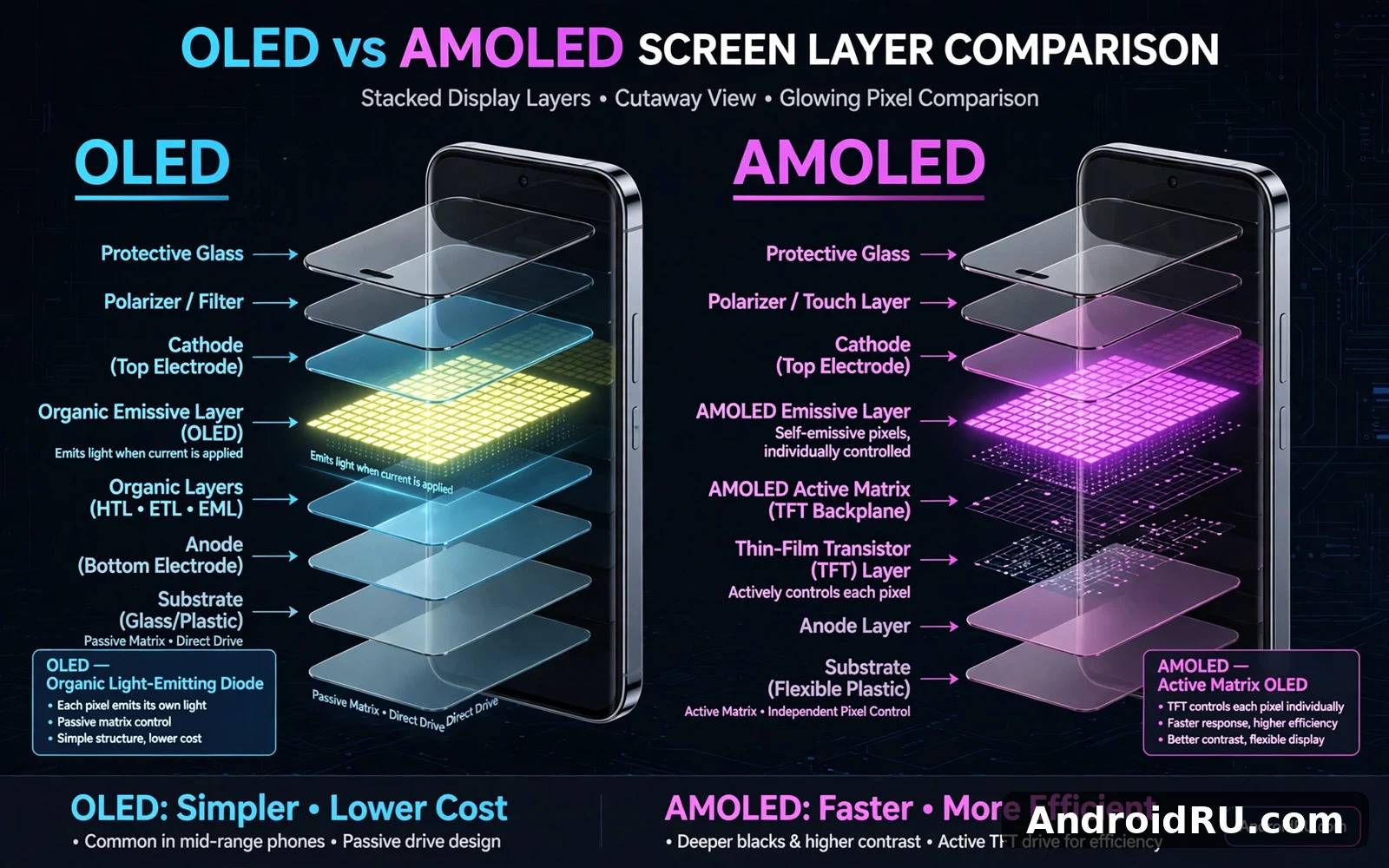
One Family Two Names
OLED and AMOLED belong to the same display family. OLED stands for a screen where each pixel creates its own light. AMOLED adds an active matrix layer that controls each pixel with a thin transistor grid. That active matrix gives faster and more precise control over brightness and colour across the whole panel. In practice most modern phone OLED screens use an active matrix even when marketing shortens the name to OLED.
The naming confusion comes from marketing rather than physics. One maker may call a panel OLED while another maker calls a very similar panel AMOLED. The label alone therefore tells you little about quality. Judge the actual panel by brightness and colour accuracy and uniformity and power behaviour. Those traits decide daily satisfaction far more than the letters on the box.
How Self Lit Pixels Work
An OLED pixel lights itself without a separate backlight. That design allows true black because a black pixel simply stays off. It also allows thin panels and flexible shapes and excellent contrast. Dark scenes in films look deep and rich because bright stars can shine beside truly dark space. Light scenes stay vivid because each pixel controls its own output.
Self lit pixels also help power use in dark modes. A dark interface turns many pixels off or dims them heavily. That behaviour saves energy compared with a backlit screen that must light the whole panel even for dark content. Bright content still draws more power because every lit pixel consumes energy. The power story therefore depends on what you show as much as on the panel type.
What Active Matrix Adds
Active matrix control switches each pixel quickly and holds its state steady between updates. That precision supports high refresh rates and smooth motion and accurate colour at different brightness levels. It also supports large high resolution panels without the ghosting that older passive control would cause. Without active matrix control a large modern phone panel would struggle to stay sharp during fast motion.
Active matrix also enables advanced features like variable refresh and always on display elements. An always on clock can light only a small set of pixels while the rest stay off. Variable refresh can drop the rate for still content and raise it for motion. These features feel like software magic but they rest on precise active matrix hardware. The motion side of that story is explained in Understanding Refresh Rates: 60Hz vs 90Hz vs 120Hz Displays where rate and panel control work together.
Colour Brightness And Viewing Angles
OLED panels generally offer wide viewing angles and rich colour. Colours can look vivid and punchy when tuned for impact. Colours can also look natural and accurate when tuned for fidelity. The tuning choice matters more than the panel label because two panels with the same technology can look very different side by side. Check colour modes in settings because many phones offer a vivid mode and a natural mode.
Brightness decides outdoor readability. A panel that reaches high brightness stays readable in sunlight. A panel with lower peak brightness washes out outdoors even when indoor colour looks lovely. Check brightness in real sunlight rather than in a shop with controlled lighting. Also check uniformity on a plain grey screen because uneven tint can annoy during reading. A bright accurate panel beats a merely labelled panel every time.
Battery Life And Dark Mode
Dark mode saves noticeable power on OLED and AMOLED panels because black pixels stay off. Light mode draws more power because most pixels stay lit. The saving grows when you use dark themes across the system and inside apps. It shrinks when you keep brightness high and show mostly bright content. Dark mode therefore helps battery but it does not transform a weak battery into a strong one.
Always on display features also benefit from self lit pixels. A clock or notification icon lights only a tiny area while the rest of the screen sleeps. That design keeps useful information visible at low cost. A backlit panel cannot match that efficiency because it must light a larger area. For users who love always on information the OLED family holds a clear edge. Battery behaviour in daily use is also weighed in Best Battery Life Smartphones: Tested for Heavy Usage where screen type joins battery size in the verdict.
Burn In And Long Term Care
OLED pixels age with use and static bright elements can leave a faint ghost over long periods. Modern phones reduce this risk with pixel shifting and brightness management and interface design. Normal varied use rarely causes visible burn in within a typical ownership period. Heavy static use with maximum brightness for many hours daily raises the risk over years.
Simple habits protect the panel. Use auto brightness rather than maximum brightness all day. Vary your content and avoid leaving a static bright image on screen for hours. Use dark themes where you enjoy them. These habits cost nothing and keep the panel looking fresh. Do not fear the technology but do respect its ageing behaviour.
Which Label Should Guide You
Treat OLED and AMOLED as cousins rather than rivals. Most phone buyers will never see a practical difference from the label alone. Focus instead on brightness and colour tuning and refresh behaviour and resolution and power use. Visit a shop and compare panels with the same photo and the same video at the same brightness. Your eyes will tell you more than a specification sheet.
Ask about the panel only after you judge the image. Ask whether the phone offers natural and vivid colour modes. Ask whether variable refresh works smoothly. Ask whether outdoor brightness stays strong. Those questions lead to a better purchase than asking whether the box says OLED or AMOLED. A comfort comparison that uses the same eyes first method appears in Top Compact Android Phones for One-Handed Use where handling and screen feel decide together.
The Bottom Line
AMOLED is an OLED panel with active matrix control rather than a separate technology. The active matrix brings speed and precision that modern phones rely on. Daily quality still depends on brightness and colour tuning and power behaviour. Judge the screen that you see and the label will take care of itself.
Panel Tuning And Colour Modes
Panel tuning decides whether a screen looks vivid or natural. Vivid tuning boosts saturation so photos and videos pop at first glance. Natural tuning aims for accurate colour so editing and photo viewing stay faithful. Neither tuning is objectively wrong because taste and task differ. A film lover may prefer vivid impact while a photo editor needs natural accuracy. A phone that offers both modes serves both users well.
Check colour modes in different lighting because a mode that looks great indoors may look harsh outdoors. A natural mode often stays more comfortable during long reading sessions. A vivid mode often makes short video browsing more exciting. Switching modes takes seconds and can transform how a phone feels. Explore the options rather than accepting the factory default without question.
Brightness Behaviour In Real Light
Peak brightness numbers describe a short burst under ideal conditions. Sustained brightness during long outdoor use often sits lower as the panel protects itself from heat. That difference matters for navigation and photography outdoors. A panel that sustains strong brightness feels reliable in sunlight. A panel that fades quickly after a bright burst feels frustrating on long walks.
Auto brightness behaviour also shapes comfort. Good auto brightness changes smoothly as light changes. Poor auto brightness jumps suddenly or lags behind a lighting change. Test auto brightness by moving between indoor and outdoor light during a normal day. A smooth and responsive system feels invisible while a jumpy system draws attention to itself constantly.
Resolution Sharpness And Text
Resolution decides how sharp text and fine detail appear. Higher resolution helps small text stay crisp during reading. It helps photo detail stay clear when zooming. It matters less for video because most streaming video uses a lower resolution than the panel maximum. A sharp panel still improves everyday reading even when video gains little.
Text rendering also depends on panel subpixel layout and software smoothing. A well tuned panel shows clean letter edges without colour fringing. A poorly tuned panel can show faint colour edges on small text. Read a long article on any candidate phone before you buy. Your eyes will notice text comfort quickly even when specification numbers look identical.
Curved Edges And Screen Protection
Curved screen edges look premium but they can distort content at the borders and invite accidental touches. Flat screens avoid edge distortion and accept screen protectors more easily. A flat panel often suits practical users better than a curved panel. A curved panel often suits users who value appearance above all else. Choose the shape that fits your grip and your protector habits.
Screen protectors also affect panel feel. A good protector preserves touch sensitivity and clarity. A poor protector dulls colour and adds glare. OLED panels pair well with quality protectors that use clear adhesive across the whole surface. Test a protector before committing to a full pack when possible. Protection should preserve the panel experience rather than degrade it.
OLED In Wearables And Tablets
OLED technology also powers watches and tablets where its traits shine differently. A watch benefits greatly because an always on face lights only a few pixels. A tablet benefits from deep blacks during film viewing and from thin light designs for portability. The same self lit pixel advantage scales across device sizes. Power savings grow where dark content dominates the screen.
Tablets used for reading benefit from OLED contrast because text stands out sharply against a dark background in night mode. Tablets used for drawing benefit from accurate colour and wide viewing angles. Watches benefit from visibility in sunlight when peak brightness stays strong. The panel family therefore serves many device types with the same core strengths adapted to each form factor.
Future Panel Directions
Future panels aim for higher brightness and lower power use and longer life. New materials promise brighter pixels that age more slowly. New control systems promise smoother variable refresh with less visible flicker. Foldable panels promise larger screens that still fit pockets. These advances build on the same OLED foundation rather than replacing it entirely. Buyers can therefore trust that OLED knowledge will stay relevant for years.
Micro LED technology may one day challenge OLED with self lit pixels that age differently. That technology remains expensive and rare in phones today. OLED remains the practical self lit choice for most buyers now. Future buyers should judge new panel types by real brightness and colour and longevity rather than by launch claims. The eyes first rule will serve every future panel generation well.

