

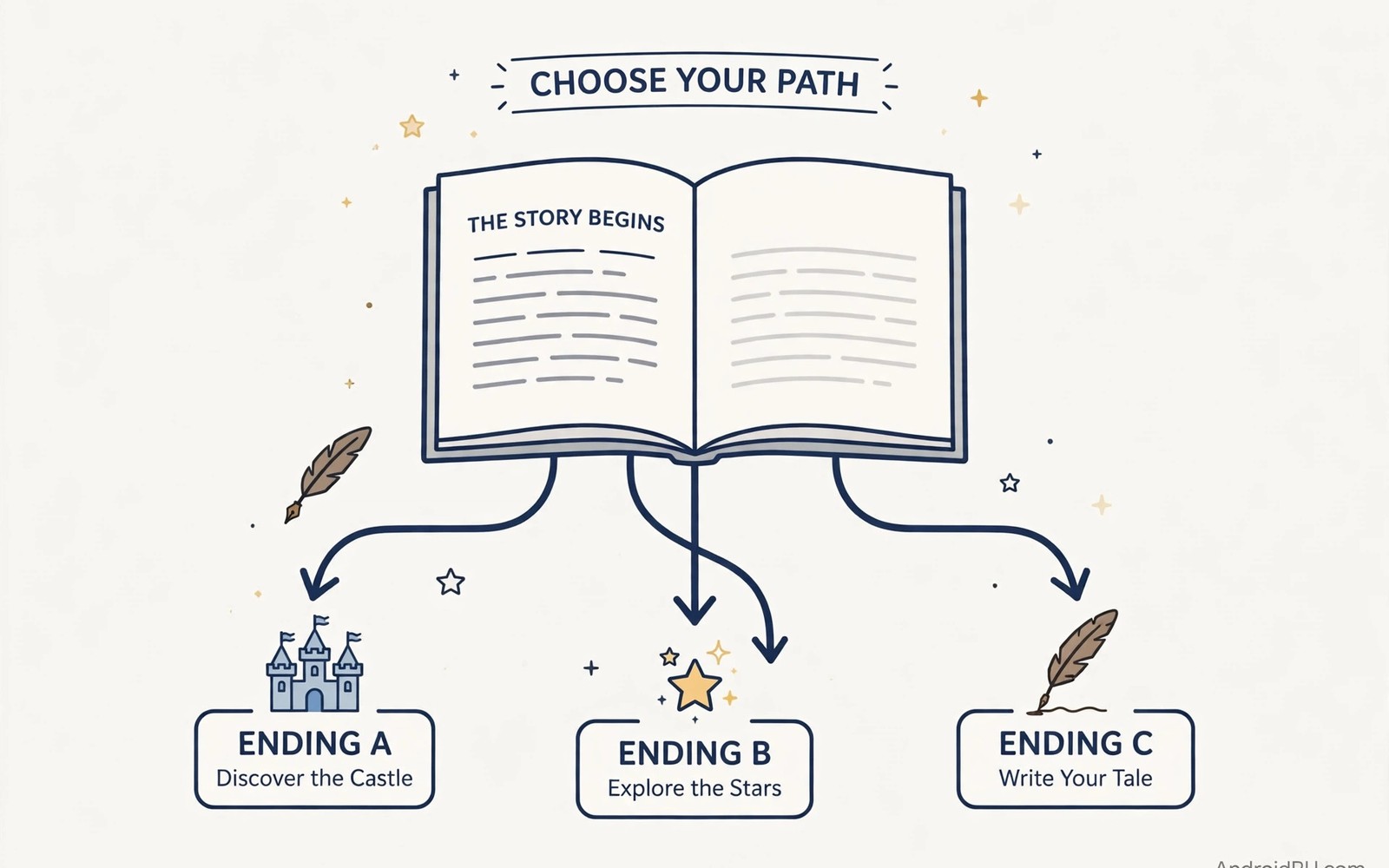
Text-based narrative RPGs prove that words can outshine graphics. A well written paragraph can terrify or move you more than any cutscene. Your imagination fills the world and your choices steer it. That partnership between writer and player is unique to the genre.
These games suit phones beautifully. You read and choose at your own pace. No reflexes and no grinding block the story. If you enjoy long single player stories then offline adventures share this focus and you can explore them through this guide to offline story-driven RPGs: offline story-driven RPGs. This guide explains how narrative RPGs work and how to find the best ones.
How choice-driven stories work
A narrative RPG presents scenes as text and offers choices at key moments. Each choice changes variables behind the scenes. A kind choice may raise a relationship score. A ruthless choice may unlock a darker path. Later scenes respond to those variables in ways that feel personal.
Good narrative games track more than major choices. Small decisions about tone and loyalty accumulate into distinct endings. A game that remembers your minor choices feels alive. A game that funnels every path to one ending feels like a trick.
Stats and role playing beneath the words
Many narrative RPGs hide light RPG systems under the prose. Attributes like strength or charm gate certain choices. Skills improve through use or through story events. Inventory items solve problems in clever ways. These systems give choices weight beyond flavour text.
Build your character deliberately. A charming diplomat opens different doors than a silent warrior. Neither path is better but each reveals different content. Replay value comes from trying a second personality and watching the story bend around it.
Writing quality and what to test
Read the opening chapter slowly before committing. Strong writing shows in the first ten minutes through voice and rhythm. Weak writing hides behind purple prose and endless exposition. If the opening bores you then the middle will not rescue it.
Check whether choices feel meaningful. Save before a big choice and try both branches briefly. If both branches converge within two scenes then the game offers illusion rather than agency. Honest branching costs writers enormous effort and the best games show that effort proudly.
Playing narrative RPGs well
Play in quiet moments when you can actually read. Narrative RPGs punish distracted skimming since a missed detail can change a whole arc. A commute with headphones and focus beats a couch session with television noise.
Keep a simple story journal. Note character names and promises you made and factions you angered. Long narrative games span weeks of play and memory fades. A few lines per session keep the tale coherent. For players who love freedom alongside story, sandbox adventures offer a different kind of agency and you can explore them through this guide to sandbox RPGs: sandbox RPGs giving players ultimate freedom.
The power of second person narration
Second person narration defines many text RPGs, because it addresses you directly and makes every choice feel personal. A sentence like you open the door implicates you in ways third person narration cannot, since the hero is you rather than a character you observe. That intimacy creates stronger emotional reactions to success and failure alike, which is why text games can move players with words alone. The technique feels unusual at first, yet it becomes immersive quickly once you accept its premise.
Second person narration also demands better writing, because clumsy you statements break immersion instantly. Skilled authors vary sentence structure and avoid repeating you at the start of every line, which keeps prose flowing naturally. When choosing a text RPG, read its opening pages carefully for this quality, since weak second person writing never improves later. Strong second person prose pulls you into the world so completely that graphics feel unnecessary.
Stats that serve story rather than dominate it
Stats in narrative RPGs should serve story rather than dominate it, because numbers that overshadow prose defeat the genre’s purpose. The best games use stats quietly, gating a few choices and shaping outcomes without turning reading into accounting. A charm stat that unlocks a diplomatic solution feels meaningful, while a spreadsheet of twenty attributes feels like homework. Judge stat systems by whether you think about story or numbers while playing.
Build characters around story identity rather than optimal numbers, because narrative games reward role playing more than min-maxing. A flawed hero with a clear personality creates better scenes than a perfect hero with no character. Let your stats reflect your hero’s history and values, and accept that some choices will fail because of those stats. Those failures often produce the most memorable stories, since struggle creates drama that success cannot.
Multiple endings and their honesty
Multiple endings promise replay value, yet their honesty varies enormously. Honest endings diverge meaningfully based on your choices, with different fates for characters and worlds that reflect your journey. Dishonest endings share ninety percent of their text and change only a final paragraph, which feels like a trick after hours of careful choices. The difference matters, because honest endings respect your time while dishonest ones exploit your hope.
Research ending honesty before committing to a long narrative RPG, because community guides usually document how much endings differ. Look for players discussing distinct endings with enthusiasm rather than complaining about palette swapped conclusions. A game with three truly different endings offers more value than a game with twenty near identical ones. Quality of divergence beats quantity of endings every time, and wise players choose accordingly.
Text RPGs and accessibility
Text RPGs lead gaming in accessibility, because words adapt to assistive technology more easily than graphics. Screen readers can narrate text games for visually impaired players, while adjustable fonts and contrast help many others. That accessibility is a genuine strength, yet it requires developers to structure text properly rather than rendering it as images. Support text games that prioritize accessibility, because they welcome players that other genres exclude.
Accessibility also includes cognitive load, since dense prose with complex branching can overwhelm some players. Good text RPGs offer recaps and clear choice labels and forgiving save systems that reduce that load. If a game confuses you, check whether its interface helps or hinders, because the problem may be design rather than your ability. The best narrative games welcome all readers, not only experienced ones.
From interactive fiction to modern narrative RPGs
Interactive fiction history stretches back decades, from early text adventures to modern narrative RPGs with rich stats and branching stories. Early games relied on parser input, where players typed commands like open door, which created freedom and frustration in equal measure. Modern games replaced parsers with choice menus, which sacrificed some freedom for accessibility and smoother pacing. That evolution made narrative RPGs welcoming to millions who never typed a parser command.
Appreciate this history by trying a classic interactive fiction title alongside a modern narrative RPG, because the contrast reveals how far the genre has come. Classics offer raw imagination and clever puzzles, while modern games offer polished stories and character depth. Both deserve respect, and together they show that words remain gaming’s most flexible medium. The future of narrative RPGs builds on this rich past, and players who know it enjoy the present more deeply.
Choice interfaces on small screens
Choice interfaces decide whether narrative RPGs feel natural on phones, because cramped or confusing options break immersion instantly. Good interfaces present choices as large tappable cards with clear text, letting you read and decide without zooming or scrolling awkwardly. Bad interfaces squeeze choices into tiny lines that invite accidental taps, which can ruin a carefully planned story with one wrong touch. Test choice interfaces during a game’s opening chapter before committing to a long run.
Customization options like text size and choice confirmation dialogs protect against interface mistakes, so favour games that offer them. A confirmation dialog for major choices prevents accidental story changes, while adjustable text size keeps long passages readable on small screens. These features seem minor, yet they decide whether a narrative RPG feels designed for phones or merely ported to them. Choose games that respect your thumbs as much as your imagination.
Keep a story journal that works
A story journal prevents the confusion that kills long narrative runs. This plain text template works in any notes app. Update it at the end of each session.
GAME: title / chapter now
ALLIES: names and what I promised them
ENEMIES: names and why they oppose me
OPEN THREADS: three unresolved plot lines max
NEXT SESSION GOAL: one scene or choice to pursue
This journal template is an original tool written for this guide. It uses no data from any specific game. Its purpose is to restore story context in sixty seconds after a break. Three open threads is a deliberate limit. More threads blur focus while fewer threads hide the richness of a branching story.
Common mistakes
The biggest mistake is treating a narrative RPG like a race. Players who tap through text quickly miss the writing that makes the genre special. Slow down and read properly. The story is the gameplay here.
Another mistake is always choosing the safe option. Narrative RPGs reward bold choices with memorable scenes. A failed bold choice often creates a better story than a safe success. Embrace consequences rather than reloading every setback.
FAQ
Are text-based RPGs just books with buttons?
No. Branching variables and stats create a living story that responds to you. A book cannot change its ending because you lied to a character. A narrative RPG can.
Do narrative RPGs work offline?
Most do since text needs little server support. Check the store listing since some titles add online features or cloud saves.
How long is a typical narrative RPG?
Most run five to twenty hours per path. Multiple endings can double or triple total playtime for completionists.
Conclusion
Text-based and choice-driven narrative RPGs offer the most personal stories on Android. Words and choices create worlds that graphics cannot match. Read slowly and choose boldly and keep a journal.
Your next step is to pick one narrative RPG and play its opening chapter with full attention tonight. If the writing grips you then commit to a full run without rushing. For more solo storytelling with richer visuals, continue with offline story-driven RPGs here: offline story-driven RPGs for single players.

