

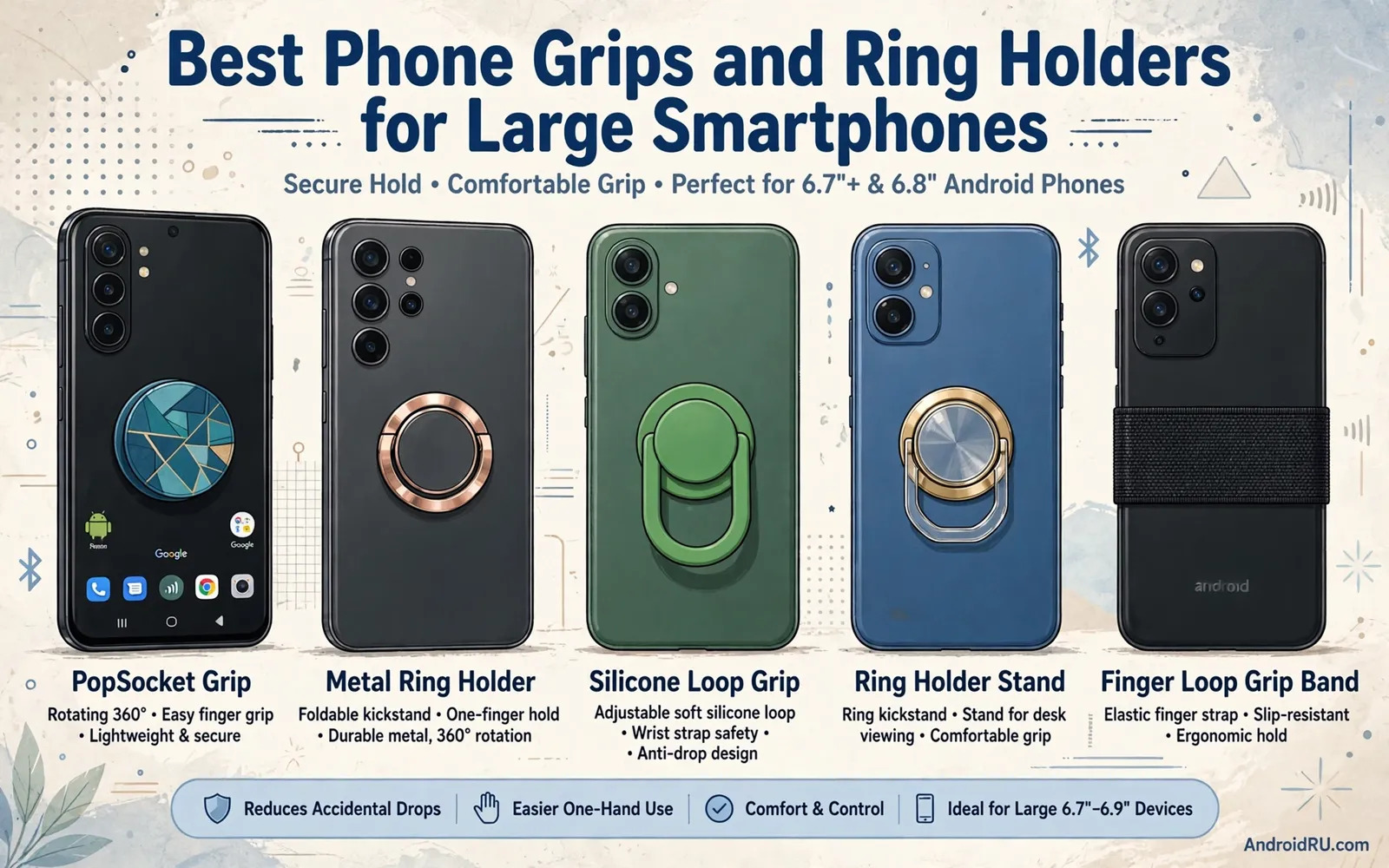
Best Phone Grips and Ring Holders for Large Smartphones
Large smartphones are wonderful until you try to hold one with a single hand. A 6.7-inch or 6.9-inch slab with a glass back weighs 200 grams or more, and your thumb can only reach about two-thirds of the screen. The pinky finger ends up carrying the whole load from underneath, which aches after ten minutes of scrolling. A slippery finish makes the whole thing worse, because every notification check feels like a small gamble.
A grip or a ring-style grip fixes the physics instead of fighting it. It gives your fingers a fixed anchor point, so the phone hangs from your hand rather than balancing on it. I have used finger rings on a 6.8-inch phone for years, and the difference is immediate: one-handed photos stop feeling risky, reading in bed stops hurting my wrist, and the phone props itself up on a train table for video. This guide covers the seven grips and ring grips that actually work on oversized handsets, with a side-by-side table, a fitting guide, and the mistakes that make cheap grips peel off within a week.
Why a Big Phone Slips: The One-Hand Reach Problem
The reach problem is simple geometry. Hold your phone in one hand and watch where your thumb naturally lands. On a 6.1-inch device it can sweep most of the screen. On a 6.8-inch device the top corners sit a full thumb-length away, so you shuffle the phone down in your palm to reach them, and that shuffle is exactly when drops happen. A ring-style holder or a pop-style grip changes the grip point: your index or middle finger threads through the ring, or the grip sits between two fingers, and the phone stays put while the thumb does its work.
Weight is the second half of the problem. A big phone with a battery over 5,000 mAh and a thick case can push past 240 grams. That is not heavy on a desk, but it is heavy hanging off one pinky for an hour. A strap-style grip spreads the load across the back of the hand, while a ring transfers it to a stronger finger. Either way, the hand relaxes, and relaxed hands drop phones less often.
The Pinky Shelf Problem
The pinky shelf is the habit most large-phone owners know without naming it: the little finger slides under the bottom edge and props the phone up like a shelf. It works for a minute. After twenty minutes the joint aches, and after a month some people notice a visible dent in the finger. A ring-style grip replaces the shelf entirely. The finger goes through the ring instead of under the phone, the weight hangs from the knuckle, and the pinky goes back to doing nothing.
Thumb Reach and the Top Corners
Reaching the top corners is the other daily pain. Pull-down notification shades, back buttons in apps, and the search bar at the top of a browser all live where the thumb cannot go. A grip does not lengthen your thumb, but it lets you slide the phone down and back up with control instead of juggling it. With a ring on the back, you loosen the finger slightly, the phone drops half an inch, you tap the corner, and you pull it back up. That small controlled slide is the real skill a grip teaches your hand.
Ring Holders, Pop Grips, Straps and Magnets: Picking a Style
Four styles cover nearly everything on sale, and they suit different hands. A metal ring holder is a flat base with a ring that folds out and rotates. A pop-style grip is a collapsible disc that pops out between two fingers and collapses flat for pockets. A strap grip is an elastic band across the back that the whole hand slides under. A magnetic ring stand sticks to a magnetic case or a magnetic ring plate and doubles as a kickstand and a car-mount point.
None of these is the best for everyone, and the wrong style is worse than no grip at all. A ring grip annoys people who type with two thumbs, because the ring sits where the fingers want to rest. A pop grip annoys people who hate bulk in a pocket. A strap grip annoys people who need to slide the phone into a tight jeans pocket. Try to match the style to your dominant hold before you look at brands: one-handed scrollers want a ring, two-handed typists want a low pop grip, readers want a strap, and drivers want a magnetic ring.
Metal Ring Holders
A metal ring holder is the oldest style and still the most secure for pure holding. The ring takes a full finger, the base rotates 360 degrees so the ring can sit flat for a pocket or upright as a stand, and the adhesive base is usually a 3M pad that holds far more weight than the phone weighs. The trade-off is thickness: even folded flat, a ring adds a few millimetres to the back, and the phone will rock slightly on a table. Ring holders also work best on smooth, flat backs or cases. A heavily textured case needs a flat adapter plate, or the adhesive will grip only the high points and peel within days.
Pop-Style Collapsible Grips
A pop-style grip collapses to a thin disc and pops out to a small knob that sits between two fingers. It is the least intrusive style when collapsed, which is why it is popular with people who carry a big phone in a pocket all day. It also works as a small stand for video, and the top disc can be swapped for different designs. The catch is holding security: a pop grip gives you something to pinch, not something to thread a finger through, so it feels less locked-in than a ring when you are walking or holding the phone over a hard floor.
Elastic Strap Grips
A strap grip uses a wide elastic band across the back of the phone or case. The hand slides under the band, the palm carries the weight, and the fingers stay free for the screen. This is the most comfortable style for long reading sessions and for people with arthritis or weak grip strength, because no single finger carries the load. The catch is pocketability and charging: a strap adds a ridge across the back, and a strap placed over the middle of the phone can sit right on the wireless charging coil. Place the strap toward the top or bottom third and test charging before you commit.
Magnetic Ring Stands
A magnetic ring stand uses the magnet array in a MagSafe-style case or a stick-on magnetic ring plate. The ring snaps on, holds the phone, folds out as a stand, and snaps off when you want a bare phone again. That removability is the big win: you can take the ring off for a pocket and snap it back on for a video call. The catch is magnet strength, which varies a lot. A weak magnet will hold a phone on a desk but let go when you swing the phone while walking. Look for rings rated for at least 1,200 grams of holding force, and test the snap with a firm shake before you trust it outside. If your phone needs a magnetic ring to use these accessories at all, the roundup of Best MagSafe Accessories for Android Phones using Adapters explains which adapter rings work and which ones slip.
The 7 Best Phone Grips and Ring Holders for Large Smartphones
Every pick below was judged on the same four questions: does it hold a 6.7-inch or larger phone securely with one hand, does it stay stuck after weeks of pocket use, does it work as a stand, and does it block wireless charging. Prices are typical online prices at the time of writing and vary by colour and retailer, so treat them as a guide rather than a fixed quote.
1. PopSockets PopGrip
The PopSockets PopGrip is the original pop-style grip and still the one most people should try first. The disc sticks to the back of the phone or case with a strong gel adhesive, pops out to sit between the index and middle finger, and collapses flat enough to slide into a pocket. The top cap swaps out, so you can change the design without buying a new base, and the grip works with PopSockets mounts for cars and desks. On a big handset, the PopGrip shines for two-handed typing and for propping the phone up for video at a slight angle.
What surprised me after a month of use is how much the PopGrip helps with photography. Holding a 6.8-inch phone one-handed to take a photo usually means a shaky grip and a thumb stretched for the shutter. With the PopGrip between two fingers, the phone sits steady and the thumb falls naturally on the shutter button. The gel adhesive also re-sticks after a rinse under water, which is useful when dust weakens the bond. The PopGrip costs around 10 to 15 dollars depending on the design.
Pros:
- Collapses flat, so a oversized phone still slides into a pocket easily.
- Swappable top caps let you change the look without replacing the grip.
- Works as a small stand and with PopSockets car and desk mounts.
Cons:
- Pinch-style hold feels less locked-in than a ring when walking.
- Gel adhesive weakens on textured cases and needs a smooth surface.
Verdict: the safest first grip for a large-screen phone. Buy it if you want the lowest-profile option that still gives your fingers something to hold. Skip it if you need a finger-through-ring level of security.
2. Spigen Style Ring
The Spigen Style Ring is a slim metal ring holder that does one job extremely well: it keeps a heavy phone attached to your hand. The ring is made of metal, folds flat against a low base, and rotates a full 360 degrees, so you can set it as a finger loop in portrait or as a kickstand in landscape. The adhesive is a 3M pad rated well above the weight of any phone, and in my use it survived months on a smooth case without a single edge lifting.
On a big-screen phone, the Style Ring earns its place because of its size. The ring is wide enough for a full finger, and the base is small enough that it does not fight with a case edge or a camera bump. It props the phone at a comfortable angle for video on a table, and the ring is strong enough to hang the phone from a car hook or a bag clip in a pinch. It costs around 10 dollars, which makes it one of the cheapest genuinely good grips available.
Pros:
- Full metal ring gives a locked-in finger hold on heavy phones.
- Rotates 360 degrees and doubles as a sturdy landscape kickstand.
- Very slim when folded, and the 3M adhesive holds for months.
Cons:
- Adds a hard ridge to the back, so the phone rocks slightly on a table.
- Only one fixed position once stuck; moving it needs a fresh adhesive pad.
Verdict: the best pure ring holder for the money. Buy it if you want maximum holding security on a big phone for about ten dollars. Skip it if you need to remove the grip often.
3. MOFT Snap-On Phone Stand and Wallet
The MOFT Snap-On Phone Stand and Wallet is a magnetic accessory that sticks to a MagSafe-style case and does three jobs: it holds up to three cards, it folds out into a stand with several viewing angles, and the edge works as a finger grip. It is made of a soft vegan leather over a rigid frame, and it snaps on and off in a second. On a large handset, the MOFT is the grip for people who want to carry less: phone, cards, and stand in one thin layer.
The stand angles are the detail that sells it. Most ring stands give you one angle. The MOFT folds into a floating mode for video calls and a low mode for watching video on a table, and both are stable with a heavy phone because the magnetic plate is wide. The trade-off is holding force: a magnetic wallet grip cannot match a glued ring for security, and a full wallet plus a heavy phone can slide if the magnet is weak or the case is not magnetic. Use it with a proper magnetic case and the hold is solid. It costs around 30 dollars.
Pros:
- Three-in-one design: wallet, multi-angle stand, and finger grip.
- Snaps on and off instantly, so the phone can go bare in seconds.
- Floating mode is genuinely useful for video calls on a large screen.
Cons:
- Needs a magnetic case or adapter ring; useless on a plain case.
- Card capacity is three cards, and a full wallet adds noticeable weight.
Verdict: the best grip for minimalists who want a wallet and a stand as well as a hold. Buy it if you already use a magnetic case. Skip it if you need a glued-on, never-let-go ring.
4. ESR HaloLock Ring Stand
The ESR HaloLock Ring Stand is a magnetic ring that snaps onto a MagSafe-style case with a claimed holding force around 1,400 grams, which is more than enough for the heaviest oversized handset. The ring is metal, folds flat, rotates for portrait and landscape viewing, and the whole unit is thin enough to leave on in a pocket. ESR also sells a version with a built-in wallet, but the plain ring is the one to buy if holding security is the priority.
What makes the HaloLock stand out is how firmly it stays put. I tested the snap with a 6.8-inch phone in a magnetic case and a deliberate shake, and the ring did not budge. That confidence matters, because a magnetic ring that lets go mid-swing is worse than no ring at all. The ring also works as a car-mount point with magnetic car holders, so it replaces two accessories at once. It costs around 16 to 20 dollars, which is good value for a metal magnetic ring.
Pros:
- Strong magnetic hold rated around 1,400 grams for heavy phones.
- Metal ring rotates for portrait and landscape stand use.
- Thin profile and works with magnetic car mounts as well.
Cons:
- Only works with a magnetic case or a stick-on magnetic ring plate.
- Removing it daily weakens the snap over time on some cases.
Verdict: the best magnetic ring for a big phone. Buy it if you use a magnetic case and want a ring that actually stays on. Skip it if your case has no magnet array.
5. OtterBox PopSocket Grip
The OtterBox PopSocket Grip is the result of OtterBox and PopSockets working together, and it is built for people who drop phones. The grip itself is a PopSocket disc, but it is designed to pair with OtterBox cases, and the combination is tougher than either part alone. The disc pops out for holding and video, collapses flat for pockets, and the adhesive is the same re-stickable gel that PopSockets is known for.
On a large-screen device, the OtterBox pairing matters because of drop protection. A grip helps you hold the phone, but a rugged case protects it when the grip fails, and OtterBox cases are among the most drop-tested on the market. The grip sits well on the flat back of an OtterBox Defender or Symmetry case, and the case lip keeps the screen off the ground when the phone lands face down. It costs around 15 to 20 dollars for the grip on its own, or more as part of a case bundle.
Pros:
- Pairs with OtterBox cases for grip plus serious drop protection in one setup.
- Collapsible disc works as a stand and stays flat in a pocket.
- Re-stickable gel adhesive survives a rinse and re-application.
Cons:
- Best value only shows when you already use, or plan to buy, an OtterBox case.
- Pinch-style hold is less secure than a metal ring for one-handed walking.
Verdict: the best grip for drop-prone owners of big phones. Buy it if you want a grip and a tough case working together. Skip it if you use a slim case from another brand.
6. Sinjimoru Metal Ring Holder
Sinjimoru is a Korean accessory maker whose metal ring holders have quietly become a favourite among large-phone owners. The M-Ring and its siblings use a stainless steel ring on a slim rotating base, with a 3M adhesive pad and a flat profile when folded. The ring is wide and smooth, so a finger slides in comfortably, and the base rotates for landscape stand use. It costs around 8 to 12 dollars, which undercuts most big-brand rings.
What I like about the Sinjimoru ring is its build quality at the price. The hinge feels solid after months of folding, the ring does not wobble, and the adhesive holds on smooth cases without edge lift. It is a simple product with no wallet, no magnets, and no gimmicks, and that simplicity is the point: it holds the phone, it props the phone, and it does not get in the way. For a 6.7-inch or larger phone, the wide ring is noticeably more comfortable than narrow rings that dig into the finger.
Pros:
- Wide stainless steel ring is comfortable for long one-handed use.
- Strong 3M adhesive and a solid hinge that survives daily folding.
- Very low price for a full-metal ring holder.
Cons:
- Less widely available than PopSockets or Spigen in some regions.
- No magnetic function, so it cannot snap onto a car mount.
Verdict: the best budget metal ring for a big-screen device. Buy it if you want Spigen-level quality for less money. Skip it if you need magnetic mounting as well.
7. Nite Ize Steelie Orbiter
The Nite Ize Steelie Orbiter is different from every other pick here: it is a magnetic mounting system first and a grip second. A small magnetic socket sticks to the back of the phone or case, and a steel ball mount holds it in a car, on a desk, or on a bike. The Orbiter kit includes a ring-style grip that attaches to the same socket, so the phone can be held by the ring, then snapped onto the car mount without removing anything.
For a oversized device, the Steelie system solves the car problem that grips usually ignore. A 6.8-inch phone on a vent mount wobbles and slides; the Steelie ball mount holds it firmly and adjusts to any angle. The ring grip is comfortable enough for daily holding, and the socket is low-profile when the ring is removed. The full kit costs around 30 to 40 dollars, which is more than a simple ring, but it replaces a grip and a car mount in one purchase. The magnet is strong, rated well above the weight of a large phone, and the ball joint lets you rotate the phone between portrait and landscape with one hand.
Pros:
- One system covers hand grip, car mount, and desk mount.
- Strong magnet and ball joint hold a heavy phone at any angle.
- Ring detaches from the socket, leaving a low-profile back.
Cons:
- Costs more than a simple ring and needs the socket stuck on the phone or case.
- The socket adds a small bump that can interfere with some wireless chargers.
Verdict: the best grip for drivers with a large phone. Buy it if you want one system for hand, car, and desk. Skip it if you only need a simple ring and never mount the phone.
Side-by-Side Comparison: Which Grip Fits Your Large Phone
The table below puts the seven picks next to each other on the criteria that matter for an oversized handset. Use it to narrow the list to two finalists, then choose by your dominant hold: ring for one-handed security, pop grip for pocketability, strap for reading comfort, and magnet for car use.
| Grip | Type | Best for | Stand function | Typical price |
|---|---|---|---|---|
| PopSockets PopGrip | Pop-style disc | Everyday pocket carry | Yes, small angle | 10 to 15 dollars |
| Spigen Style Ring | Metal ring | Maximum one-hand security | Yes, landscape | Around 10 dollars |
| MOFT Snap-On Stand and Wallet | Magnetic wallet stand | Minimalist carry | Yes, several angles | Around 30 dollars |
| ESR HaloLock Ring Stand | Magnetic ring | Strong magnetic hold | Yes, portrait and landscape | 16 to 20 dollars |
| OtterBox PopSocket Grip | Pop-style disc | Drop-prone owners | Yes, small angle | 15 to 20 dollars |
| Sinjimoru Metal Ring Holder | Metal ring | Budget metal ring | Yes, landscape | 8 to 12 dollars |
| Nite Ize Steelie Orbiter | Magnetic mount system | Drivers and mounts | Yes, with ball mount | 30 to 40 dollars |
If price is the deciding factor, the Spigen Style Ring and the Sinjimoru ring give the most holding security per dollar. If you want the thinnest pocket profile, the PopSockets PopGrip wins. If you drive a lot, the Steelie Orbiter is the only pick that also solves the car mount problem. And if you carry cards, the MOFT is the only pick that replaces a wallet too.
How to Fit a Grip on a Large Phone Without Blocking Wireless Charging
Fitting a grip is a five-minute job, but placement decides whether it works for months or peels off in a week. The centre of the phone back is the default spot, and it is usually right: the ring sits under the middle finger, the phone balances, and the thumb reaches the screen. But the centre is also where the wireless charging coil lives on most big phones, so a metal ring or a thick base in the dead centre can slow or block charging. Shift the grip a centimetre or two toward the bottom third and the coil stays clear while the hold stays comfortable.
Find the Wireless Charging Coil First
Before you stick anything on, find the wireless charging coil. Put the phone on a wireless charger and note where the charging starts reliably, then mark that spot mentally. On most oversized phones the coil sits in the middle third of the back, slightly above centre. A metal ring directly over it will often still allow charging, but slowly, and some chargers will stop and start repeatedly. A magnetic ring plate over the coil is worse, because the metal plate shields the field.
A Quick Coil Test With a Charger
Stick the grip on, then place the phone on the wireless charger and watch the charging icon for a full minute. If charging starts within a few seconds and stays on, the placement is fine. If it flickers or the phone gets warm without charging, move the grip a centimetre down and test again. Two minutes of testing now saves months of annoyance.
What to Do When the Grip Sits on the Coil
If the only comfortable grip position covers the coil, you have three options: move the grip lower and accept a slightly different hold, switch to a non-metal pop grip that interferes less, or charge with a cable instead of wirelessly. A cable is not a failure; many large-phone owners charge by cable overnight anyway, and a grip that fits the hand beats a grip that fits the charger.
Clean, Press, Wait: The 24-Hour Rule
Adhesive grips fail because of dirt, not because of weak glue. Clean the phone back or case with a wipe of isopropyl alcohol or a damp cloth, let it dry fully, then press the grip on firmly for a full minute. Do not use the grip hard for the first 24 hours. The adhesive needs that time to bond, and a heavy phone hung from a fresh ring on day one will peel the pad. I learned this the hard way with a ring that came off in my pocket on the first evening. After following the 24-hour rule, the same model stayed on for eight months.
Pairing a Grip With the Right Case
A grip and a case are a team, and the case decides how well the grip sticks. Smooth hard plastic and smooth silicone hold adhesive well. Soft-touch matte finishes hold reasonably well after cleaning. Heavily textured cases, leather cases with deep grain, and fabric cases hold adhesive poorly, and a ring stuck to them will peel at the edges within days. For those cases, use a flat adapter plate stuck to the case, or choose a magnetic grip that works with a magnetic case instead.
For owners who drop phones often, the strongest setup is a rugged case plus a ring. The case absorbs the drop and the ring prevents most drops in the first place. The guide to Top Heavy-Duty Protective Cases for Extreme Drop Protection covers the toughest cases available and explains how their raised edges and reinforced corners work together with a grip. At the other end of the spectrum, a slim case keeps the phone pocketable and pairs best with a low-profile pop grip or a thin magnetic ring. The roundup of Best Thin and Minimalist Cases for Sleek Phone Feel shows which thin cases still protect the corners and which ones are purely cosmetic.
Rugged Cases and Grips: A Tough Pair
A rugged case adds bulk, and bulk makes a large phone even harder to hold, which is exactly why a ring helps most on a rugged setup. The flat back of most rugged cases takes adhesive well, and the ring gives the hand a fixed anchor despite the extra width. Check that the ring base clears the case’s raised camera surround and that the ring can fold flat without hitting a corner bumper.
Thin Cases and Low-Profile Grips
A thin case plus a thick ring defeats the purpose of the thin case. If you chose a slim case for the sleek feel, pair it with a collapsible pop grip or a slim magnetic ring that folds nearly flat. The phone stays pocketable, the grip disappears when collapsed, and you still get the holding anchor when it pops out.
Mistakes That Make a Grip Peel, Wobble or Snap
Most grip failures are fitting mistakes, not product defects. The same ring that lasts a year on a clean smooth case will peel in a week on a dusty textured one. The list below covers the failures I see most often, and all of them are avoidable with a few minutes of care at fitting time.
Sticking a Grip to a Dirty or Textured Case
Dust, skin oil, and case texture are the three enemies of adhesive. A case that looks clean still carries a film of oil from hands, and that film is enough to halve the bond strength. Clean with alcohol, dry fully, and if the case is deeply textured, stick a flat metal adapter plate on first and the grip onto the plate. The plate gives the adhesive a smooth surface and spreads the load.
Placing the Ring Where Your Finger Cannot Reach It
A ring stuck too high forces the finger to stretch, and a ring stuck too low lets the phone tip forward. Hold the phone naturally, mark where your middle finger rests on the back, and stick the ring there. Test the hold before the adhesive sets: thread the finger through, walk around the room, and try reaching the top corners. If the phone feels tippy, move the ring a centimetre toward the centre before the bond sets.
Trusting a Weak Magnet on the Move
Magnetic rings are convenient, but magnet strength varies widely between brands. A ring that holds on a desk can let go when you swing the phone while walking or when you pull the phone out of a tight pocket. Test every magnetic ring with a firm shake over a soft surface before you trust it outside. If it slips, the case magnet is too weak or the ring plate is misaligned, and no amount of hoping will fix it.
Frequently Asked Questions About Phone Grips for Large Smartphones
Do ring holders work with wireless charging?
Usually yes, with placement care. A metal ring directly over the charging coil can slow charging or make it flicker, so shift the ring toward the bottom third of the phone back and test on your charger for a full minute. Non-metal pop grips interfere less. Magnetic ring plates are the worst offenders, because the metal plate shields the coil, so check charging after fitting any magnetic accessory.
Will a grip damage my phone or case when I remove it?
A quality adhesive grip peels off cleanly from glass and smooth plastic, especially if you warm it slightly with a hair dryer on low and peel slowly. Gel adhesives leave almost no residue. Cheap foam adhesives can leave a sticky patch, which comes off with a wipe of isopropyl alcohol. Never yank a ring off a leather case, because the adhesive can lift the finish.
Can I use a ring holder with a phone that has a pop socket case?
Yes, but check the fit first. Some cases have a built-in pop socket or a recessed back that leaves no flat area for a ring base. In that case, use the grip the case was designed for, or switch to a magnetic ring that works with the case’s magnet array. Forcing a ring onto a curved or recessed back guarantees an early peel.
Are magnetic ring holders safe for a large phone?
Yes, provided the magnet is strong enough for the phone’s weight. Look for a holding force of at least 1,200 grams, test with a firm shake over a bed or sofa, and use a case with a proper magnet array rather than a stick-on plate when possible. A weak magnet is the one real risk, because the phone can slide off a car mount or out of a hand without warning.
The Bottom Line: Which Grip Should You Buy First
If you only buy one grip for a large phone, buy the Spigen Style Ring. It costs about ten dollars, it holds a heavy phone with a real finger-through-ring grip, and it doubles as a stand. If you carry your phone in a pocket all day and hate bulk, buy the PopSockets PopGrip instead. If you drive a lot, the Nite Ize Steelie Orbiter is worth the extra money because it also solves the car mount problem.
Whatever you choose, fit it properly: clean the surface, place it where your middle finger naturally rests, keep it clear of the charging coil, and leave it alone for 24 hours. Do that, and a ten-dollar ring will do more for your daily comfort than any other accessory you can buy for a large phone. Try one this week, use it for a full day of normal use, and notice how rarely your pinky aches by the evening.

