

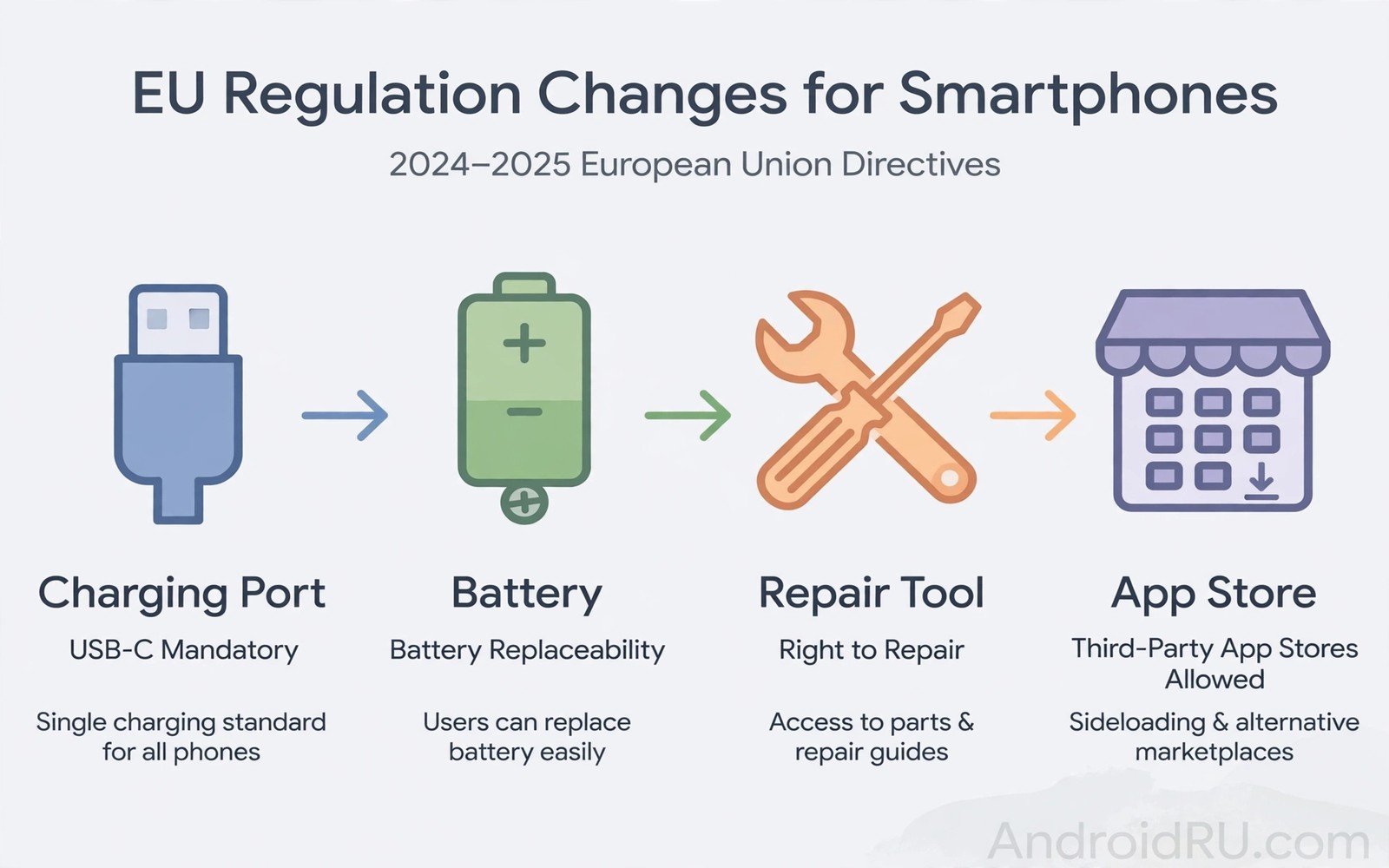
European Union regulations affect phones sold around the world because the EU market is large and makers prefer one global design over many regional variants. A rule that requires a common charger or a replaceable battery or a fair app store in Europe often shapes the phone that a buyer in another region receives. That global ripple effect explains why EU decisions appear in headlines far beyond Europe.
Regulation does not aim to punish phone makers. It aims to reduce waste and improve competition and protect consumers who cannot negotiate with large companies alone. A single charger reduces drawer clutter and electronic waste. A replaceable battery extends phone life. Fair app store rules give developers more choice. Those goals sound simple but they require detailed technical rules and long transition periods.
Common charging and cable rules
The common charger rule requires many devices to use a standard USB-C port for charging. That change ended a period when different phones needed different cables for the same task. A traveller can now carry one cable for a phone and a tablet and headphones. A household can share chargers rather than buying a new cable with every device.
Makers adapted by redesigning ports and power systems and packaging. Some makers removed chargers from boxes and argued that users already own USB-C chargers. That packaging change saved materials but frustrated buyers who expected a charger in the box. The rule still helps over time because a shared standard reduces waste and confusion across brands.
Battery replacement and repair rules
New repair rules push makers toward batteries that a user or a repair shop can replace with common tools. A sealed battery that requires special equipment and glue makes repair expensive and risky. A replaceable battery lets a phone last for more years because battery wear is the most common reason for replacement. A user who can swap a battery can keep a good phone instead of buying a new one.
Makers must also provide spare parts and repair information for a set period. That requirement helps independent repair shops compete with official service centres. It also helps users in regions without an official store. Repair rules do not force every phone to have a tool free back cover. They force a design that a trained repairer can open without destroying the device.
App store competition and sideloading
App store rules require large platforms to allow alternative stores and sideloading under clear conditions. A developer can offer an app outside the main store and can use alternative payment systems in some cases. That choice can lower fees for developers and can give users more options. It also creates new security questions because an alternative store may not vet apps as strictly.
Android already allowed sideloading before these rules but the process was often buried in settings and warnings. New rules aim to make choice clearer without removing security warnings entirely. A user who installs from an alternative store should still see clear information about the source and permissions. Competition works best when choice is visible and risks are explained in plain language.
Interoperability and messaging
Interoperability rules push large messaging services toward basic compatibility with other services. A user on one app should be able to send a basic message to a user on another app without forcing everyone onto the same platform. That goal is technically hard because encryption and features differ across services. Regulators focus first on basic text and media rather than every advanced feature.
Interoperability could reduce lock in because a user would not lose contacts when switching apps. It could also slow innovation if every new feature must work across all services. Regulators try to balance those effects by setting phased requirements and technical standards. The outcome will unfold over years rather than in a single update.
Data and privacy rules for phones
Privacy rules require clear consent for data collection and tracking and personalised ads. A phone maker must explain what data it collects and why it needs that data. A user must be able to refuse tracking without losing basic phone functions. Those rules changed how apps ask for permissions and how ads work on mobile devices.
Privacy rules also affect default settings because a system should not enable invasive tracking by default. A user who wants personalised ads can opt in. A user who does not want tracking should not need to hunt through many menus to opt out. Clear defaults protect users who never open privacy settings.
What changes mean for buyers outside Europe
Buyers outside Europe often receive the same hardware because makers avoid building separate models for each region. A USB-C phone sold in Europe is likely the same model sold elsewhere. A phone with a more repairable battery in Europe may also be more repairable elsewhere if the design is global. That spillover gives non European buyers benefits without local regulation.
Software differences can still vary by region because app store rules and payment rules may apply only where the law requires them. A buyer should check local store options and charger inclusion before purchase. Hardware tends to travel globally while software policy can stay regional for legal reasons.
How to buy a phone under new rules
A buyer should check the charger type and battery replacement options and update length before choosing a phone. A USB-C phone with a clear repair guide and spare parts will last longer and cost less over time. A phone with a long update promise will stay secure after repair rules take effect. Those factors matter more than a small difference in camera megapixels for most users.
A buyer should also check whether a phone supports alternative app stores if that choice matters. Some users prefer a single trusted store. Other users want more choice and lower fees. Neither preference is wrong. A clear understanding of store options helps a buyer avoid surprise after purchase.
Long term effects on phone design
Regulation changes phone design over several product cycles because a maker cannot redesign a battery system or a port system overnight. Engineers must test new materials and new layouts and new supply chains before a change reaches mass production. That slow timeline explains why a law passed today may only appear in phones two years later. Buyers who understand that timeline avoid expecting instant change.
Long term effects also include more standard parts that repair shops can stock. A standard battery size or a standard connector reduces inventory cost for small shops. That benefit grows over time as more models share parts. A market with standard parts supports repair jobs and reduces waste in a way that a single law alone cannot achieve overnight.
Common mistakes
People often assume that EU rules apply instantly to every phone in every country. That assumption ignores transition periods and regional software differences. A rule can take years to move from law to product design. A fair view checks the effective date and the scope for each rule.
- Assuming a new charger rule means every old cable becomes useless overnight.
- Expecting a replaceable battery on every model immediately after a law passes.
- Treating alternative app stores as unsafe without checking the specific store and app.
- Ignoring repair and update length when comparing phones on price alone.
- Assuming that a phone sold outside Europe has exactly the same software rules.
A careful buyer reads the effective dates and checks the exact model for the region of purchase. That habit prevents disappointment when a global headline does not match a local product.
Frequently asked questions
Do EU phone rules affect buyers in other countries?
EU rules often affect buyers elsewhere because makers use global hardware designs for efficiency. A common charger and a repairable battery design may appear worldwide. Software rules for app stores and payments may stay regional where the law applies.
Check the exact model and region before purchase because software options can differ even when hardware looks identical. Retailer listings usually state charger inclusion and regional features.
Will EU rules make phones more expensive?
EU rules can add design and testing costs in the short term but they can also save money by extending phone life and reducing charger waste. A repairable phone that lasts an extra year can be cheaper overall than a cheaper phone that needs early replacement.
Price also depends on display and camera and storage choices. Regulation alone does not decide the final price of a phone.
Are alternative app stores safe?
Alternative app stores vary in safety because vetting and review standards differ. A reputable store with clear developer policies and malware scanning is safer than an unknown store with no review process. Users should check permissions and reviews before installing any app from a new source.
Keep security settings on and avoid granting broad permissions to apps from unknown sources. A trusted main store remains the safest default for most users.
Conclusion
European Union regulations force smartphone changes because they set common standards for charging and repair and competition and privacy. Those standards ripple globally through hardware design even when software rules stay regional. Buyers gain longer lasting phones and clearer choices when they understand the rules and check effective dates. Makers gain a clearer framework even if compliance costs time and money. Related hardware coverage includes custom silicon processing chips and open RISC-V chip architecture and software features introduced in betas.
Take one concrete next step today. Check your current phone for its charger type and battery replacement options and remaining update length. Use that information to decide whether your next phone should prioritise repair and longevity over a minor camera upgrade.
A final check helps a buyer avoid headline confusion. Confirm whether a new rule applies to your exact model and region before expecting a feature. That confirmation saves time and prevents a purchase based on a rule that has not yet taken effect locally.
# Check USB and battery information on a connected Android device
adb shell dumpsys battery | grep -E "level|health"
adb shell dumpsys usb | grep -m 1 "port"
The commands above were written for this guide to show a simple way to check battery health and USB status on a connected device. They are general diagnostic examples and they do not modify the phone.

