

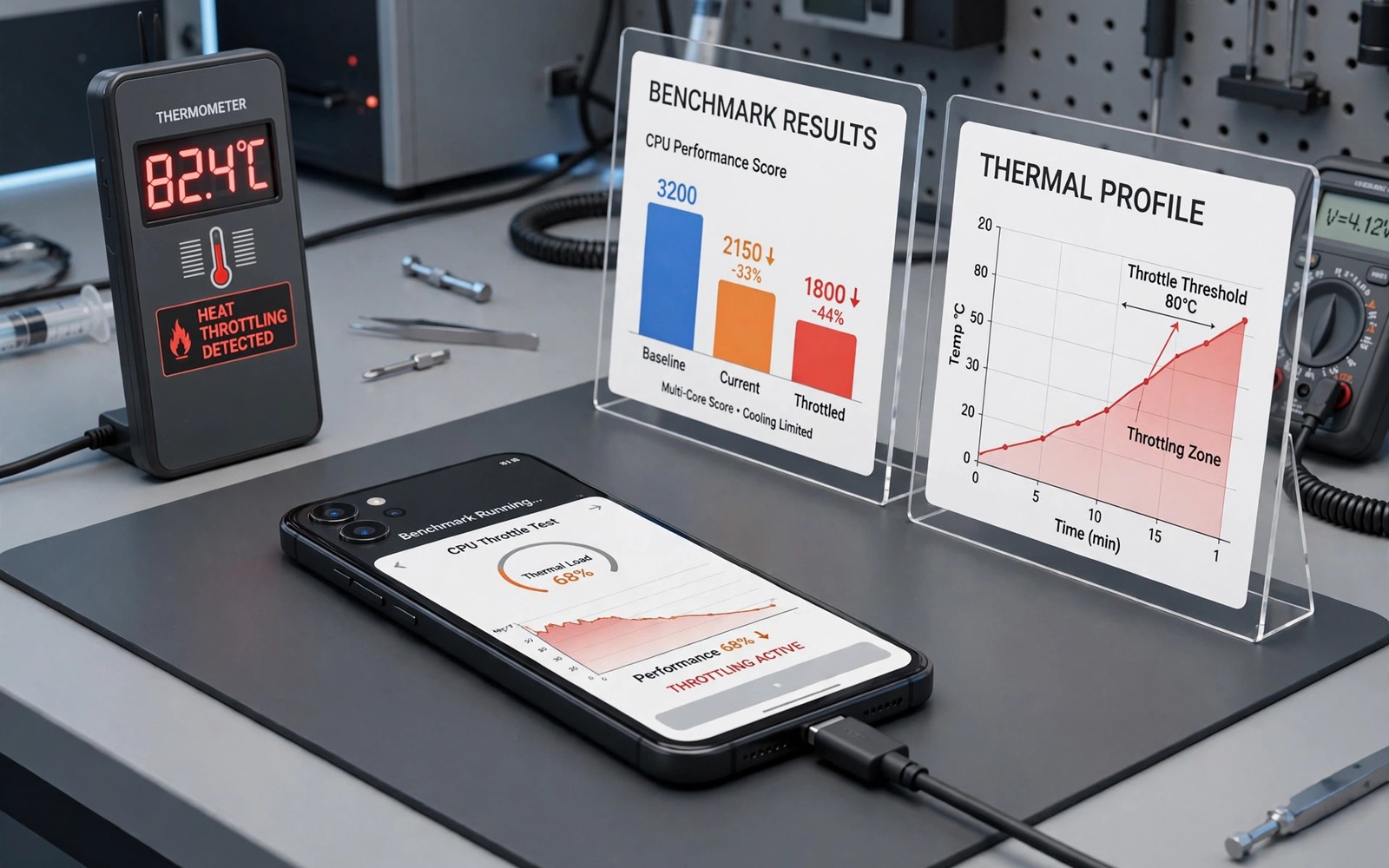
A phone that tops a benchmark chart can still stutter when you open a camera app on a hot afternoon. That gap is the whole story behind synthetic scores. A benchmark runs a short burst of work under ideal conditions. Your daily life runs long mixed work under heat and battery limits and background apps. The two situations rarely match. This guide explains why a single score misleads buyers and it gives you a practical test you can run in twenty minutes.
Benchmark apps measure small slices of performance in isolation. One slice tests processor math. Another slice tests graphics triangles. A third slice tests memory speed. Each slice runs for seconds and then stops before heat builds up. A real phone game runs for thirty minutes while the modem and the screen and the processor all draw power at once. The scoreboard never shows that combined load. It also never shows how the phone behaves after a software update or with a nearly full storage drive.
The marketing problem makes the gap worse. Phone makers tune devices to score well on famous tests. Some raise clock speeds briefly during a known benchmark and then drop back for normal apps. Some cool the test with a fan in a lab while your pocket traps heat. The result is a number that describes a lab sprint rather than a daily marathon. A buyer who trusts that number may pay extra for speed that never appears in messages or maps or video calls.
Why One Number Cannot Describe A Phone
A single total hides trade-offs that matter every day. A phone can score high on processor math and still feel slow because its storage is slow. App launches depend on storage speed more than on raw math. A phone can score high on graphics and still drop frames because its cooling is weak. A phone can score high overall and still drain fast because the test never measures a full day of mixed use. You need separate answers for launch speed and game stability and battery life and heat. One number cannot carry all four answers.
Think of a delivery van and a race car. The race car wins a sprint on a track. The van wins a week of loaded city deliveries. A benchmark is a track sprint. Your phone is a delivery van that must carry messages and photos and navigation and calls all day. The sprint winner may still be the wrong tool for the job. That is why two phones with close scores can feel very different in your hand. The difference lives in cooling and software tuning and storage and modem behaviour.
Scores also shift with conditions that the chart never lists. Room temperature changes results. Battery level changes results. Background updates change results. A test run at full charge in a cool room beats the same phone at twenty percent battery in summer heat. Reviewers rarely repeat every test under identical heat and battery states. A gap of ten percent between two phones can vanish once both phones run warm. Treat small gaps as noise rather than proof.
Thermal Throttling Is The Hidden Variable
Modern phone chips run fast for a short burst and then slow down to protect themselves from heat. This slowdown is called throttling. A benchmark that lasts ninety seconds may finish before throttling starts. A game session that lasts forty minutes lives mostly in the throttled state. The phone you actually use is the throttled phone. The phone on the chart is the fresh cold phone. That mismatch explains why a chart champion can lag in the tenth minute of a match.
You can see throttling without any special tool. Play a demanding game for fifteen minutes and note when frames start to dip. Then feel the back of the phone near the camera area. Warmth there often lines up with the dip. Next close the game for five minutes and play again. The first minutes usually feel smoother than the later minutes. That pattern is throttling in action. It is normal physics rather than a defect. Every thin phone faces it. The question is how far the speed falls and how fast it recovers.
Cooling design decides the size of the fall. A larger vapour chamber spreads heat across more area. A graphite sheet moves heat away from the chip slowly. A plastic body traps heat more than a metal frame does. A phone with a slightly lower peak score but a much smaller throttle drop can win a long session. Buyers who chase only the peak number miss this completely. Ask instead how the phone performs at minute twenty. That answer matters more than any launch day chart.
Software tuning adds another layer. Some phones hold high speed longer and accept more heat. Some phones cut speed early to protect battery life. Neither choice is wrong by itself. A gamer may prefer the aggressive phone. A commuter who needs all day battery may prefer the cautious phone. A single score hides which philosophy the maker chose. Your own priorities should decide which trade-off fits you. The chart cannot know your day.
What Benchmarks Skip Entirely
Benchmarks skip the parts of a phone that annoy you most. They skip notification delays. They skip camera launch time when storage is nearly full. They skip how long a phone takes to reconnect to a weak mobile signal. They skip voice call clarity in a noisy street. They skip how often an app reloads after you switch away for a minute. These daily frictions never appear in a graphics triangle count. Yet they shape how fast a phone feels far more than a math score does.
Benchmarks also skip software quality. Two phones can share the same chip and still feel different because their software differs. One maker may keep background apps alive longer. Another may kill them aggressively to save battery. The aggressive phone may reopen apps slowly and lose your place in a form. The lenient phone may feel faster even with a lower score. Update policy matters here too. A phone with a longer update promise stays secure and smooth for more years. A chart from launch day says nothing about year three.
Camera processing is another blind spot. A benchmark may test the graphics chip but it never tests the full photo pipeline. Night photos need multi frame merging and noise reduction and colour tuning. That pipeline uses the image processor and software smarts that a generic test ignores. A phone can lead a benchmark and still produce muddy night shots. If photos matter to you then sample shots in low light matter more than any score. Judge the camera with your own eyes in a dim room.
Storage speed deserves its own warning. Many buyers check processor and memory but ignore storage type and fill level. A phone with slow storage opens large apps slowly even with a fast chip. A phone that is ninety percent full also slows down because the system has little room to work. Benchmark charts rarely state the storage configuration of the tested unit. A top model with fast storage can outscore a base model with slower storage even when both share a chip name. Check the exact variant you plan to buy.
A Better Twenty Minute Test You Can Run
Start with a full charge and a cool room if you can. Open your five most used apps in turn and time each launch with a stopwatch. Write the times down. Then switch between those apps rapidly for two minutes and note any reloads. A good phone keeps most apps in memory. A weak phone reloads them and loses your place. This simple test mirrors your real day far better than a synthetic run does.
Next play a demanding game or record 4K video for fifteen minutes. Watch for frame dips and warmth and battery drop. Note the minute when smoothness first falls. That minute tells you more than a peak score ever will. Then test the camera in low light with moving subjects. Take five shots and check sharpness on the phone screen at full zoom. Blurry shots at full zoom reveal a weak pipeline even when daylight shots look fine.
Finish with a battery and signal check. Use the phone normally for the rest of the day and note the battery level at lunch and at dinner. Note any dead zones on your commute where calls drop or maps stall. A phone that holds signal well saves battery because the modem works less hard. A phone that hunts for signal drains fast even with a large battery. These lived results should outweigh a chart gap of a few percent. A guide on how Snapdragon and MediaTek chips differ in sustained use adds useful context for the heat behaviour you just observed.
Repeat the test on any phone you already own before you shop. Your current phone gives you a baseline. A new phone should beat that baseline in the tasks you actually do. It does not need to beat every chart. It needs to beat your baseline in launch speed and game stability and camera quality. That personal baseline turns shopping from score chasing into a clear upgrade decision. The same thinking helps when you read which phone features are not worth paying extra for because it keeps your budget on real gains.
How To Read A Review Without Being Fooled
Look for reviews that show sustained performance graphs rather than single numbers. A good graph shows speed across ten or twenty minutes. A flat line near the peak means strong cooling. A steep fall means heavy throttling. Also look for battery drain during the game test. A phone that scores high only by burning battery fast is not a better daily phone. It is a sprinter that empties its tank early.
Check whether the reviewer tested the exact storage and memory variant you want. A twelve gigabyte model can hold more apps than an eight gigabyte model. A faster storage tier can launch apps sooner. Small print about the test unit matters. If a review never names the variant then treat its numbers as a rough hint rather than a promise. Cross check at least two independent reviews before you trust a claim. One lab can differ from another by several percent on the same phone.
Watch for cherry picked comparisons too. A maker may compare its new phone against an old rival rather than the current rival. A reviewer may repeat that comparison without checking. Always ask which rival generation was used. A win against a two year old phone proves little. A win against the current rival at the same price proves much more. Price context turns a raw score into a value judgement. A phone that scores ten percent higher but costs forty percent more is not automatically the better buy.
adb shell dumpsys battery | grep level
adb shell cmd package list packages
# run game for 15 minutes then note fps dips
# record battery level at start and end
battery_start = 100
battery_end = 0
The snippet above is an original example written for this guide. It shows generic commands you can adapt to your own device. It does not copy code from any outside source.
Use the commands only as a note taking aid for your own test. The battery lines remind you to record start and end levels. The package list line reminds you to check which apps were running during the test. You do not need to run any command to judge a phone. Your stopwatch and your eyes give you the main evidence. The commands simply make your notes tidier if you like working in a terminal.
Common Mistakes
Many buyers compare scores across different benchmark versions. A score from an old version cannot be compared with a score from a new version. The test workload changes between versions. Always compare numbers from the same version and the same test settings. A second mistake is trusting a score from a single run. Scores vary with heat and battery and background work. Run any test three times and use the middle result.
A third mistake is ignoring the price gap. A flagship score may beat a midrange score by twenty percent while costing twice as much. That extra money could buy better storage or a longer update promise or a stronger camera. A fourth mistake is testing only in a shop. Shop phones run demo software under bright lights and constant charging. Their behaviour differs from a personal phone with your apps and accounts. A short shop test can mislead you badly.
A fifth mistake is forgetting storage fill. Test a phone when it is nearly full if you plan to fill it. Many buyers keep phones for years and fill them slowly. A phone that feels fast when empty may feel slow when full. Ask the seller about the storage speed of the exact variant. Do not assume that every variant of one model shares the same storage speed.
Frequently Asked Questions
Question: Do benchmark scores mean nothing at all?
Answer: Scores mean something narrow. They show peak capability under short ideal conditions. They fail as a full picture of daily speed and heat and battery life. Use them as one small input among many real tests.
Question: Which single real test matters most?
Answer: A fifteen minute demanding game or 4K recording session matters most. It reveals throttling and heat and battery drain together. Pair it with app launch timing for a fuller picture.
Question: Should I pay more for a higher scoring phone?
Answer: Pay more only when the higher phone also wins your own tests. Check launch speed and sustained gaming and camera quality at the same price. A small chart lead alone does not justify a large price jump.
Conclusion
Synthetic scores describe a sprint in a lab. Your phone lives a marathon in your pocket. Judge phones by launch times and sustained gaming and camera results and battery behaviour on your own routine. That evidence beats any chart. Your concrete next step is simple. Tonight time five app launches on your current phone and play one demanding game for fifteen minutes. Write both results down. Use those numbers as your baseline when you shop. Any new phone must beat them where it counts for you. For wider buying context read a full buying guide before you choose a new phone and how a refurbished flagship compares with a new budget phone before you spend.

