

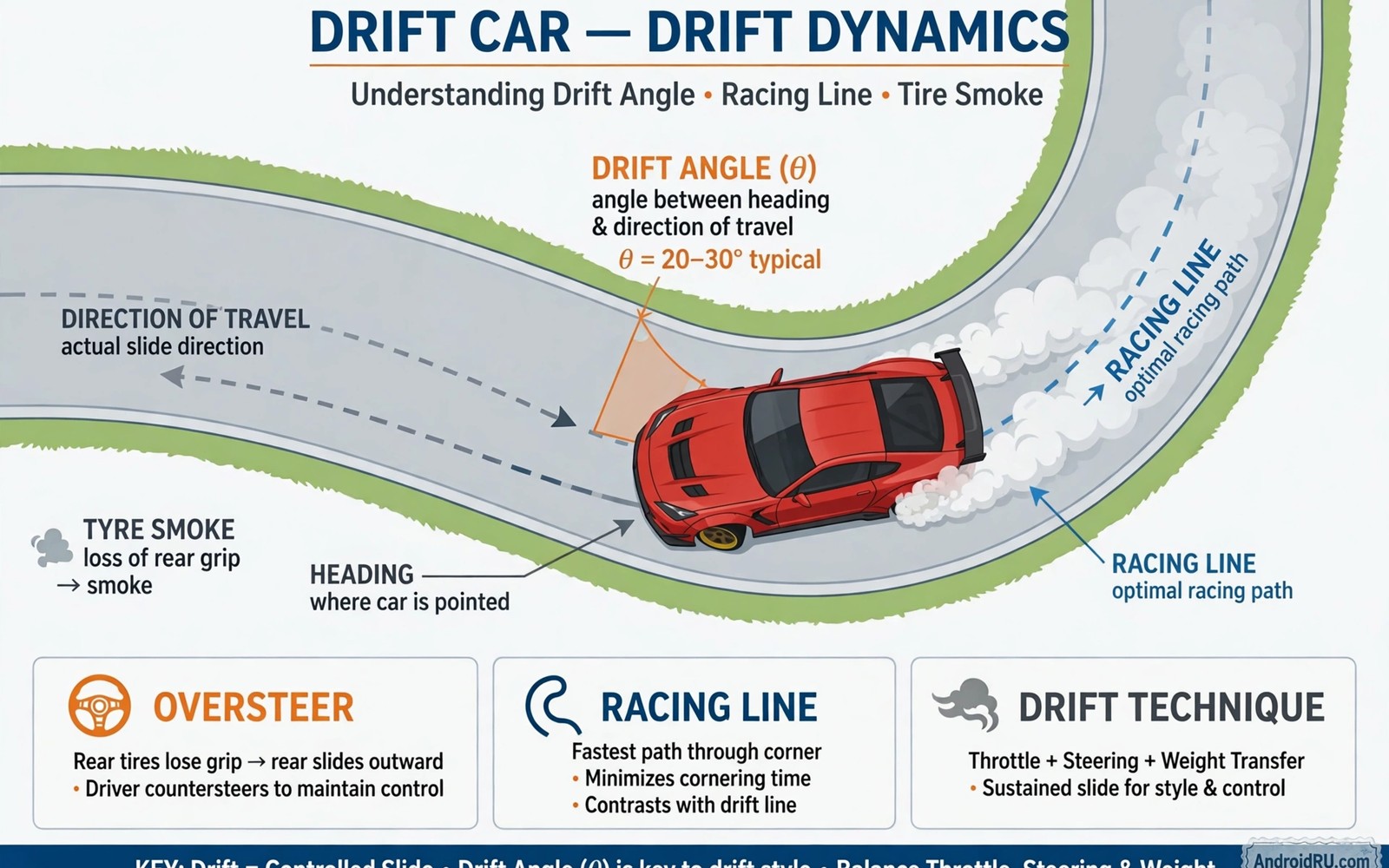
Drifting simulators turn controlled slides into a scoring art form on mobile. Angle and speed and smoothness decide your points on every run. A wild slide looks exciting but scores poorly without control. This guide teaches tuning and technique for maximum drift points without constant spins.
Good drift games reward a long smooth slide far more than a short violent one. Judges in game terms value line and angle and style together. Chasing angle alone causes spins and low scores. Balance is the real skill behind every high score run. truck driving simulators
Drift tuning differs completely from grip racing tuning. Soft rear suspension and locked differentials help hold slides. Tyre choice and steering settings shape how slides start and end. Learn tuning basics before you blame the car for spins. Most spin problems come from setup or throttle habits.
Drift culture celebrates car control and style beyond lap times. Drift events judge smoke and angle and line together. Mobile drift games capture that culture accessibly. Learning drift history adds appreciation for scoring systems.
Start slides with weight transfer
Weight transfer starts most controlled drifts in a reliable way. Brake briefly before a corner to shift weight forward. Turn sharply and then apply throttle to break rear grip. That sequence starts a slide without a violent handbrake yank. Practice the sequence slowly before adding speed.
Handbrake starts suit tight corners where space is very limited. Pull the handbrake briefly and release it before the slide grows too far. Holding it too long kills speed and angle together. Short handbrake taps give control that long pulls destroy. Use handbrake as a tool and not as a habit.
Initiation techniques vary by car and track conditions significantly. Clutch kicks suit powerful cars on grippy surfaces. Feint motions suit light cars on slippery surfaces. Learn initiation methods per car through testing. One initiation method never suits every drift car.
Control slides with throttle and steering
Throttle controls slide angle more than steering does during a drift. More throttle widens the angle and increases speed at once. Less throttle tightens the slide and risks regaining grip suddenly. Feather the throttle in small changes and not in big bursts. Smooth throttle keeps slides long and scoreable.
Counter steering keeps the car pointing along the road while sliding sideways. Steer opposite to the slide direction in small corrections. Large steering swings cause oscillations that end in spins. Watch the road ahead and not the spinning car body. Your eyes guide hands better than panic does. Bluetooth wheel controllers
Smoke volume signals tyre wear during long drift runs. Heavy smoke looks impressive but wears tyres fast. Worn tyres lose grip unpredictably late in runs. Manage smoke production for consistent long runs. Style and tyre management balance in judged events.
adb shell settings put system haptic_feedback_enabled 1
adb shell cmd game mode performance com.example.drift
adb shell dumpsys gfxinfo com.example.drift framestats
The commands above are adapted from public platform documentation for Android settings and game performance tools. They are included here as a teaching example for testing drift game smoothness and not as copied game code.
Tune cars for drift scoring
Rear suspension softer than front suspension helps slides start easily. Stiff front suspension keeps steering response sharp during slides. That split suits most drift cars on most tracks. Adjust in small steps and test over full runs. Drastic changes hide which setting actually helped.
Steering angle upgrades let cars hold deeper slides without spinning. More angle gives more control at high slide angles. Power upgrades help maintain speed through long slides. Balance power against control because excess power spins tyres too fast. A controllable car scores higher than a wild car.
Steering ratio settings change drift control feel dramatically. Quick ratios help fast transitions between slides. Slow ratios help smooth long single slides. Match ratio to track corner sequences. Transition heavy tracks favour quick ratios strongly.
Link corners for combo points
Linking corners means holding a slide from one turn into the next. That skill multiplies scores in most drift games. It demands throttle control through straights between corners. Do not straighten fully between linked corners. Keep a small slide alive and transition smoothly into the next turn.
Transitions are the hardest part of linked drift runs. Shift weight quickly but smoothly from one side to the other. Time the transition at the straight midpoint when possible. Early transitions waste angle and late transitions cause spins. Practice one linked pair until it feels boringly reliable. graphic settings in mobile racers
Drift tandem runs add proximity pressure to solo skills. Following another drifter closely demands mirror awareness. Lead drivers set lines that followers must match. Tandem skills build on solo drift foundations. Practice solo mastery before tandem events.
Read tracks like a drift judge
Wide tracks with long corners suit high angle drift runs best. Narrow tracks demand tighter slides and faster transitions. Study corner sequences before a scored run whenever possible. Plan where slides start and where they must end. A plan beats improvisation in judged drift events.
Surface changes affect grip during a single run in realistic drift games. Painted lines and wet patches reduce grip suddenly. Avoid sudden throttle changes over those surfaces. Smooth inputs carry you across grip changes safely. Track knowledge includes surface memory as well as corner shapes.
Track temperature affects tyre grip in realistic drift sims. Hot tracks grip less and slide easier. Cold tracks grip more and resist initiation. Adapt throttle to temperature conditions. Temperature awareness separates experienced drifters from beginners.
Score higher with judged run strategy
Judged drift runs reward planned lines over improvised slides. Walk the course mentally before scored runs begin. Plan initiation points for each corner sequence. Planned runs score higher than reactive runs consistently.
First corners set judge impressions for entire runs. Start strong with clean angle and good speed. Early mistakes lower scores even with strong finishes. Treat opening corners as the most important section.
Middle sections should maintain angle without risky hero moves. Consistent middle slides build score steadily. Risky moves belong in final sections when needed. Score management across runs beats single corner heroics.
Final corners offer comeback chances when early sections falter. Increase angle slightly in final corners if safe. Avoid desperate moves that cause spins. A clean finish preserves partial scores better than crashes.
Keep improving after the basics
Advanced drifters practise transition speed as a separate skill from slide holding. Fast transitions link corners without losing momentum. Slow transitions waste speed between linked corners. Transition drills use short slalom courses with cones or markers. Practise transitions at increasing speeds gradually. Speed increases only after smooth transitions feel automatic. Transition mastery unlocks high scoring linked runs that beginners cannot attempt safely.
Drift car setup evolves with driver skill in predictable stages. Beginners need stable cars with forgiving slide behaviour. Intermediate drivers need responsive cars for linked corners. Advanced drivers need precise cars for judged angle control. Setup progression should follow skill progression closely. Premature advanced setups frustrate beginners unnecessarily. Honest skill assessment guides setup choices better than ambition alone.
Drift event formats vary from solo judged runs to tandem battles. Solo formats reward consistency and line precision. Tandem formats reward proximity and adaptability. Each format demands different mental preparation. Solo preparation focuses on personal best lines. Tandem preparation focuses on rival behaviour reading. Experience both formats to discover your natural drift strengths.
Common mistakes
The classic mistake is using full throttle through an entire slide. Full throttle spins the car or burns speed through tyre smoke. Feather throttle to hold angle and speed together. Control always beats noise in drift scoring.
Another mistake is tuning only for maximum power before learning technique. Power without control creates spins that score nothing. Learn slides in a moderate car first. Add power only when current power limits your scores.
A further mistake is drifting every corner in grip races unnecessarily. Drift techniques suit drift events and not grip events. Grip racing rewards clean lines and minimal sliding. Use each skill in its proper event type.
Frequently asked questions
Is drifting harder on touch controls?
Touch controls can feel harder at first because throttle feathering needs fine input. Practice with trigger style controls if your game offers them. Smooth small inputs beat fast large inputs every time. Most players adapt within two weeks of daily practice.
Touch controls feel harder initially for throttle feathering. Trigger style controls help when games offer them. Smooth small inputs beat fast large inputs. Most players adapt within two weeks of daily practice.
Do I need a tuned car to score well?
No basic drift cars score well once technique improves enough. Tuning helps at higher levels but never replaces throttle control. Start stock and learn slides properly. Tune later to fix specific problems you can name clearly.
Basic drift cars score well once technique improves enough. Tuning helps at higher levels but never replaces control. Start stock and learn slides properly. Tune later to fix specific named problems.
Why do I spin on corner exit?
Spins on exit usually come from sudden full throttle while still sliding hard. Ease throttle as the slide straightens and reduce counter steer gradually. Exit patience preserves points from the whole corner. Rushing exits wastes good slides too often.
Exit spins usually come from sudden full throttle while sliding hard. Ease throttle as slides straighten gradually. Reduce counter steer gradually too. Exit patience preserves points from whole corners.
Conclusion
Drifting simulators reward smooth throttle and balanced tuning over wild power. Start slides with weight transfer and control them with small inputs. Link corners only after single corners feel reliable. Scores rise when control replaces chaos.
Your next step is practical tonight. Run ten drift attempts on one corner with a stock car. Focus only on throttle feathering and counter steering. Score will improve before you change any tuning setting.
Study judged drift scoring criteria in your game menu carefully. Criteria reveal what judges value most in runs. Tailor practice to criteria rather than personal style alone. Strategic practice raises scores faster than random sliding.

