

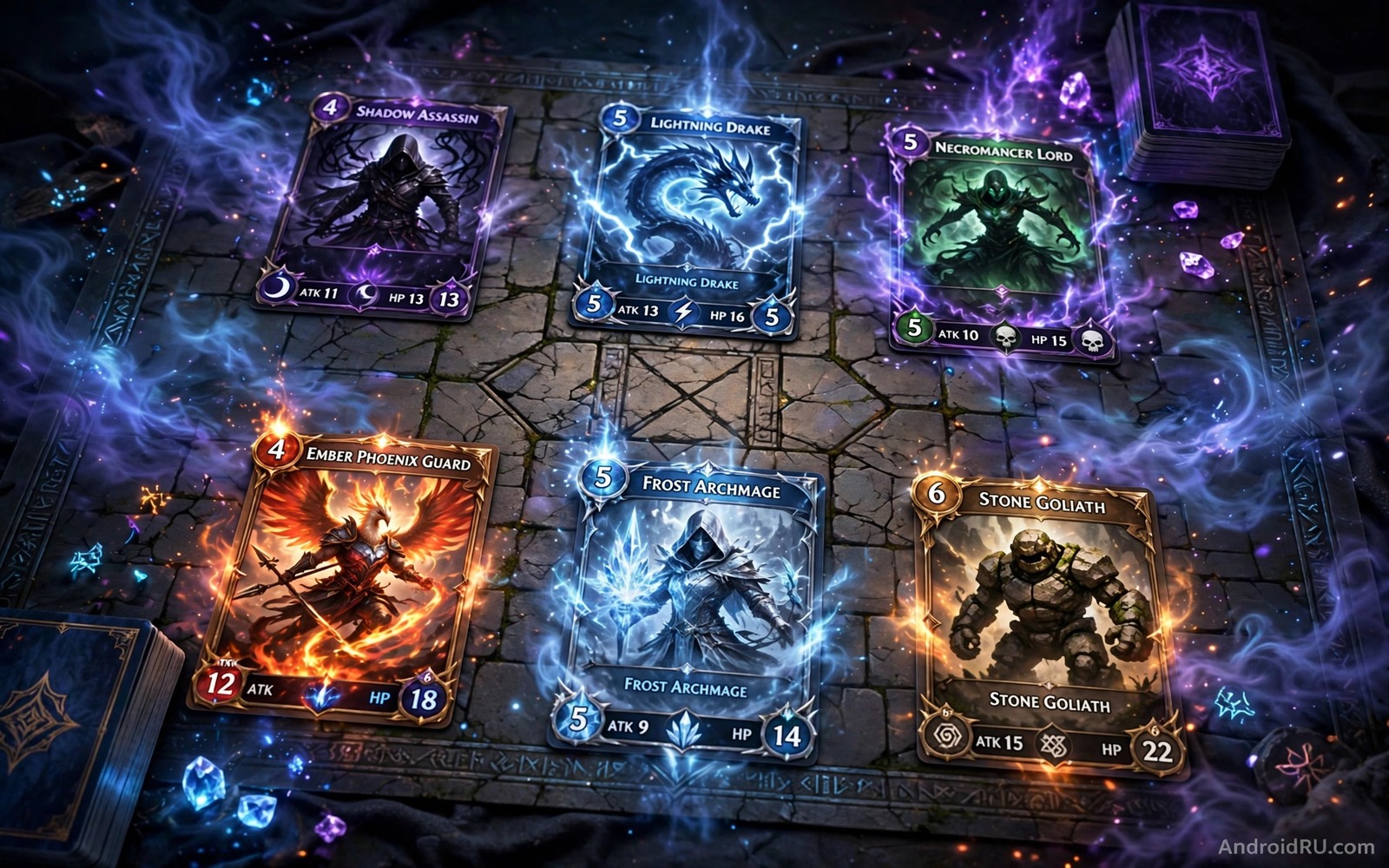
How Game Mechanics Keep Mobile Card Strategy Games Balanced
A good card game feels fair even when you lose. You can point to the turn where you spent too much, missed a counter, or held your best card too long. A bad card game feels rigged: one deck wins every match, one card answers everything, and your choices stop mattering. The difference between those two feelings is balance, and balance is not an accident. It is built from a handful of systems that work together, and once you can see them, you play better and you enjoy losing less.
I learned this the slow way, by copying a top deck, losing with it, and blaming the game. After a week of tracking my games, the pattern was clear: I was not losing to a broken card, I was losing to my own mana curve, to missing counters, and to changing five cards after every loss. This guide explains the four systems that decide most results, compares the games that use them best, and gives you a weekly plan you can follow in short daily sessions. It fits players who enjoy careful planning, and it works whether you play for twenty minutes a day or for a long weekend session. Players who enjoy careful planning will find that dungeon builder games sharpens the same habit in a faster setting with shorter matches and clearer feedback.
What Balance Means in a Mobile Card Strategy Game
Balance is what keeps a card game fun after the first week. One dominant deck kills variety fast, because everyone either plays it or plays the one deck that beats it, and every other idea disappears. Good balance gives many decks a fair chance to win, so your choice of deck, your timing, and your reading of the opponent decide the result more than the name on your deck list. Designers balance through costs and counters and limits: a strong card costs more or needs setup, a counter card keeps strong strategies honest, and rotation removes stale cards before they choke the game.
Why One Dominant Deck Hurts Everyone
When one deck wins far more than half its games, the whole game shrinks. Players stop trying new ideas, because trying a new idea means losing to the dominant deck. New players copy the dominant deck without understanding it, then lose to players who know its counters. The game becomes a test of who draws better, not who plays better. Designers watch win rates closely for this reason: a deck that wins about fifty-five percent or more of its games across many players is a warning sign, and a small change to one card can reopen the game for everyone.
How Designers Measure Balance With Win Rates
Designers do not guess. They track win rates by deck, by card, by rank, and by match length. A card that appears in almost every deck is a problem, even if its win rate looks normal, because it squeezes out choice. A deck with a high win rate at low ranks but a normal rate at high ranks is a different problem: it may be easy to play, not truly strong. When you read patch notes, look for those clues. A nerf to a card that appears everywhere is a health fix, not a punishment, and it usually makes room for decks you have not tried yet.
Mana Curves: The Cost System That Shapes Every Turn
Mana is the resource that limits what you can play each turn, and the mana curve is the shape of your deck across costs. Cheap cards shape the early game, mid-cost cards hold the middle, and expensive cards finish games that last long. A deck with only expensive cards does nothing for the first three turns and loses before it starts. A deck with only cheap cards runs out of power late and cannot answer a big threat. The mana curve of a balanced deck spreads costs across early and late game, so you have a useful play on most turns, not just on turn one or turn eight.
Building a Curve That Works Early and Late
Start with the early game. Pick cheap cards that contest the board or draw cards, so you are not waiting for turn four to do something. Then add mid-cost cards that answer the most common threats in your rank. Finish with one or two expensive cards that win long games. Test the deck for ten games before you change anything, and write down the turn where you felt stuck. If you felt stuck early, add a cheap card. If you felt stuck late, add a finisher. Changing one card at a time is the only way to know which change helped.
Counters and Matchups: How Strong Strategies Stay Honest
Every strong strategy needs a playable counter. Counters keep the game varied, because a strategy with no counter dominates until it is patched. A counter can be a single card that removes a key threat, a deck style that punishes slow play, or a timing choice that denies your opponent their best turn. Learning counters is not about memorising a list. It is about asking, before each game, what your opponent wants to do and what you have that stops it.
Hard Counters, Soft Counters, and Tech Cards Explained
A hard counter answers a threat cleanly, usually by removing it or cancelling it. A soft counter slows it down or trades evenly, so you survive long enough to win another way. A tech card is a narrow counter you add for one popular deck, and you accept that it is weak elsewhere. Use hard counters for threats that end the game if unanswered, soft counters for threats you can outlast, and tech cards only when one deck makes up a large share of your matches. If that deck fades from the ladder, cut the tech card and use the slot for a card that helps in more matches.
When to Hold a Counter and When to Play It Early
Hold your strongest counter until the moment it decides the game, if you can afford to wait. Playing it early wastes its surprise value and lets your opponent rebuild. Play it early only when waiting would cost you the game, for example when the threat would grow too large to answer next turn. Ask what your opponent fears most, and hold the answer until it counts. That patience turns a good card into a winning play, and it is a habit that transfers to every card game you play.
Rotation, Bans, and Power Creep Over Time
Rotation retires old cards to keep the card pool fresh. Fresh pools force new deck ideas, and rotation also limits power creep over time. Power creep is the slow rise in card strength: each new set must be a little stronger to sell, so old cards become useless and the game becomes a race to buy the newest set. Rotation breaks that cycle by removing the oldest set, so the power level resets and old strategies must be rebuilt with new tools. It can feel harsh when a favourite card leaves, but it is the reason a game can stay fresh for years.
How Rotation Keeps the Card Pool Fresh
After a rotation, the first week is the best time to experiment. Everyone is rebuilding, the best deck is not settled, and a simple idea can win because opponents have not learned its counters yet. Use that week to try two or three deck ideas in casual matches, track your win rate across ten games for each, and keep the one that fits your style. Do not spend heavily on the first day of a new set. Wait, watch what wins, and spend on the cards that appear in several good decks, not on one card that only fits one deck.
Matchmaking and Ranked Ladders Explained
Matchmaking pairs players by skill and deck strength, and fair matches teach faster than one-sided games. Ranked ladders sort players over many games, so your rank after fifty games means far more than your rank after five. Early in a season, ranks reset and strong players meet weaker players, so do not judge a deck by the first week. Play normally, record your wins, and let the ladder sort you. A balanced win rate near half your games means you are matched fairly, and that is the best place to learn.
Skill Rating, Deck Strength, and Fair Matches
Most games use a hidden skill rating as well as a visible rank. The rating moves up when you beat stronger players and down when you lose to weaker ones, and the matchmaker tries to pair players with similar ratings. Deck strength matters too: some games match you against decks of similar power, so a new player with a basic deck does not face a full collection every game. That is why a new deck can feel strong at first and then harder as your rating rises. The game is not turning against you, it is matching you against better players because you improved.
Marvel Snap, Clash Royale, Hearthstone, and Legends of Runeterra Compared
These four games teach balance in different ways, and each one is a useful example of the genre. Marvel Snap uses short three-minute matches, twelve-card decks, and locations that change each game, so the balance question is about snap timing and location play. Clash Royale uses real-time elixir, eight-card decks, and tower defence, so balance is about elixir trades and counter pushes. Hearthstone uses thirty-card decks, mana crystals, and hero powers, so balance is about curve and card draw. Legends of Runeterra uses twenty- or forty-card decks, spell mana, and champion level-ups, so balance is about resource banking and timing. None of these is the best game for everyone, and each one rewards a different kind of thinking.
| Game | Deck size and match length | Core resource | What balance depends on most | Best for players who like |
|---|---|---|---|---|
| Marvel Snap | 12 cards, about 3 minutes | Energy that rises each turn | Location variety and snap timing | Fast matches and bold reads |
| Clash Royale | 8 cards, about 3 minutes | Elixir that refills over time | Elixir trades and counter pushes | Real-time decisions and tower play |
| Hearthstone | 30 cards, about 10 minutes | Mana crystals that rise each turn | Mana curve and card draw | Classic deck building and long games |
| Legends of Runeterra | 40 cards, about 10 minutes | Mana plus banked spell mana | Resource banking and champion timing | Careful planning and long-term play |
| Marvel Snap vs Hearthstone | Short vs long matches | Energy vs mana crystals | Location luck vs curve consistency | Players choosing between speed and depth |
A Weekly Practice Plan That Builds Real Skill
Before you start, set one clear goal for the week. A single goal keeps practice focused. You might aim to scout earlier in every match, or to stop wasting resources on units you never use. Write the goal down and check it after each session. After your first week, try deckbuilding card games to practise a related skill without abandoning your main game or losing your current progress. Small focused sessions build habits that last, and a written goal makes progress visible.
Learning Days vs Testing Days in Your Week
On learning days, isolate one system per session. Start with mana curves and use it deliberately in three games. Then move to counters and notice how it changes your results. Isolated practice reveals cause and effect faster than changing everything at once. On testing days, play normally with your best deck and track your win rate across ten games. Do not change cards on a testing day. If you lose, write down the turn where the game slipped away, and save that note for the next learning day. Review your lessons each Sunday and pick next week’s goal from the error that appeared most often.
A Concrete Seven-Day Session Plan
Follow this plan for your first week, and repeat it with a new goal in week two. Each session is about twenty minutes, and each day has one clear job, so you never sit down wondering what to practise.
- Monday, learning: play three games focusing only on your mana curve, and note every turn where you had no useful play.
- Tuesday, learning: play three games focusing only on counters, and include two counter cards for the most common threat you meet.
- Wednesday, testing: play two normal games with your best deck, track wins and losses, and change nothing.
- Thursday, learning: read the latest patch notes, then play three games with one card swapped based on what changed.
- Friday, testing: play two ranked games, record your win rate, and write one lesson after each game.
- Saturday, learning: watch one strong player and copy one habit only, such as early scouting, then practise it in three games.
- Sunday, rest and review: review the week’s notes, pick next week’s goal, and play one relaxed game if you want to.
Common Mistakes That Cost New Players Games
Many of these mistakes appear in tablet strategy play too, so fixing them once improves results across several strategy styles at the same time. Keep your game updated but read update notes first, because updates can change balance and controls without warning. Update over Wi-Fi before sessions so downloads never interrupt play, and play in a quiet spot with do-not-disturb mode for matches that matter, because notifications break focus at key moments.
Copying Top Decks Without Learning Counters
A top deck is a tool, not a shortcut. The player who built it knows when to hold a card, when to trade, and when to give up a turn to win the next one. If you copy the list without that knowledge, you will lose games the original player would win, and you will blame the deck. Instead, pick one deck, stay with it for ten focused sessions, and learn its matchups one by one. Familiarity reveals small advantages that switching hides. Switch only after you can explain why your current choice loses, in one sentence, with a specific matchup and a specific turn in mind.
Frequently Asked Questions About Card Game Balance
Why do card games nerf popular cards?
Nerfs protect variety when one card dominates play. Dominant cards shrink deck choice for everyone, because every deck must either play that card or play the answer to it. A small nerf can reopen many strategies, and a nerf is usually a sign that the designers are watching win rates, not that they want to punish players who found a good deck. Keep the nerfed card if you like it, but test the deck again for ten games before you decide it is dead.
Is perfect balance possible in card games?
No, because new cards shift the game constantly, and players keep finding new combinations that designers did not foresee. Good balance means many viable decks, not identical cards. Perfect balance would make all cards feel the same, and deck building would lose its point. Judge a game by whether you can win with three or four different decks, not by whether every card wins equally often.
How often should balance patches arrive?
Regular small patches beat rare huge patches. Small changes let players adapt gradually, and a single card change is easy to test. Huge patches can destroy decks overnight and force everyone to rebuild at once. The best balance patch schedule is a small update every few weeks, with a larger rotation a few times a year, so the game changes enough to stay fresh but never so fast that your practice becomes useless.
When should I switch to a different card game?
Stay with one game until its core systems feel natural. Switching early resets learning before habits form, so give a new game at least ten focused sessions. Switch when progress stalls for three weeks despite practice, or when you no longer enjoy the game even after a break. Try a related style that uses the same skills differently, keep your old game installed, and return later with fresh perspective. Many players improve at an old game after a break, because the break fixes habits that grinding could not.
Start small and build one skill at a time. Card game balance becomes far more fun once the core systems feel natural, and the fastest way to get there is to track three numbers for two weeks: wins, average game length, and one repeated error. When the repeated error fades, your rank usually follows. Use this guide as a checklist for your next ten sessions, open your game tonight, and play three focused sessions using the plan above. Note one mistake after each session and fix it in the next one. That loop will do more for your results than any single purchase, and it will keep the game fair, fresh, and fun for months.

