

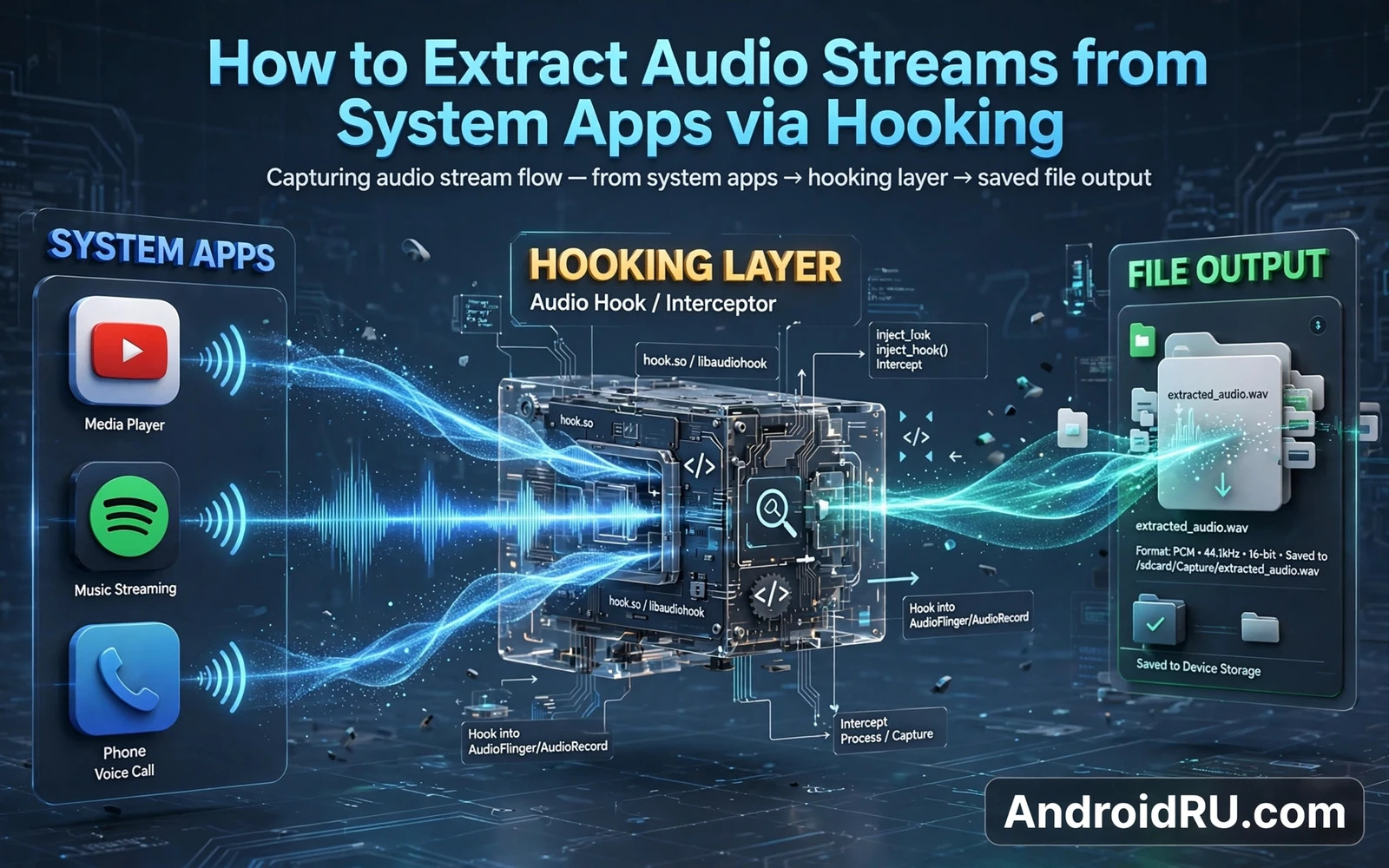
How to Extract Audio Streams from System Apps via Hooking
Audio extraction captures the digital audio data that an app plays or records, before it reaches the speaker or after it leaves the microphone. Hooking intercepts the audio buffer at a point in the audio pipeline where the data is accessible in a known format, and the captured buffer can then be written to a file for analysis. Extraction does not mean recording speaker output with a microphone. It means capturing the data stream itself, and that distinction matters for both quality and purpose.
System apps present a special case, because they may use privileged audio paths that ordinary apps cannot access. A hook in the audio framework or in the target app process can access those paths if the hooking framework has sufficient privilege, and access depends on the Android version and on the audio API the app uses. Older audio APIs expose buffers differently from newer low latency APIs, so format knowledge and API identification are essential before you build anything.
Extraction for testing is legitimate when the owner tests their own app or analyses audio behaviour on their own device with their own content. Extraction of copyrighted streams or private conversations without consent is not legitimate. The technical method does not change the legal context, so owners must decide the purpose before building the tool. This guide covers the legitimate testing use case only: capturing your own audio, on your own device, for analysis and debugging.
What Audio Extraction Means in Technical Terms
An app creates an audio track for playback or an audio record object for capture. The audio framework mixes tracks from multiple apps and sends the mixed output to the audio hardware abstraction layer. The hardware layer talks to the kernel driver that drives the speaker or the microphone. Hooks can sit at the app layer or at the framework layer depending on the goal. App layer hooks capture audio for a single app, while framework layer hooks capture mixed audio from many apps at once. App layer hooks are more precise and easier to attribute to a source. Framework layer hooks capture everything and require careful separation of sources. Precision usually beats breadth for testing purposes.
Buffer size affects capture quality and timing. Small buffers give low latency but require frequent handling. Large buffers are easier to handle but add delay. An extraction hook must keep up with buffer delivery or it will drop data, and dropped buffers produce gaps in the captured file. A hook that does heavy file writing inside the audio callback risks dropping buffers, so offload file writing to a separate thread. Sample rate conversion may be needed when the captured stream rate differs from the desired file rate, and conversion must preserve timing or the captured file will drift. Drift becomes noticeable in long captures where audio slowly falls out of sync with video, so test long captures explicitly rather than assuming that a short test proves long capture quality.
Format Metadata Decides Whether Captured Audio Sounds Right
Audio buffers carry sample rate, channel count, and sample format information. A captured buffer without correct format metadata sounds like noise when played back. A good extraction implementation reads the format from the audio track configuration rather than guessing it. Guessed formats produce distorted output that looks like a failure of the hook, when the real failure is metadata handling. Check sample rate, channel count, and sample format against the track configuration before you suspect the hook itself.
Why Guessed Formats Sound Like Noise
A buffer of 48 kHz stereo audio played back as 44.1 kHz mono sounds slowed down and distorted, even though every byte was captured perfectly. The data is fine and the interpretation is wrong. Reading format from the track configuration removes this whole class of false failures.
How Audio Flows Through Android
The audio path has four stages: the app creates a track, the framework mixes tracks, the hardware abstraction layer receives the mix, and the kernel driver drives the hardware. Each stage is a possible hook point, and the right point depends on what you need to capture. Capturing at the app buffer gives uncompressed audio from one app. Capturing at the framework layer gives mixed audio from many apps, including system sounds, unless you filter by source. Capturing after Bluetooth encoding gives compressed audio with lower quality, so owners who need analysis quality should capture as early as possible, while owners who need to study Bluetooth behaviour should capture later deliberately.
Microphone capture paths differ from playback paths, because they involve permission and privacy indicators. Modern Android shows an indicator when the microphone is in use, and a hook that captures microphone data should respect indicator behaviour rather than hiding it. Hiding a privacy indicator undermines user trust and may violate platform policy. Visible indicators are part of responsible capture design. System sounds and notification sounds mix with app audio at the framework layer, so a framework layer capture includes system sounds unless filtered by source, while an app layer capture excludes system sounds naturally. Layer choice determines contamination risk.
Java Audio APIs vs Native Audio APIs
Java audio APIs expose buffers through callbacks that a hook can intercept with relative ease. Native audio APIs expose buffers through lower level functions that require native hooking techniques. An extraction tool designed for Java APIs will miss native streams entirely, so owners should identify the API family before choosing a tool. API identification prevents wasted effort on an incompatible hook point. For related pipeline knowledge, the camera guide that explains how to redirect camera input to gallery videos using hooking covers the parallel video pipeline, and the same layer thinking applies to audio.
Setting Up an Audio Extraction Test Safely
Use your own audio content for testing. Generate a simple tone sequence or record your own voice with consent. Known test content makes it easy to verify that the captured file matches the source, while unknown content makes verification impossible because there is no reference to compare against. Scope the hook to the test app only, because a system wide hook captures audio from every app. A system wide audio hook captures audio from every app including messaging and calls, and scoped capture protects privacy and reduces the chance of capturing sensitive audio accidentally. Privacy protection should be designed into the test rather than added as an afterthought.
Back up the device before installing an audio hooking module. Audio framework hooks can affect calls and media playback across the system, and a backup lets you restore working audio quickly if the module breaks playback. Test calls and media playback after installing the module before starting any extraction test. Store captured files securely and delete test files when the test is complete, because captured audio can contain sensitive information even when the test content seems harmless. A test file left on shared storage can be accessed by other apps with storage permission, so secure handling is part of responsible testing.
Low Latency Paths Need Minimal Work in the Callback
Low latency audio paths use small buffers and strict timing. A hook that adds processing delay to a low latency path can cause glitches that the listener hears as clicks. Glitch free capture on a low latency path requires minimal work inside the audio callback, and heavy work must move to a worker thread. Thread design separates successful low latency capture from glitchy capture: the callback copies the buffer and returns immediately, while a separate thread writes the file, converts the format, and handles errors.
The Hooks Framework Behind Audio Hooks
Audio hooks sit on top of a hooking framework that intercepts method calls in the target process. The hooks overview that explains understanding Android system hooks and substrate architecture explains the framework that makes audio hooks possible, and the patching guide that explains how to patch Android apps to disable ads and tracking logs shows another precise hook use case. Together they help owners place audio extraction in its proper technical and ethical context.
Troubleshooting Audio Extraction Problems
If captured audio sounds distorted, check format metadata first. Check sample rate, channel count, and sample format against the track configuration. If metadata is correct, check for buffer drops by looking for gaps in the waveform: gaps point to a hook that cannot keep up, while distortion without gaps points to a format mismatch. If the target app produces no captured data, check whether the app uses a different audio API from the one hooked. Some apps use native audio paths that bypass the Java audio layer, and a Java only hook cannot capture a native only stream. API identification is therefore a required first step, not an optional one.
If system audio breaks after enabling the module, disable it and reboot immediately. Do not add a second audio module to compensate. Audio framework instability can affect emergency calls in extreme cases, and a phone that cannot make calls is not a suitable test device. Restore working audio before continuing any experiment. Never stack two audio modules to fix a broken one, because the second module only adds another failure point to an already unstable pipeline.
Reading Waveforms and Spectra to Find Capture Faults
Waveform visualisation helps identify gaps, clipping, and silence periods quickly. A visual scan of a waveform reveals problems that listening alone may miss: gaps appear as flat lines, clipping appears as flattened peaks, and silence appears as a long flat section. Spectral analysis reveals frequency content that waveform analysis hides: a tone that sounds pure may contain harmonics visible in a spectrum, and a voice recording contains formant patterns visible in a spectrum. Owners analysing audio behaviour should use both waveform and spectrum views, because each view answers different questions.
Storing and Analysing Captured Audio Properly
Captured audio files should use a lossless container during analysis to avoid compression artefacts confusing results. Lossy compression changes waveform details that analysis may misinterpret, so analysis should happen on lossless files, and lossy versions can be created later for sharing. Order matters, because lossy to lossless conversion cannot restore lost detail. File naming should include source app, capture date, and format parameters: descriptive names prevent confusion when many captures accumulate, and a descriptive name is self documenting. Self documenting files survive moves between devices better than index dependent files.
Sample format conversion during capture can introduce artefacts if done incorrectly. Converting between integer and float samples requires proper scaling, and incorrect scaling produces clipping or quiet audio that looks like a capture failure. Conversion code should be tested with known tones before use on real content, because known tone testing validates conversion independently of hook correctness. Long captures should be segmented for analysis, because a single huge file is hard to navigate. Segmentation by time or by event creates manageable pieces, each segment can be analysed independently, and segmentation makes it easier to share a relevant excerpt without sharing an entire long capture that may contain unrelated audio.
Secure Deletion After Analysis
Secure deletion of captured audio after analysis protects privacy. Standard deletion may leave data recoverable on storage media, while secure deletion methods overwrite file contents where the filesystem allows it. Owners handling sensitive captures should use secure deletion rather than ordinary deletion, because ordinary deletion removes the directory entry but not necessarily the data. Delete test files when the test is complete, and treat every capture as sensitive until you have confirmed it contains only your own test content.
Frequently Asked Questions About Audio Stream Extraction
Is it legal to extract audio streams from apps on my own phone?
Extracting your own audio, from your own app, on your own device, for testing and analysis is legitimate. Extracting copyrighted streams or private conversations without consent is not. The technical method does not change the legal context, so decide the purpose before you build the tool, and keep the scope limited to your own content.
Why does my captured audio sound distorted even though the hook works?
Distortion usually means a format mismatch, not a hook failure. Check sample rate, channel count, and sample format against the track configuration. If the format is correct, look for gaps in the waveform, which point to a hook that cannot keep up with buffer delivery. Fix the format first, then the threading.
Why does my hook capture nothing from a particular app?
The app probably uses a different audio API from the one you hooked. Some apps use native audio paths that bypass the Java audio layer entirely, and a Java only hook cannot capture a native only stream. Identify the API family the app uses before choosing a hook point.
Can audio hooking break phone calls?
Yes. Audio framework hooks can affect calls and media playback across the system, and in extreme cases instability can affect emergency calls. Test calls and media playback after installing any audio module, and disable the module and reboot immediately if audio breaks. Never test an audio module on a phone you depend on for emergency calls.
Audio extraction is a testing tool, not a recording shortcut. Capture your own content, scope the hook to one app, read the format from the track configuration, keep heavy work out of the audio callback, and analyse lossless files with both waveform and spectrum views. Your concrete next step is to generate a simple tone sequence, hook your own test app, and verify that the captured file matches the tone you generated. That single verified capture proves the whole pipeline works, and every later test builds on it.

