

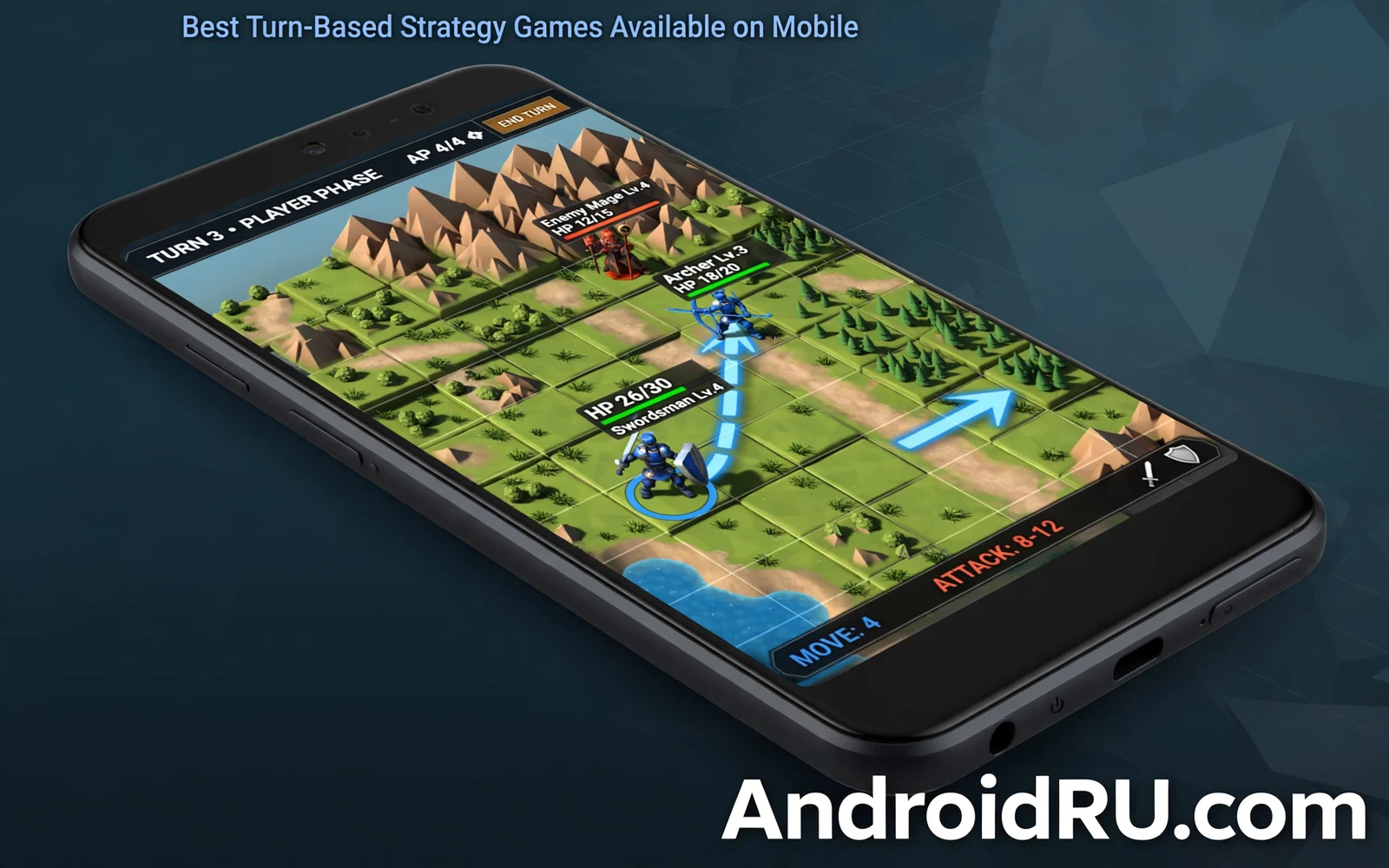
Best Turn-Based Strategy Games Available on Mobile
Some games demand fast thumbs. These do not. A turn-based strategy game waits while you think, and that single quality makes the genre a natural fit for a phone. You can study the map on a train, answer a message, and come back to the same battle without losing anything. I have played most of the games below on a mid-range Android phone over several years, in short bursts and in long evening sessions, and the ones that survived on my home screen all share the same trait: every move feels like a decision, not a reflex test.
This guide names seven real games you can play on mobile right now, explains how each one plays, and tells you who it suits. It also compares them on price, offline play, and depth, so you can pick one tonight instead of scrolling through a shop listing for an hour. If you have never played a tactics game before, start with the comparison table near the end, then jump to the game that matches your patience and your budget.
Why Turn-Based Strategy Games Work So Well on Mobile
A phone is an interruption machine. Calls, messages, and notifications arrive at the worst moments, and a real-time game punishes you for every one of them. Turn-based play removes that pressure completely. The enemy does not move while you check a message. A battle that takes forty minutes can be spread across a whole day in five-minute pieces, and nothing about the game gets worse for it. That respect for your time is the main reason the genre has grown so much on mobile.
The second reason is the touch screen itself. Tapping a square to move a unit, dragging to check an attack range, and pinching to zoom out over a map all feel direct in a way a mouse never quite matches. A good mobile tactics game is built around those gestures, with large tap targets and clear range highlights, so you rarely mis-tap a unit into danger. The bad ones port a PC interface unchanged and leave you fighting the controls instead of the enemy.
Playing in short bursts without losing your place
Short sessions work when a game saves constantly and shows you the state of a battle at a glance. The best titles on this list auto-save after every turn, and many of them show a short summary when you return: whose turn it is, which units are hurt, and what your objective is. That matters more than it sounds. I have abandoned tactics games simply because returning after two days meant re-reading a mission briefing and guessing what my plan had been. A game that respects short sessions never makes you reconstruct your thinking from scratch.
Session length also changes which game fits your life. A single Into the Breach battle takes about fifteen minutes, which fits a commute. A Civilization VI game can run for hours across many days, which fits a player who likes one long campaign. Neither is better in general. The right pick is the one whose session shape matches the gaps in your day, and the comparison table later in this guide lays that out side by side.
Tactics over reflexes: why planning beats fast thumbs
In a turn-based battle, a weaker army can win through position. High ground adds damage in XCOM. A narrow bridge in Bad North turns eight raiders into a manageable trickle. A flanking move in Into the Breach pushes an enemy into the path of its own attack. These systems reward reading the map, and they reward it every single turn. That is the core pleasure of the genre: a plan coming together three turns after you made it.
That said, planning only feels fair when the rules are visible. You should always know how far a unit can move, how much damage a skill will deal, and what happens when a turn ends. Hidden maths and vague tooltips ruin strategy, because you cannot plan around numbers you cannot see. The games below show ranges, damage previews, and status effects in plain language, and that clarity is a big part of why they made the list.
How to judge a tactics game before you install it
Before you spend money or time, check four things on the listing page. First, look for recent updates: a tactics game that has not been updated in two years may still work, but it may also break on a new Android version. Second, read recent reviews that mention controls, not graphics. Third, check whether the game works offline, since several of the best tactics games do and it changes where you can play them. Fourth, look at how the game charges: a single purchase with no timers is usually a better deal than a free game that sells energy.
How I Picked These Seven Turn-Based Strategy Games for Android and iOS
I started with a longer list of about twenty candidates, including several well-known PC tactics games that also exist on mobile. I cut anything that needed a constant connection for single-player, anything whose touch controls were clearly an afterthought, and anything that gated progress behind timers or energy systems. What survived are games I would still recommend to a friend today, not games that were good five years ago and have since been left behind.
Depth mattered, but so did honesty. A game earns a place here when its systems stay interesting after ten hours, when losing a battle teaches you something, and when the price you pay is the price you were told. Grid-based tactics is the thread that runs through most of these picks, though two of them bend the formula in interesting ways, and I have called that out in each verdict so you know what you are getting.
What counted: depth, clarity, and honest pricing
Three tests decided the final order. Depth: does the game still surprise you after the tutorial, with new units, maps, or enemy behaviour? Clarity: can you see ranges, damage, and objectives without guessing? Pricing: do you know what you are paying before you start, and does paying once actually buy the game? A title could be brilliant and still miss the list if it hid its real cost behind a free install, because that is the kind of surprise nobody enjoys on a phone.
Readers who want the wider empire-building side of strategy, where long-term planning matters as much as single battles, can explore the picks in Best Strategy Games for Android: Build Your Empire. That broader view pairs well with the focused squad battles covered here, and several games appear in both guides for different reasons.
The 7 Best Turn-Based Strategy Games Available on Mobile
Here are the seven, in an order that roughly follows how easy they are to pick up. The first three are the friendliest starting points. The last four ask more of you, and give more back. Every entry below covers how the game plays, who it suits, what it does well, what holds it back, and a short verdict, so you can compare them without installing all seven.
1. XCOM: Enemy Within
XCOM: Enemy Within is the full console tactics game, ported to mobile with its turn-based squad combat intact. You command a small squad of soldiers against an alien invasion, moving them across grid maps, using cover, and deciding when to take a risky shot. Between missions you research new weapons, build facilities in your base, and manage a world map where countries panic and leave your project if you ignore them. It is a single purchase, it works offline, and it is still the benchmark other mobile tactics games are measured against.
The gameplay loop has two layers that feed each other. On the battlefield, every soldier can move and act once per turn, and the famous cover system means a soldier behind a full wall is far safer than one in the open. In the base, every research choice and building placement shapes what your soldiers can carry into the next fight. A bad month of base management shows up on the battlefield as underpowered weapons, and a lost squad shows up in the base as empty barracks. That connection between layers is what keeps a campaign tense for dozens of hours.
Who it is for: players who want a serious, complete tactics campaign and do not mind losing soldiers to bad luck. The game is famously punishing, and a missed 90 percent shot can end a soldier you have trained for ten missions. If that sounds thrilling rather than annoying, this is your game.
- Pros: a complete campaign with no timers or energy systems, deep squad customisation, and genuine tension in every mission.
- Pros: works fully offline once installed, so it plays anywhere, including on flights.
- Cons: the touch interface is dense on small phones, and the difficulty spikes early for new players.
- Cons: a single purchase price that is higher than most mobile games, though it is often reduced in sales.
Verdict: the best first pick if you want one deep tactics game rather than several light ones. Start on Easy, accept that soldiers will die, and let the campaign teach you.
Best squad habits for new commanders
Keep soldiers in pairs so one can always cover the other, never dash a soldier into fog you have not scouted, and spend your first research on better armour before better guns. A soldier who survives a mission gains experience, and experienced soldiers are worth more than any weapon upgrade in the early game.
2. Into the Breach
Into the Breach is a small, perfect tactics puzzle from the makers of FTL. You control three mechs defending cities from giant insects, the Vek, on an 8 by 8 grid. Every battle is short, every enemy move is shown to you before it happens, and every turn is a puzzle with a visible solution if you look hard enough. The twist is that your goal is not to kill everything: it is to protect buildings, because each building lost costs you power, and losing all your power ends the run.
The game shows you exactly what each enemy will do next, including where it will attack and how much damage it will deal. That perfect information changes the whole feel of tactics. You are not guessing, you are solving. Pushing an enemy one square can make it attack its own ally. Blocking a spawn point can stop a Vek from appearing at all. A run lasts about an hour across several islands, and when it ends, one of your pilots carries their experience into the next timeline. It is the most replayable game on this list, and the cheapest to learn.
Who it is for: puzzle lovers and busy players. If you like chess problems and short sessions, this is the tactics game that respects your time most. If you want a story-heavy campaign, look at XCOM instead.
- Pros: perfect information makes every loss feel fair, battles last about fifteen minutes, and runs stay fresh through different mech squads.
- Pros: clean touch controls designed for small screens, and a low price for the depth on offer.
- Cons: the presentation is spare, with little story or character to carry you between runs.
- Cons: the short campaign can feel repetitive once you have beaten it with two or three squads.
Verdict: the smartest tactics game on mobile, and the best one to play in short bursts. Buy it if you want a game that makes you feel clever rather than busy.
3. The Battle of Polytopia
The Battle of Polytopia is a light, bright 4X strategy game that squeezes empire building into thirty-minute matches. You pick a tribe, explore a small square map, found cities, research technologies, and expand until you meet your neighbours and decide whether to trade, fight, or outscore them. Each turn you manage stars, the single currency that pays for units, buildings, and research, and every choice is a trade-off between growing now and defending later.
The genius of Polytopia is how much strategy it fits into so few rules. There is one currency, a short technology tree, and units with clear roles, yet matches still turn on scouting, timing, and map control. The base game is free with several tribes included, and extra tribes are sold as small one-time purchases. It works offline against AI opponents, and its online multiplayer is asynchronous, so a match can stretch across days with each player taking turns when they are free.
Who it is for: newcomers to strategy, and anyone who wants a tactics game they can finish on a lunch break. It is also the best game on this list to play with friends who do not usually play strategy games.
- Pros: matches are short and readable, the free version is genuinely generous, and asynchronous multiplayer fits real life.
- Pros: a calm, colourful look that stays clear even on a small screen.
- Cons: the AI is a soft opponent once you learn the basics, and the game is shallow next to Civilization VI.
- Cons: extra tribes cost money, and the best ones are not in the free set.
Verdict: the friendliest door into turn-based strategy on mobile. Start free, learn the stars economy, and buy a tribe only when you know which play style you enjoy.
Which tribe should beginners pick first?
Start with the free tribes and learn the map before spending anything. The Imperius tribe is a balanced pick for learning city growth, while Bardur teaches you to use forests for income. Avoid the naval tribes until you understand land combat, because water maps add a whole second layer of rules.
4. Sid Meier’s Civilization VI
Civilization VI on mobile is the full PC strategy game, and it is the biggest game on this list by a wide margin. You found a city in 4000 BC, research technologies, found religions, build wonders, and compete with rival leaders across thousands of years of history. Turns are taken one at a time, cities are built district by district, and victory can come through science, culture, domination, religion, or diplomacy. A single game can run for many hours, and the mobile version supports the same depth as the desktop original.
What makes Civilization VI special on a phone is that it never rushes you. You can take a turn, put the phone down for an hour, and return to a city that still needs its granary. The touch interface is the weakest part of the port: menus are dense, buttons are small, and a tablet is noticeably more comfortable than a phone. On a larger screen, though, it is a remarkable achievement, and the base game is free to try for a limited number of turns before a single purchase opens the full game.
Who it is for: patient players who want the deepest strategy game on mobile and own a tablet or a large phone. If you have never played a 4X game, Polytopia is a kinder first step.
- Pros: enormous depth with five different victory paths, dozens of leaders, and endless replay value.
- Pros: a free trial that lets you play the opening turns before you pay anything.
- Cons: the interface is cramped on small phones, and a full game can take ten hours or more.
- Cons: extra leaders and scenarios are sold separately, so the full collection costs more than the base game.
Verdict: the deepest strategy game you can carry in your pocket. Play it on the biggest screen you own, and treat each game as a week-long project rather than an evening.
5. Slay the Spire
Slay the Spire is a deck-building roguelike where every fight is turn-based, and it belongs on this list because its battles are pure tactics with cards instead of units. You climb a tower floor by floor, fighting enemies with a deck you build as you go. Each turn you draw five cards and spend energy to attack, defend, or apply powers, and each enemy tells you exactly what it intends to do next. Between fights you choose new cards, buy relics, rest, or take risks at events, and one wrong choice can end a run that lasted an hour.
The tactics here live in deck construction rather than positioning. A deck with too many attacks and no defence collapses against heavy hitters. A deck built around poison needs time to work, so it needs cards that buy that time. The game offers four characters with very different decks, daily climbs with shared modifiers, and a custom mode for experimenting. It is a single purchase, it works offline, and it is one of the most replayed games on mobile, because no two runs ever play the same way.
Who it is for: players who like building and refining a plan, and who enjoy losing a run and immediately starting another with a lesson learned. Card game sceptics should try it anyway: the tactics are the point, and the cards are just the language.
- Pros: endless replay value from random maps, cards, and relics, with four distinct characters to master.
- Pros: perfect information about enemy intentions keeps every loss fair and readable.
- Cons: the art style is plain, and the game explains its deeper systems poorly to new players.
- Cons: runs can last over an hour, which is awkward if you only have short gaps in your day.
Verdict: the most addictive tactics game here, and the best value per hour. Start with the Ironclad, learn to value defence cards, and expect your first ten runs to end in defeat.
6. Rebel Inc.
Rebel Inc. comes from the makers of Plague Inc., and it turns counter-insurgency into a turn-based strategy game about stabilising a region after a war. You are the governor of a province. Insurgents appear in remote areas and spread if you ignore them. You spend money on soldiers, roads, schools, and clinics, and you balance military action against the civilian support that actually wins the game. Push too hard with soldiers and locals turn against you. Spend everything on services and the insurgents take the map while you build.
The game plays out in real months with pauses for decisions, but every choice is turn-like in practice: where to send troops, which initiative to fund, when to negotiate. Maps are based on real regions, governors have different abilities, and difficulty ranges from gentle to brutal. It is a single purchase, it works offline, and it teaches a genuinely different kind of strategy from the rest of this list, because the enemy is not an army on a grid but an idea spreading through villages.
Who it is for: players who want strategy with a story and a moral weight, and who enjoy management games as much as battles. It also suits Plague Inc. fans who want the same tension pointed in the opposite direction.
- Pros: a fresh setting and a clever balance between military and civilian spending, with strong replay value across maps and governors.
- Pros: short, tense campaigns that fit into a few sittings, and a fair single price.
- Cons: the interface throws a lot of numbers at new players, and the learning curve is steep on higher difficulties.
- Cons: some scenarios can feel unwinnable once insurgents take root early, which frustrates careful players.
Verdict: the most original strategy game on this list. Play it when you want a thinking game with something to say, not just another battle.
7. Bad North
Bad North is a small, beautiful real-time tactics game with turn-like pacing, and it earns its place here because its battles are really a series of careful positioning decisions. You command tiny Viking islanders defending procedurally generated islands against raiders. You place squads on high ground, use choke points, and pull units back before they are overwhelmed. There is no base building and no technology tree: the whole game is about reading an island in ten seconds and placing your people in the right squares.
Each island is a puzzle. A squad of archers on a hill can hold a beach. A squad of shield-bearers in a narrow pass can stop twice their number. Between islands you spend coins on new units and upgrades, and you choose which island to defend next, knowing you cannot save them all. The art is minimal and lovely, the sound design is quiet, and a full campaign takes a few hours. It is a single purchase, it works offline, and it is the calmest game on this list.
Who it is for: players who want tactics without menus, and anyone who likes the idea of defending a place rather than conquering one. It is also a good pick for younger players, since the violence is abstract and the rules are simple.
- Pros: elegant, readable tactics with almost no learning curve, and a lovely art style that stays clear on any screen.
- Pros: short islands fit perfectly into five-minute sessions, and the game saves between every island.
- Cons: the strategy is shallow next to XCOM or Civilization VI, and the campaign is short.
- Cons: losing a veteran squad to one mistake can feel harsh, since replacements start weak.
Verdict: the prettiest and calmest tactics game here. Play it when you want a thoughtful ten minutes, not a campaign that takes over your week.
Turn-Based Strategy Games Compared: Price, Offline Play, and Depth
The table below puts the seven games side by side on the questions readers actually ask: what does it cost, can I play it without a connection, and how deep does it go? Prices change with sales, so treat the price column as the usual model rather than a promise: a single purchase means you pay once, a free start means the base game costs nothing and extras are optional. Check the current listing before you buy, since sale prices on mobile change often.
| Game | Price model | Offline play | Best for |
|---|---|---|---|
| XCOM: Enemy Within | Single purchase | Yes, fully offline | Deep squad campaigns |
| Into the Breach | Single purchase | Yes, fully offline | Short puzzle battles |
| The Battle of Polytopia | Free start, extra tribes paid | Yes, vs AI offline | Beginners and friends |
| Sid Meier’s Civilization VI | Free trial, then single purchase | Yes, fully offline | Long empire campaigns |
| Slay the Spire | Single purchase | Yes, fully offline | Endless replay value |
| Rebel Inc. | Single purchase | Yes, fully offline | Management and story |
| Bad North | Single purchase | Yes, fully offline | Calm five-minute sessions |
One pattern stands out: every game on this list works offline in single-player, which is rare for mobile games in general and one of the reasons the genre suits phones so well. Offline play is the feature I check first in any tactics game now, because a strategy game that needs Wi-Fi is a game you cannot play on a train, on a flight, or in a dead zone. If offline play matters to you, the wider set of options is covered in Best Offline Android Games That Don’t Require Wi-Fi, which is worth a look before a long trip.
Price is the other honest filter. Six of the seven games are single purchases, which means the price you see is the price you pay, with no energy timers waiting behind it. Polytopia is the exception, and its free start is genuinely generous rather than a demo with a paywall after ten minutes. Games that mix tactics with resource pressure and survival, like Rebel Inc. and Bad North, share DNA with the survival genre, and readers who enjoy that tension can find more of it in Best Survival Games for Android: Craft, Build, and Survive.
Best Turn-Based Strategy Games for Short Sessions and Long Campaigns
Session shape is the most practical way to choose. A game that needs an hour per sitting will frustrate you if your free time comes in ten-minute pieces, and a game built for five minutes will bore you if you sit down for a whole evening. The list splits cleanly into two groups, and most players will want one game from each.
When you have ten minutes
Into the Breach, Bad North, and Polytopia are the short-session picks. An Into the Breach battle is a single self-contained puzzle. A Bad North island takes about five minutes from landing to victory. A Polytopia match against the AI takes twenty to thirty minutes, but you can save mid-match and return later without losing anything. These three also share forgiving save systems: Into the Breach saves between islands, Bad North saves between islands, and Polytopia saves every turn. If your gaming time is the gap between stops on a commute, start here.
When you have a whole evening
XCOM, Civilization VI, and Slay the Spire are the long-session picks. An XCOM campaign is best played in hour-long sittings, because missions and base management flow together and stopping mid-mission breaks the tension. Civilization VI is a game of just-one-more-turn, and a single game can absorb an entire weekend. Slay the Spire runs last forty minutes to an hour, and the game is at its best when you can play two or three runs back to back and feel your deck sense improving. Rebel Inc. sits in the middle: campaigns take a few sittings, and each sitting can be as short as fifteen minutes.
Common Mistakes That Ruin a Turn-Based Strategy Run
Most lost campaigns are not lost to bad luck. They are lost to habits that feel safe and are not. The three mistakes below show up in every game on this list, and fixing them will improve your results faster than any guide to a specific title.
Moving every unit before thinking
The most common error is moving a unit the moment its turn begins. In almost every tactics game, the order of moves matters more than the moves themselves. Scout with a fast unit first, so you know where the enemy is before you commit your heavy units. In XCOM, that means moving one soldier forward to reveal enemies, then deciding with the rest. In Into the Breach, it means checking every enemy attack preview before moving a single mech. A thirty-second pause before your first move saves more campaigns than any upgrade.
Ignoring terrain and range
New players fight the enemy. Experienced players fight the map. High ground, cover, choke points, and attack range decide more battles than raw stats do, and the games on this list are all built around that idea. In Bad North, a hill is worth two extra soldiers. In Polytopia, a mountain pass is worth a wall. In Slay the Spire, the terrain is your deck, and the equivalent mistake is playing attack cards without thinking about what the enemy will do next. Before every turn, ask one question: what does this square give me that the next square does not?
Frequently Asked Questions About Turn-Based Strategy Games on Mobile
What is the best turn-based strategy game for beginners on mobile?
The Battle of Polytopia is the best starting point, because it is free to try, its rules fit on one screen, and a match takes about half an hour. Into the Breach is the second-best choice: it costs little, its battles are short, and its perfect information means you always know why you lost. Start with Polytopia if you want empire building, and start with Into the Breach if you want squad puzzles.
Can I play turn-based strategy games on mobile without Wi-Fi?
Yes, all seven games in this guide work offline in single-player once installed. XCOM, Into the Breach, Civilization VI, Slay the Spire, Rebel Inc., and Bad North need no connection at all for their campaigns. Polytopia works offline against AI opponents, and only its online multiplayer needs a connection. That makes the whole genre a strong choice for flights, trains, and places with weak signal.
Are turn-based strategy games on mobile free?
Most of the best ones are paid, usually as a single purchase between a few dollars and the price of a cheap lunch, with sales cutting that price often. Polytopia is the exception, with a genuinely free base game and optional tribe purchases. Free tactics games do exist, but many of them sell energy or timers, which is why this guide leans toward single-purchase games: you pay once, and the game never asks again.
Do turn-based strategy games work well on a small phone screen?
It depends on the game. Into the Breach, Bad North, and Polytopia were designed with small screens in mind and play well on any phone. XCOM and Slay the Spire are playable on a phone but more comfortable on a larger one. Civilization VI is the hardest case: it works on a phone, but its menus are dense, and a tablet is noticeably better. If you only have a small phone, start with the first three games and work up from there.
Which Turn-Based Strategy Game Should You Start With Today?
If you read this whole guide and still cannot decide, here is the short version. Pick Polytopia if you have never played a strategy game and want to learn for free. Pick Into the Breach if you want the cleverest tactics in the shortest sessions. Pick XCOM if you want one big campaign to live in for a month. Pick Slay the Spire if you want a game you will still be playing a year from now. Turn-based tactics on mobile rewards patience more than spending, and the best game for you is the one whose session length matches your day, not the one with the highest review score.
Install one game tonight, play three sessions before you judge it, and pay attention to how it feels on your third day, not your first hour. A tactics game that is still interesting after the tutorial ends is a game worth keeping, and all seven games above passed that test on my phone. Your next move is the easy one: pick the game that fits your time, start a campaign, and let the game teach you its rules one turn at a time.

