

Why Cards Make Great Mobile Strategy
Cards make great mobile strategy because a hand of cards is a set of choices you can read at a glance. You do not need fast reflexes to enjoy a card battle. You need planning and memory and nerve. A good card game turns each turn into a small puzzle where the right play depends on your hand and your deck and your opponent and the board state. That density of choice fits a phone perfectly because you can think while you tap and pause without penalty.
Deckbuilding adds a second layer of strategy beyond single battles. You start with a simple deck and add cards as you progress through a run. Each new card changes what your deck can do. A card that looks weak alone may become powerful with the right companions. A card that looks strong may clog your draws if it costs too much energy. Learning to build a coherent deck is a skill that grows over many runs and keeps the genre fresh long after the rules feel familiar.
Core Mechanics Every Player Should Learn
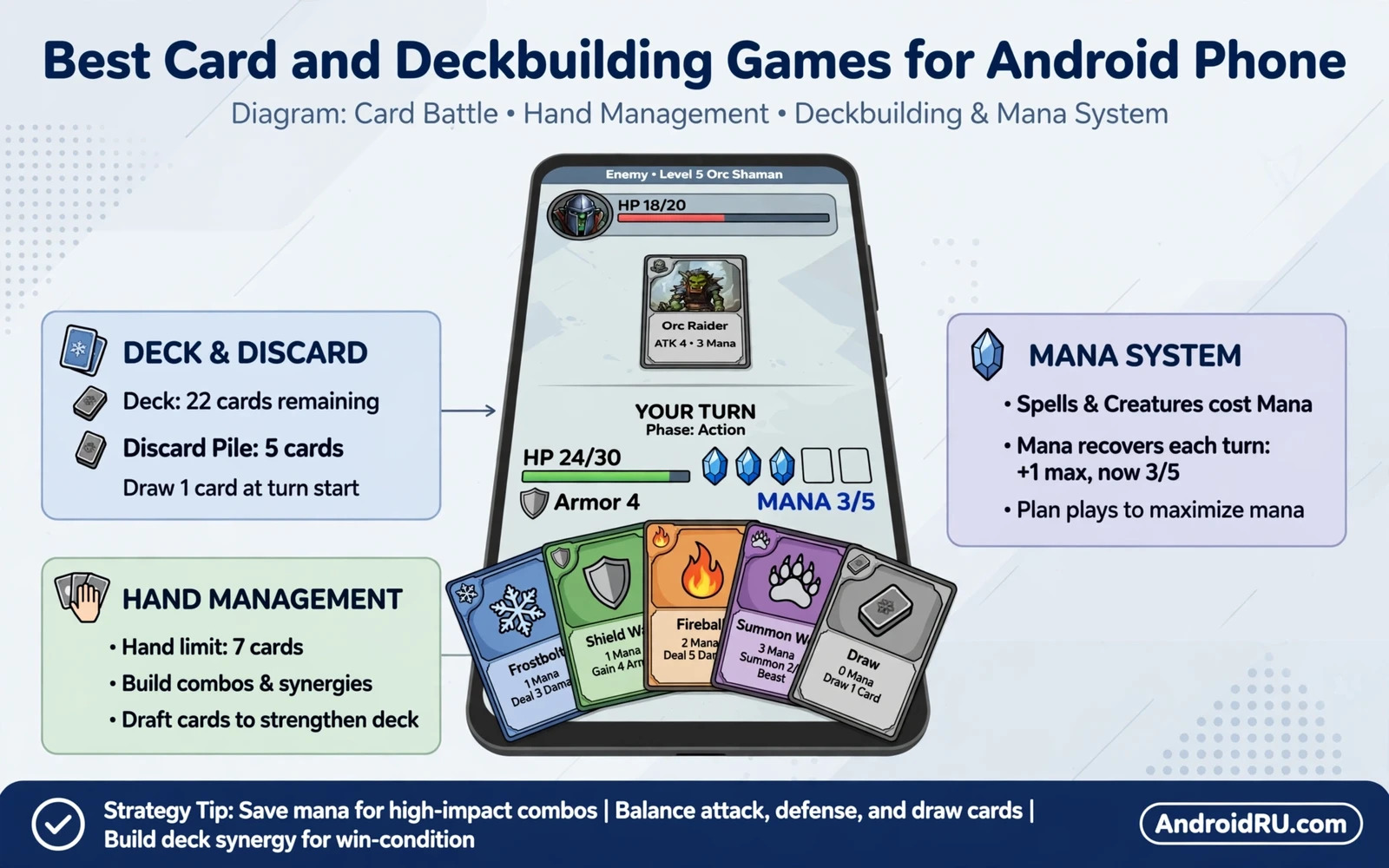
Energy management is the first mechanic to master. Most card games limit how many cards you can play each turn through energy or mana. A powerful card that costs all your energy may leave you defenceless. A cheap card played at the right moment may set up a winning turn later. Good players plan energy across turns rather than spending everything at once. They also learn when to pass or defend instead of attacking because survival often matters more than damage.
Draw and discard shape every run. A deck that draws its best cards reliably beats a deck filled with random power. Thinning weak starter cards can improve consistency. Keeping a balanced mix of attack and defence and utility prevents dead hands where no play feels useful. Watch your draw pile as a resource rather than a mystery. The best deckbuilders reward players who track what remains and plan around the next draw.
Strategy players who enjoy long term planning will also like the empire picks in Best Strategy Games for Android: Build Your Empire because resource discipline matters in both genres. A careful planner wins in cards and in kingdoms through the same habits.
Roguelike Deckbuilders And Single Runs
Roguelike deckbuilders are a popular mobile format because each run starts fresh and ends with lessons. You may fail a run early and still feel progress because you learned a new combo or a new enemy pattern. That loop suits short sessions because a run can be paused and resumed. It also suits experimentation because a failed deck costs only time rather than a permanent collection. Players who fear commitment love this format because every run is a clean slate.
Enemy variety keeps roguelike runs honest. A deck that crushes one boss may struggle against another boss with different mechanics. Adapting mid run is a core skill. You may need to add defence cards against a heavy hitter or add removal cards against swarms. Rigid decks fail when the game changes its questions. Flexible decks that can answer many threats tend to climb further. That adaptability is the true mark of a skilled deckbuilder.
Turn based thinkers can sharpen the same skills through Best Turn-Based Strategy Games Available on Mobile where positioning and timing add another dimension to careful planning. Card players who study tactics broadly become harder to beat in any format.
Collection Card Games And Fair Progression
Collection card games differ from roguelike deckbuilders because you build a permanent collection over months. You may open packs and craft cards and trade resources for specific pieces. That long term collection gives a sense of ownership that single runs cannot match. It also creates a fairness question. A game should let dedicated free players build competitive decks over time. A game that locks competitive play behind constant spending fails its players no matter how beautiful its cards look.
Judge a collection game by its crafting and reward systems. Daily quests should give meaningful progress. Duplicate cards should convert into useful crafting material rather than vanishing value. New player rewards should help you build at least one solid deck rather than a pile of random cards. Events should offer fun formats and fair rewards rather than only paid advantages. A transparent system builds trust and trust keeps a community alive for years.
Playing Without A Connection
Many card games work well offline when they focus on single player runs or campaigns. Offline play suits travel and quiet sessions where a connection is unreliable. Check whether a game needs a server check before each battle because some titles look single player yet require constant connectivity. A truly offline friendly card game respects your signal and your battery and your time. It also tends to load faster and crash less because fewer network steps stand between you and the next turn.
Offline modes also help learning. You can replay a tough battle and study your mistakes without ranked pressure. You can test a new deck against AI opponents before taking it into multiplayer. That practice space builds confidence. Use it freely before you enter competitive modes where every misplay costs ranking points and patience.
Offline friendly players will find kindred picks in Best Offline Android Games That Don’t Require Wi-Fi because the same design respect appears across genres. A game that works anywhere earns a permanent place on a phone.
Multiplayer Duels And Tournament Mindset
Multiplayer duels test your deck against human creativity rather than scripted AI patterns. Humans bluff and adapt and exploit habits that AI opponents ignore. A strong duel player studies the current meta without copying it blindly. The meta tells you which decks are popular but your own deck should still fit your style. A control deck suits a patient player. An aggressive deck suits a fast player. A combo deck suits a player who loves intricate setups. Fit matters more than fashion.
Tournament mindset also means accepting variance. Card draws involve luck and even a perfect deck loses sometimes. Good players focus on decision quality rather than single results. Did you play the best line available with the information you had. Did you manage risk across the whole match. Those questions matter more than one unlucky draw. Over many matches skill dominates luck and that long view keeps frustration in check.
Puzzle minded card players can cross train with the logic picks in Best Puzzle Games for Android to Train Your Brain because pattern recognition and forward planning help in both arenas. A sharper mind reads boards faster and spots winning lines sooner.
Building Your First Winning Deck
Start with a simple plan and a clear win condition. Decide how your deck wins before you add flashy cards. A deck may win through steady damage or through a late combo or through outlasting the opponent. Every card should serve that plan or answer a common threat. Cut cards that only work in rare situations because they dilute your draws. A focused deck of moderate size usually beats a large deck filled with unrelated ideas.
Test your deck in low stakes modes and track which cards feel dead in hand. Remove dead cards first and add cards that solve real problems you faced. Repeat that cycle after each session. Deckbuilding is iteration rather than inspiration alone. A deck that improves a little each week will eventually outperform a deck built once and never revised. Patience and honest review are the quiet superpowers of card gaming.
Mistakes That Cost New Players Games
One common mistake is playing every card as soon as possible. Holding a key card for the right moment often wins more games than spending it early. Another mistake is ignoring defence while chasing damage. A player with low health cannot enjoy a strong hand. A third mistake is building around a single combo without backup plans. When the combo fails the deck collapses. Always include a secondary path to victory.
A final mistake is blaming luck for every loss. Luck matters but review matters more. After a loss ask which decision you would change with hindsight. That habit turns random outcomes into lessons. Over time your decisions improve and your win rate follows. Card games reward reflective players who treat each match as a classroom rather than a lottery.
Reading The Meta Without Copying It
The meta describes which decks win most often in competitive play. Reading the meta helps you understand threats you will face and cards you must answer. Copying the meta blindly helps less because a copied deck may not fit your style or your collection. Use meta knowledge to inform your own builds rather than to replace your judgement. Adapt a popular idea to your strengths and keep a personal twist that opponents cannot predict from a public list.
Meta knowledge also changes with balance updates and new card releases. A dominant deck today may fade after a single patch. A forgotten archetype may return when new support arrives. Stay flexible and keep several decks ready for different matchups. Flexibility beats loyalty to one deck when the environment shifts. The best card players treat the meta as weather to navigate rather than as law to obey and they adjust sails whenever the wind changes.
Draft Modes And Building Under Pressure
Draft modes test deckbuilding under pressure because you choose cards one pack at a time without a full collection. Each pick shapes the deck that follows. A strong early pick may commit you to a strategy. A flexible early pick keeps options open. Draft skill means reading signals from offered cards and recognising which strategy the draft supports. That reading skill transfers to constructed play where flexibility also matters.
Draft games suit mobile sessions because a draft and a few matches fit a commute. Mistakes in draft cost only that run rather than a permanent collection. That low stake environment encourages experimentation with unusual combinations. Try a strategy you would avoid in constructed play and learn its strengths firsthand. Draft freedom teaches deckbuilding faster than theory alone because every lesson arrives through play.
Review drafts after they end and ask which pick you would change with hindsight. A single changed pick often alters the whole deck direction. That review habit builds draft intuition over time. Soon you will recognise strong picks instantly and avoid traps that once looked tempting. Draft mastery feels like learning a language where each card is a word and each deck is a sentence.

