

Download APK Cars Racing Games for Kids Feature Guide, Update Benefits & Review
I opened Cars Racing Games for Kids on a Tuesday morning while my phone was still on charge. I had ten minutes before I needed to leave the house, and the first screen felt calm. I did not have to hunt for the main feature, and that small start made me want to stay a little longer. A few weeks later it had become a normal part of my day, the kind of game I open without thinking hard about it, and that easy return is high praise for any app built for children.
This guide covers what the game actually offers, how the latest update changes play for young drivers, how to set it up for a child, and an honest review with pros and cons from a parent’s point of view. I also compare it with GPro Classic Racing Manager and Ras Racing and Sports, so you can see when a child is ready for a deeper racing game and when the simple loop here is still the better choice. Everything below comes from real use: short sessions at home, quick races while waiting, and watching a less confident player learn the controls without help.
What Cars Racing Games for Kids Is and Who It Is Made For
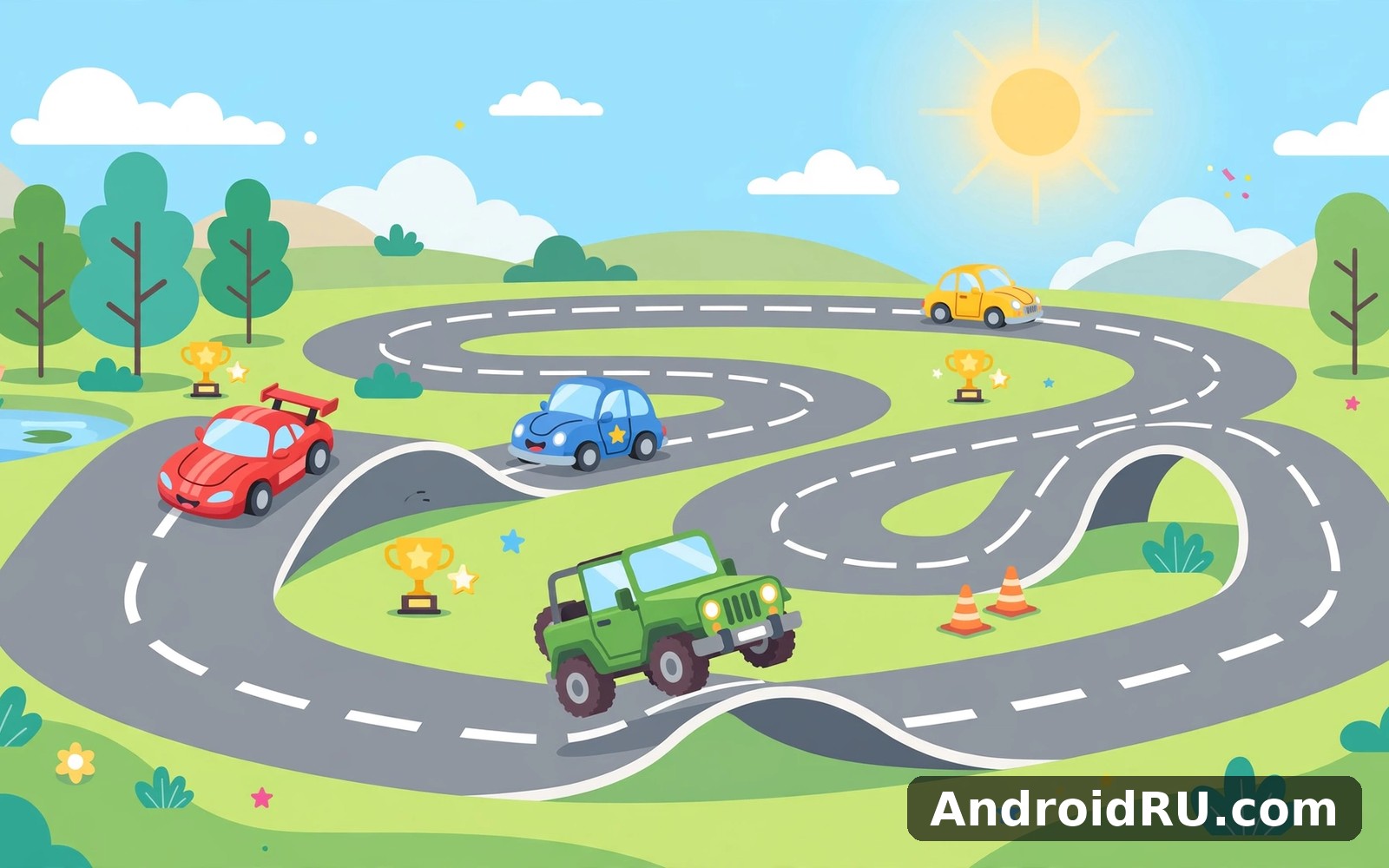
Cars Racing Games for Kids is a racing game built around young players. The races are short, the cars are bright and easy to tell apart, and the controls stay simple enough that a child can learn them in one sitting. It does not ask for reading skill, quick reflexes, or knowledge of racing rules. It asks only for a tap or a tilt at the right moment, and it rewards that with visible progress, new colours, and the small thrill of crossing a finish line.
The game fits into short gaps in the day. I use it while waiting for a kettle to boil or while sitting in a parked car, and those small moments add up without turning into a chore. A few minutes here and there feels enough, because each race is short and each session ends with something to show for it. That rhythm suits children well too, since a race that lasts two or three minutes fits a young attention span far better than a twenty minute event that demands patience a child does not have yet.
Short races built around young players
Each race is short by design. A child picks a car, picks a track, and is racing within seconds, with no long menus or loading waits in between. The finish comes quickly enough that losing a race does not sting for long, and winning one feels like a real event rather than a grind. That pace keeps the game friendly for beginners, because the cost of a mistake is one short race rather than a long session wasted.
The layout stays simple even when you return after a gap. You do not need to relearn the app each week, and progress and recent activity are easy to spot. That predictability feels comforting in practice, and it matters for children who come back to a game after days away and want to find their favourite car exactly where they left it.
Controls a child can learn in one sitting
The simple touch controls are the heart of the game. Steering, speed, and braking are kept to a few big, clear inputs, so a child can focus on the race instead of on the buttons. I watched a friend who is less confident with phones manage the main feature without my help, and that told me more than any feature list could. An app that works for a nervous beginner will work for almost anyone, and simplicity here is a real strength rather than a missing feature.
Cars Racing Games for Kids Features: Cars, Tracks, and Controls
A useful strength of this game is how it keeps its best tools close at hand. You do not dig through layers to reach the cars or the tracks, and shortcuts and recent items save time on repeat visits. That design suits daily use very well, because a child who opens the game wants to race, not to navigate menus. The features below are the ones that shape daily play, and they are worth knowing before you hand the phone over.
Customisation is present but it does not take over the experience. You can adjust a few settings to suit your taste, and the defaults work well for most people. I changed only two settings in my first week, and the rest stayed as they were. That balance is hard to get right, and this game gets close: enough choice to feel personal, not so much that a child gets lost in options.
Car choices and colours that keep children interested
The car selection is built around variety a child can see at a glance. Different colours, shapes, and styles give each car its own character, and picking a favourite becomes part of the fun before the race even starts. A child who loves a bright red car will race it again and again, and that attachment is what brings them back tomorrow. New cars and colours earned through play give a gentle reason to keep racing without turning progress into a chore.
Each car feels a little different on the track, but the differences stay small enough that no single choice punishes a beginner. That matters, because a young player who picks a car for its colour should not discover that the choice made the race unwinnable. The game keeps the gap between cars narrow, so the fun stays in the driving rather than in picking the right vehicle.
Tracks, laps, and gentle difficulty
The tracks are short loops with clear turns, bright scenery, and few surprises. A child can learn a track in one or two races, and that familiarity builds confidence fast. Laps are kept short, so a race never drags on past the point where a young player loses interest. The difficulty rises gently as well: early races are forgiving, and later ones ask for a little more care with steering and timing, but the step up never feels like a wall.
That gentle curve is the difference between a game a child keeps and a game a child drops after a day. When the challenge grows slowly, each small win feels earned, and the next race feels reachable. When the challenge jumps suddenly, children stop playing rather than pushing through, and this game avoids that trap by keeping each new track only a little harder than the last.
Sound, speed, and other settings parents can adjust
Check the sound and speed settings together in the first week. A reminder that arrives at a busy hour will get ignored and then resented, and the same logic applies to game sound at bedtime or in the car. Turn the sound down or off for quiet times, and keep the speed setting where your child feels in control rather than overwhelmed. One setting tweak early on can make the whole game feel calmer, and changing one setting at a time lets you see how it feels for a few days before you touch the next one.
What the Latest Update Changes for Young Players
Updates to a children’s game should make play smoother, not stranger, and the latest update to Cars Racing Games for Kids follows that rule. The changes focus on the parts of the game a child touches every day: how races start, how cars and tracks are picked, and how progress is shown after each race. Nothing in the update asks a young player to relearn the game. The familiar loop stays in place, and the improvements sit quietly underneath it, which is exactly how an update to a kids’ game should behave.
In daily use, the update shows its value in small ways. Races start a little faster, the menus feel tidier, and the screen after a race makes it clearer what the child earned and what comes next. Those are not dramatic changes, but they add up across a week of short sessions. A game that respects a child’s time and attention earns its place on the home screen, and this update moves the game in that direction rather than away from it.
Update benefits worth checking after you install
-
Quicker race starts. Less waiting between picking a car and driving it means more of a short session is spent actually racing.
-
Clearer progress after each race. Children can see what they earned and what is next without needing a parent to explain the screen.
-
Tidier menus for cars and tracks. Favourites are easier to find, so a child spends less time hunting and more time playing.
-
Smoother play on older phones. Short sessions feel more stable, which matters when the game runs on a hand-me-down device.
-
Small fixes to everyday annoyances. Little rough edges in menus and race screens have been polished, so the game feels more finished than before.
After an update, it is worth playing one race yourself before handing the phone to a child. Check that the sound level, the speed setting, and the car selection are all as you left them, because updates sometimes reset a setting to its default. That one minute check avoids a confused child and a race that feels suddenly different for no clear reason.
How to Set Up Cars Racing Games for Kids for a Child
Setting up the game takes minutes, not an afternoon, and most of that time is best spent playing one race together first. A child who watches a race before playing one understands the controls far faster than a child who is handed the phone cold. The steps below give you a calm first session and a setup that will hold up for weeks without further fiddling.
-
Install the game and open it yourself first. Look through the main screen, find the settings, and note where the sound and speed controls live.
-
Pick a car together with your child. Let colour and shape decide, because the cars are close enough in performance that the favourite is the right choice.
-
Play the first race yourself while your child watches. Talk through the steering and the finish line as you drive, so the controls make sense before small hands take over.
-
Hand the phone over for a short race on the easiest track. Stay nearby, but let your child make mistakes and finish the race without taking over.
-
Set a simple daily limit together before the second session. A clear limit agreed in advance causes far fewer arguments than a limit invented mid-race.
-
Move the game to a visible spot on the home screen. Out of sight meant out of mind for me in the first week, and a visible app gets used while a hidden app gets forgotten.
A first race together: what to show before handing over the phone
Show three things in that first race: how to steer, how to slow down for a turn, and where the finish line is. Those three facts carry a child through the first week. Skip the rest until it comes up naturally, because a long lesson before the first race drains the excitement that brought the child to the game. I suggest starting small on day one: pick one feature and use it well before trying everything, since that habit helped me learn faster than jumping between menus. By day three I knew where everything lived, and a child learns the same way.
Keep your routine tied to something you already do each day. I linked my session to my morning coffee and that anchor did most of the work: when coffee happened, practice happened too. For a child, the same trick works with an after-school snack or the quiet time before dinner. If you miss a day, just restart the next morning without a guilt spiral, because the game does not scold you or reset your progress. It simply shows you where you left off and lets you continue, and that gentle welcome makes returning easy.
Cars Racing Games for Kids Pros and Cons: A Parent’s View
My overall review is positive, and it comes from daily use rather than a quick glance. The game feels honest about what it does. It does not promise more than it can deliver, and that honesty is rare enough to value. The clear strength is consistency: the app makes showing up easy, it rewards small effort in a visible way, and I never felt punished for missing a day. That balance between encouragement and pressure feels well judged, and it is the main reason the game stayed on my phone.
That said, the game is not deep, and it does not try to be. The honest strain is depth for advanced users: short race sessions can only carry you so far before you need longer material elsewhere. That is not a failure of the game. It is a sign that a player has outgrown the beginner loop, and I see this game as a strong daily base rather than a complete school for racing.
Pros: what young players enjoy most
-
Simple controls a child learns fast. Big, clear inputs keep the focus on racing instead of on the buttons.
-
Short races that fit young attention spans. A race ends before boredom sets in, and the next one starts quickly.
-
Bright cars and tracks with clear choices. Picking a favourite car is part of the fun, and variety keeps children coming back.
-
Gentle difficulty that builds confidence. Early races forgive mistakes, and later ones ask only a little more each time.
-
A calm return after a gap. The game shows where you left off without scolding you for missing a day.
Cons: where the game feels thin
-
Limited depth for older or skilled players. Children who master the tracks quickly will want longer races and deeper challenges that this game does not offer.
-
Repetition over long sessions. The same short loops can feel samey after an hour, so the game suits short daily play better than long sittings.
-
Little for parents to do alongside. There is no shared mode to speak of, so a parent who wants to race with a child will need to take turns on one phone.
Who it is for, and which children will outgrow it fast
This game is for young children who want the joy of racing without the complexity of a full racing simulator. It suits ages roughly five to nine best, though the exact fit depends on the child: a careful seven-year-old will love it, and a racing-mad ten-year-old may find it too easy within a week. It also suits parents who want a calm, simple game they can hand over without worry, and children who are new to phones and need a first game that does not overwhelm them.
Children who already play deeper racing games will outgrow it fast, and that is fine. A game that serves as a first step does not need to serve as the last step. When a child starts asking for car upgrades, team management, or longer championships, that is the moment to look at a deeper racing game rather than to ask this one to become something it is not.
Cars Racing Games for Kids vs Other Racing Games for Young Players
When a child is ready for something different, the next game depends on what they want more of. Some children want longer races and real tracks, while others want to manage a team or follow a sport. The table below compares Cars Racing Games for Kids with two very different alternatives on the same criteria, so you can judge which one matches your child’s age and interests.
| Criterion | Cars Racing Games for Kids | GPro Classic Racing Manager | Ras Racing and Sports |
|---|---|---|---|
| Age fit | Young children, roughly five to nine | Older players who enjoy strategy and planning | Older children and teens who follow racing |
| Controls | Simple touch controls, learned in one sitting | Menu-based team decisions, no driving controls | Varied, with more to learn before racing |
| Race length | Short races of a few minutes | Long seasons built from many decisions | Longer events and sports coverage |
| Depth and challenge | Gentle curve, easy to finish races | Deep management: cars, drivers, tactics | Broader sports content beyond one race type |
| Best for | A first racing game for a young child | Players who like managing a racing team | Young fans who want more racing to follow |
If you enjoy games and play then Likee is a natural next app to try. It offers a different angle on the same kind of activity, with live chat and party games rather than racing. When you want a change of pace then GPro Classic Racing Manager covers that need neatly, because it swaps driving for team management. And for a third option Ras Racing and Sports is worth a look as well, since it covers racing and sports more broadly. I still came back to Cars Racing Games for Kids for my daily routine, because the other apps are useful but they did not replace the simple loop I built here.
When a child is ready for a deeper racing game
The sign is not age but appetite. When a child finishes every track, asks how cars can be improved, or wants to know what happens between races, the simple loop has done its job and a deeper game will feel like a reward rather than a jump. GPro Classic Racing Manager is a good next step at that point, because it keeps the racing theme while adding decisions about cars, drivers, and tactics. Let the child try it in short sessions first, just as they did with this game, and keep the simple racer on the phone for days when only a quick race will do.
Screen Time, Safety, and Keeping Play Balanced
For games and play, I found that consistency beats intensity every time. A few minutes each day built a clearer picture than one long burst on Sunday, and the game rewards that steady pattern with visible progress. I could see small wins stack up over days and weeks, and those wins kept me motivated when novelty faded. The same pattern works for children: a short daily race becomes a habit they look forward to, while a long session on a tired evening teaches them far less and leaves them cranky.
Timing matters more than effort. A short session when a child is fresh gives more than a long session when they are tired, so I stopped forcing long sessions on busy evenings. Instead I saved exploration for weekends and kept weekdays short. That rhythm felt sustainable and it kept the game enjoyable rather than stressful, and it is the single most useful thing I learned from a month of daily play.
Simple limits that work without arguments
Agree the limit before play starts, not during it. Three short races after homework, or ten minutes before dinner, is a limit a child can understand and count down themselves. Use the phone’s own screen time tools or a simple kitchen timer, and keep the rule the same every day so it becomes part of the routine rather than a daily negotiation. When the timer ends, the next race waits until tomorrow, and the fact that progress is kept makes that wait easy to accept.
Notifications deserve a quick look in week one as well. Turn on only the ones that actually help you, because a game that pings a child at the wrong hour creates arguments for no reason. I kept morning reminders and switched off the rest, and that balance made the game feel helpful rather than noisy. If a feature seems slow then check your connection before you blame the game, since I learned that lesson on a weak signal day and the game felt fast again once the signal improved.
Frequently Asked Questions About Cars Racing Games for Kids
These are the questions parents ask most after reading about the game, with direct answers drawn from daily use. Each answer adds something the main guide does not cover, so they are worth a quick read before you install.
Is Cars Racing Games for Kids suitable for a five-year-old?
Yes, a five-year-old can enjoy it, because the controls are simple, the races are short, and nothing in the game demands reading skill or fast reflexes. The best start is a first race played together, with a parent showing the steering and the finish line before handing the phone over. If the child can follow a bright car around a track and smile at the finish, the game fits, and the gentle difficulty means early races forgive the mistakes every beginner makes.
Does Cars Racing Games for Kids work offline?
The races themselves do not need a live connection once the game is installed, so a child can play in the car or on a plane without a signal. In my use, the game opened and raced normally without waiting on a connection, and progress stayed on the device. Some extras, such as fetching new content or checking for updates, do need a connection, so it is worth updating the game on home Wi-Fi before a trip rather than relying on mobile data on the road.
How long is a typical race in Cars Racing Games for Kids?
A typical race lasts a few minutes from start to finish, which is the main reason the game fits so well into short gaps in the day. That length suits young attention spans and lets a parent set a clear limit, such as three races after homework, without needing a timer for every session. Longer play comes from racing again with a different car or track, not from a single race dragging on, so the game stays fresh by variety rather than by length.
Can two children play together on one phone?
The game is built around single-player races, so the simplest way to share is to take turns: one child races while the other watches, then they swap for the next race. Taking turns works well in practice, because watching a race is part of the fun at this age and each child gets a fresh start every few minutes. Agree the turn order before the first race starts, and let each child pick their own car so the wait feels like part of the game rather than a punishment.
Final Verdict: Who Will Enjoy This Racing Game Most
After a few weeks of use I still open Cars Racing Games for Kids without thinking hard about it. It fits a busy life, it keeps progress visible, and it does its job with patience and charm. For young children it is a strong first racing game: simple to learn, kind to beginners, and short enough to fit a real day. For parents it is a calm choice they can hand over without a long setup or a worried glance at the settings.
That verdict comes with one honest limit. Race progress for young players stays shallow by design, so an older child who wants upgrades, championships, and long seasons will outgrow the game and should move on to a deeper racing title. That is not a flaw; it is the game knowing what it is. If you want to try the same kind of low-pressure start then Cars Racing Games for Kids is a good place to begin, and a week of short sessions will show you its real character far better than any review can.
When you are ready to give it a proper try, use the link below. It takes you straight to the Cars Racing Games for Kids page on AndroidRU. I suggest trying it for a full week before you judge it, because a week of short sessions shows the real character of a game. Click here to download the Cars Racing Games for Kids app
A similar app is worth a quick look too. Click here to download the Likee app. For a second option, Click here to download the GPro Classic Racing Manager app.

