

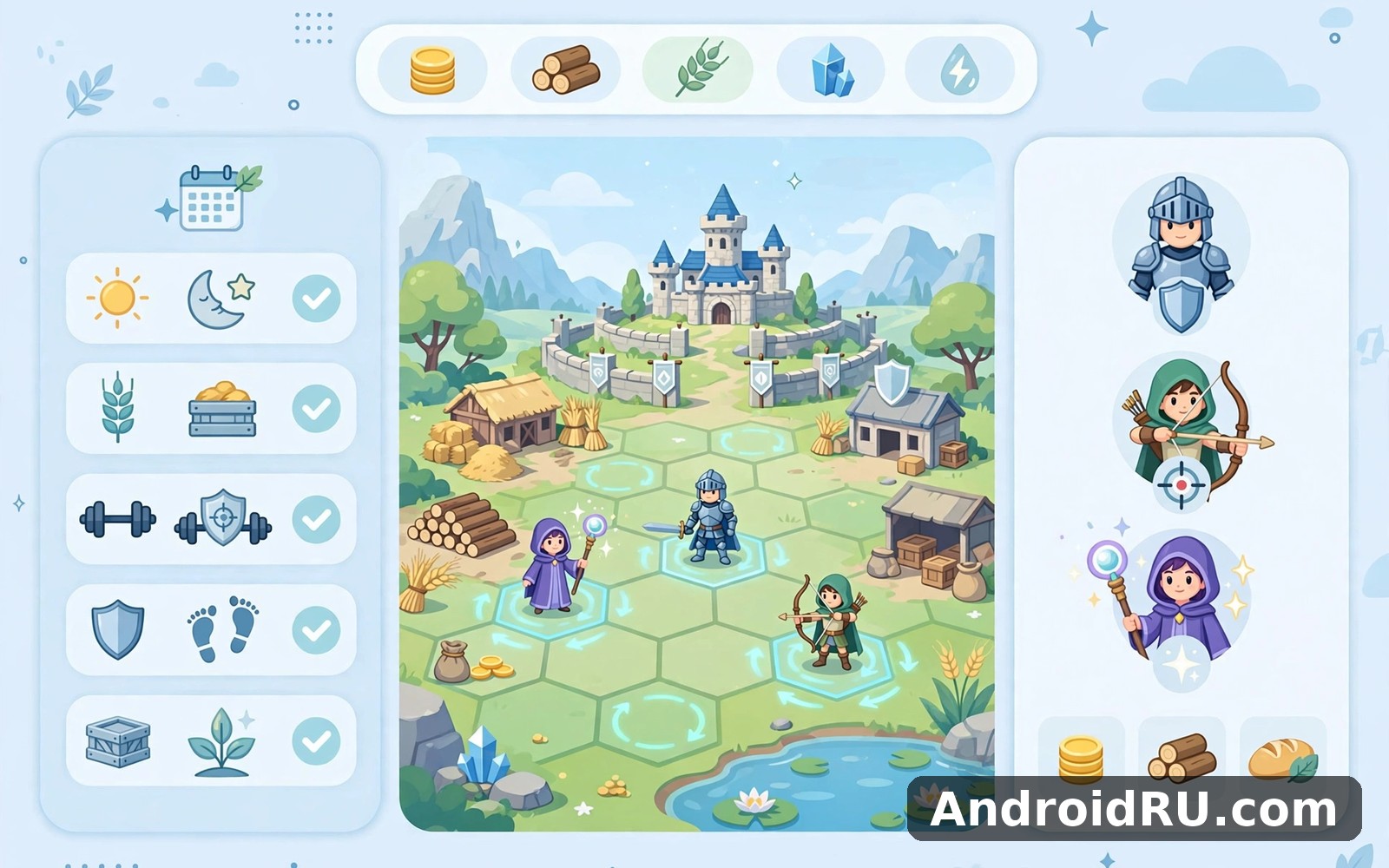
Download APK Domination Dynasty Turn Based Latest Updates, Hands-On Experience & App Review
Domination Dynasty Turn Based is a strategy game that asks for patience, and it rewards patience in a way few mobile games do. There is no rush to tap fast, no timer counting down while you think, and no enemy that attacks while you are still reading the map. You look at the land, you count your gold, you move your units one by one, and then you press the button that ends your turn and watch the other side make its own choices. I played three full campaigns on a mid-range Android phone, and this review covers what the game is, what has changed in recent updates, how it actually plays over long sessions, and whether it deserves the space on your phone.
The game belongs to the turn-based strategy family, the kind of game where a single decision can echo ten turns later. You control a faction on a map divided into provinces, you build armies, you take cities, you manage gold and food, and you slowly push your borders outward until only your dynasty remains. It is a slower cousin of the real-time strategy game, and that slowness is the point. Every move can be thought through, every battle can be planned, and a loss usually has a clear reason you can learn from rather than a moment of bad luck you cannot explain.
This article is for players who like strategy games but have limited time, for people who tried the game once and bounced off the first campaign, and for anyone deciding whether the latest version is worth a fresh look. I will walk through the opening moves, the units, the recent updates, the comparison with other strategy games on Android, and an honest list of what works and what does not.
What Domination Dynasty Turn Based is and how a match plays out
A match begins with a small piece of land, a capital city, a handful of units, and a treasury that feels far too small for the ambitions the map suggests. The first turns are quiet: you recruit a few soldiers, you send a scout toward the nearest empty province, and you try to earn more gold than you spend. By the middle of the game the map is crowded, borders touch, alliances form and break, and every turn becomes a choice between building, attacking, and defending. The end of a match usually comes slowly, as one faction takes city after city, rather than in a single dramatic battle.
The turn structure is the heart of the game. Each turn you receive income from the cities you hold, you spend it on units and buildings, you move each unit within its range, and you fight the battles you choose to start. The enemy then takes its turn, and you watch its moves on the map. That rhythm, think then act then watch, is what makes the game relaxing and tense at the same time. A bad move is rarely fatal on its own, but three bad moves in a row will cost you a city, and losing a city costs you income, which costs you units, which costs you the game. The chain is slow enough to see coming and fast enough to punish carelessness.
A turn-based strategy game built around territory and timing
Territory is the main resource in Domination Dynasty, more than gold or units, because every province you hold pays you each turn and gives your armies somewhere safe to stand. Empty provinces are free to take if you can reach them, which makes the early game a race for land, while enemy provinces must be fought for, which makes the late game a test of army strength. Timing matters because an army that arrives one turn late finds a city already reinforced, and an army that attacks one turn early finds itself alone against a larger force. The best players I have watched, in my own games and in the habits the game teaches, are the ones who wait one more turn to gather strength rather than the ones who attack at the first chance.
The map itself shapes every decision. Rivers slow movement, mountains block it, forests hide units, and roads speed an army toward a city that needs help. A capital placed behind a river is easier to defend than one sitting on open plains, and a narrow pass can be held by a small force against a large one. Learning to read the map is the first real skill the game teaches, and it is learned by losing a city to a flanking move and then never making that mistake again. The game gives you the tools to see all of this before you move, and it never hides the terrain rules from you.
Your first ten turns: what to build first
The first ten turns decide more than most new players expect. Build too many soldiers and you run out of gold before you have land to feed them. Build too few and a neighbour takes the empty provinces around you while you are still recruiting. The balance that worked for me is simple: two cheap infantry units, one scout, and then save gold for a second city. Take the nearest empty province first, then the one after it, and only then think about a larger army. Income grows with land, so land comes first and soldiers come second, and a player who reverses that order spends the whole game catching up.
Buildings deserve the same discipline. A market or a farm in the capital pays for itself over many turns, while a barracks in a border city lets you recruit where the fighting will happen. I build income first in safe cities and military buildings in border cities, and I never build a costly building in a city I might lose next turn. The game shows the cost and the benefit of each building clearly, so the decision is about judgement rather than guesswork, and a few campaigns will teach you which buildings earn their keep and which ones only look useful.
Opening moves that keep your capital safe
Keep one unit near the capital for the first fifteen turns, even when the map tempts you to send everything outward. A neighbour who sees an empty capital will attack it, and losing the capital costs far more than the province that unit could have taken. Place the guard on a forest or a hill next to the city, where it defends better, and move it only when a second unit can take its place. This one habit saved two of my campaigns, and both times the enemy scouted the capital, saw the guard, and turned away toward easier land. Defence is not exciting, but it is what lets you play the long game.
Latest updates to Domination Dynasty Turn Based
Recent updates to Domination Dynasty have focused on balance, performance, and the rough edges that long-time players kept reporting. Balance changes have adjusted the cost and strength of several units, so that cheap infantry no longer wins every fight by numbers alone and cavalry has a clearer role as a fast strike force. New units and a few new map layouts have been added in recent versions, giving returning players fresh ground to learn. Map fixes have corrected provinces that were too easy to defend and a handful of borders that confused the movement system, and the game now explains a failed move more clearly than it used to.
Performance work is the part of the update most players will feel first. Loading times on mid-range phones have improved, the map scrolls more smoothly when many units are on screen, and the game is more careful with memory during long sessions, so a campaign that runs for two hours is less likely to slow down or close unexpectedly. The update notes for the latest versions also mention fixes for saved games, so a campaign saved mid-battle loads back in the state you left it. Check the version number in the settings screen and compare it with the latest version listed for the game, because the fixes only help if the update is actually installed.
Balance changes, new units and map fixes in recent updates
The balance changes matter most to players who already know the game. Infantry costs a little more than it used to, which slows the early rush and gives the defender a fairer chance. Ranged units hit harder from a distance but fall faster if cavalry reaches them, which makes protecting archers a real decision rather than an afterthought. A new unit type, a heavier infantry with a higher cost and a stronger defence, gives players a way to hold a narrow pass without spending the whole treasury. None of these changes rewrites the game, but together they make the middle of a campaign less predictable, and a less predictable middle is a better game.
Map fixes are quieter but just as welcome. A few provinces used to sit behind terrain that made them nearly impossible to attack, which let a player hide there for the whole game. Those spots have been opened up, so no city is safe forever. A handful of borders that used to block movement for no clear reason now behave the way the map suggests they should. If you return to the game after a long break, the maps will feel familiar but fairer, and the first campaign after an update is the best time to relearn the terrain, because the old habits may not fit the new map.
Performance and loading improvements on mid-range phones
I played on a mid-range phone with 6 GB of memory, and the difference after the updates is easy to feel. The game opens faster, the map responds to a drag without the small stutter that used to appear when twenty units were visible, and ending a turn takes a second or two rather than a long pause. Battery use is still noticeable during a long session, as it is with any game that keeps the screen on and the processor busy, so I play with the brightness down and the phone plugged in for the longest campaigns. The game also handles interruptions better now: a phone call or a switch to another app is less likely to lose the current turn.
How to check which version you have installed
Open the game, go to the settings screen, and look for the version number near the bottom, usually written as a short number such as 1.4 or 2.1. Compare that number with the latest version shown on the game page, and if yours is older, update before starting a new campaign, because a campaign started on an old version may not get the balance changes. A saved campaign usually survives an update, but I finish any campaign I care about before updating, just in case. The version number is also the first thing to quote if you ever report a problem, because the fix for a bug in one version may already exist in the next.
Hands-on experience: three campaigns I played start to finish
I played three full campaigns, each on a different map and with a different faction, and each one taught me something the tutorial never mentions. The first was a slow expansion that paid off late, the second was an early war I almost lost, and the third was a careful game where I won by economy rather than by battle. Together they cover the three ways this game is usually won, and they show why a single campaign is a poor way to judge it. The game only shows its depth after the opening turns, when the map is full and every choice has a cost.
Each campaign took between four and eight hours spread over several evenings, which is a fair length for a mobile strategy game. I played in sessions of thirty to forty minutes, which suits the turn structure well: a session is long enough to make real progress and short enough that the game never feels like a chore. The save system worked throughout, and I never lost a campaign to a crash, though I did lose one to a decision I made on a tired evening, which is a different kind of lesson entirely.
Campaign one: a slow expansion that paid off late
In the first campaign I took empty land for twenty turns and fought almost nobody. My neighbours were busy with each other, my income grew steadily, and by the middle of the game I had the largest treasury on the map and the smallest army. That sounds like a mistake, and for a while it was, because a neighbour noticed the weak army and attacked a border city. I lost the city, spent the treasury on soldiers in two turns, took the city back, and then kept the army strong for the rest of the game. The lesson was plain: an economy without an army is a target, and the richest player on the map is the most tempting one to attack. I won that campaign in the end, but only after learning that wealth must be guarded.
Campaign two: an early war I almost lost
The second campaign began with a neighbour attacking on turn eight, before I had a second city. I had spent my gold on a market, which was the right building for a peaceful game and the wrong building for a war. I lost two provinces in the first ten turns and spent the next twenty fighting to get them back. The turning point came when I stopped trying to retake both provinces at once and focused every unit on one of them, while a single cheap unit held the other border. That focus worked, the first province fell, and the income from it paid for the army that took the second. The campaign taught me that a losing war is usually lost by trying to defend everything at once, and won by choosing one place to hold and one place to attack.
Units, buildings and resources explained in plain terms
The game has a small set of resources, and understanding them is more useful than memorising every unit. Gold pays for units and buildings, and it arrives each turn from the cities you hold. Food keeps your armies fed and your cities growing, and a city without enough food grows slowly. Some versions add a third resource, such as wood or iron, for stronger units and better buildings, and the exact names vary by version, so read the in-game description of each resource before you plan around it. The rule that never changes is that income comes from land, and land comes from units, so the whole game is a circle: land pays for soldiers, soldiers take land, and land pays for more soldiers.
Buildings turn income into strength. A market raises gold, a farm raises food, a barracks lets you recruit soldiers in that city, and a wall makes a city harder to take. The choice is always between earning more and defending better, and the right answer changes with the map. A safe city in the middle of your land should earn. A border city should defend and recruit. A city you just captured should do nothing expensive until you are sure you can keep it. Players who build the same thing in every city waste gold, and the game punishes waste quietly, by giving the careful player a larger army ten turns later.
Infantry, cavalry and ranged units compared
Infantry is the backbone of every army: cheap, steady, and strong when holding ground, especially in forests and hills. Cavalry is fast and hits hard on open ground, and it is the best unit for reaching a weak city quickly or catching a ranged unit that has moved too far forward. Ranged units, such as archers, deal damage from a distance but need protection, because a cavalry charge will break them in one or two turns. A good army mixes all three, with infantry in front, ranged units behind, and cavalry waiting for the moment to strike. A mixed army beats a single-type force, because an army of one type, however large, has a weakness that a clever enemy will find.
| Unit | Best use | Weakness |
|---|---|---|
| Infantry | Holding cities and rough ground | Slow, weak on open plains |
| Cavalry | Fast strikes and chasing ranged units | Costly, weak in forests |
| Ranged units | Damage from a safe distance | Fragile if reached in close combat |
| Heavy infantry | Defending narrow passes | Expensive and slow to move |
| Scout | Revealing the map cheaply | Cannot win a real fight |
Buildings that earn their keep
The market is the building I build first in most safe cities, because gold is the resource that buys everything else, and a market pays for itself over a long campaign. The farm comes next in a city that feeds a large army, because an army that cannot eat cannot march. The barracks belongs in border cities, where a new unit can join the fight in one turn rather than marching for three. Walls belong on the city the enemy wants most, usually the capital or a city guarding a pass. The building I build least is the expensive wonder or monument, which looks grand and does little while the war is still being decided. Save the monuments for a campaign you have already won.
Domination Dynasty vs other turn-based strategy games on Android
Domination Dynasty sits in a crowded family of turn-based strategy games on Android, and each of its neighbours does one thing better. Age of History II Lite offers a larger historical map and deeper diplomacy, with more ways to win without fighting, but it is harder to learn and its interface asks more of a new player. Age of History II Lite is worth a look as well if you want a bigger map and a slower, more political game. Super Bear Adventure is a different kind of game entirely, a cheerful 3D platform adventure, and Super Bear Adventure is a natural next app to try when you want a break from thinking and a game that rewards jumping and exploring instead. Maximus 2 is a side-scrolling beat-em-up, and Maximus 2 Fantasy Beat Em Up covers that need neatly when you want fast action after a long evening of careful turns.
The honest comparison is that Domination Dynasty is the easiest of the serious strategy games to pick up, and the hardest to put down once a campaign gets going. It does not have the deepest diplomacy or the largest map, but it has the clearest rules and the shortest path from opening the game to making a decision that matters. That clarity is why I recommend it first to a player who is new to the genre, and why I still return to it when I want a campaign I can finish in a week rather than a month.
| Game | Best for | Learning curve |
|---|---|---|
| Domination Dynasty Turn Based | Clear, finishable campaigns | Gentle, clear rules |
| Age of History II Lite | Large maps and diplomacy | Steep, deep systems |
| Super Bear Adventure | Relaxed 3D platforming | Easy, playful |
| Maximus 2 Fantasy Beat Em Up | Fast action sessions | Easy, skill based |
| Classic board-style strategy | Short puzzle-like matches | Moderate, varied |
How it compares with Age of History II Lite
Age of History II Lite gives you more to manage: more provinces, more diplomacy options, more ways to spend money, and more history to read. A campaign there can last weeks, and the game expects you to care about the difference between two treaties. Domination Dynasty gives you less to manage and more to decide, and a campaign fits into a week of evenings. The trade-off is real, and it depends on what you want from a game. If you want a world to live in, Age of History II Lite is the better choice. If you want a war to win, Domination Dynasty is the better one. I keep both installed, and I choose between them the way I choose between a long novel and a short story.
Pros and cons after long sessions
Long sessions reveal what a short trial hides. The game is at its best in the middle of a campaign, when the map is full, the armies are large, and every turn offers a decision that could change the outcome. It is at its weakest at the very start, when the first turns feel slow, and at the very end, when victory is certain but the game still asks you to take the last few cities one by one. Those weak moments are short, and they are the price of a game that lets you think, but they are worth naming honestly, because a player who expects constant excitement will be disappointed by the quiet turns.
Pros of Domination Dynasty Turn Based
- The rules are clear and the game explains them well, so a new player can make real decisions in the first hour.
- Turns can be taken slowly, which makes the game ideal for short sessions on a bus or before bed.
- Campaigns are long enough to matter and short enough to finish, usually within a week of evenings.
- The map, terrain, and unit mix give real tactical choices, not just a race to build the largest army.
- Recent updates have improved performance and balance, and the game runs well on a mid-range phone.
Cons of Domination Dynasty Turn Based
- The opening turns can feel slow, especially on a large map with few neighbours nearby.
- The end of a campaign can drag once victory is certain but a few cities remain to be taken.
- Diplomacy is simpler than in deeper strategy games, so players who love negotiation may find it thin.
- Long sessions use noticeable battery, and the game is best played with the brightness down or the phone charging.
- Some unit and building details change between versions, so advice written for one version may not fit the next exactly.
Who Domination Dynasty Turn Based is for
This game is for players who like to think before they act, who enjoy watching a plan come together over many turns, and who prefer a quiet evening of strategy to a fast session of reflexes. It is for the player who likes chess, board games, and slow-building stories, and for the player who wants a strategy game that can be played in short bursts without losing the thread. It is not for players who want constant action, instant rewards, or a game that can be finished in ten minutes. The right player will know within three campaigns, and the wrong player will know within three turns, and both answers are fair.
Tips that actually help new commanders
The best tips in this game are habits, not tricks. Play one campaign at a time, so the map stays in your head and you remember why you placed each unit where it stands. Save before a big battle, not because the game is unfair, but because a saved game lets you try a different plan and learn which one works. Read the terrain before every move, because a hill or a forest changes a battle more than an extra unit does. And never spend the last of your gold, because the turn after a big purchase is the turn the enemy attacks, and a treasury with nothing in it cannot raise a defence.
A second habit is worth building early: look at the enemy before you look at yourself. Each turn, before you move your own units, check where the enemy armies are and what they could reach next turn. A player who only looks at their own side misses the attack that is already on its way. The game shows enemy positions clearly, and a minute spent studying them saves a city more often than a minute spent recruiting. After a few campaigns this check becomes automatic, and it is the single habit that separates a player who survives from a player who wins.
Five habits that win campaigns
- Take empty land first, because income grows with land and land is free while it lasts.
- Keep a guard near the capital, because a capital without a guard invites an attack.
- Mix infantry, cavalry, and ranged units, because a one-type army has a weakness an enemy will find.
- Save gold for the turn after a big battle, because the next attack often comes at once.
- Finish one campaign before starting another, because a half-finished map teaches nothing.
Save your best units for the battle that matters
It is tempting to use your strongest units on the first enemy you meet, and it is almost always a mistake. A strong unit spent on a weak province is a strong unit that is not available when the real army arrives. Keep your best units one step behind the front line, let the cheap units take the easy land, and commit the strong ones only when the battle will decide a city or a border. The game rewards patience here more than anywhere else, and the campaigns I won were the ones where my best units were still fresh when the decisive battle finally came.
Common mistakes and how to avoid them
The most common mistake is expanding too fast. A player who takes five provinces in five turns has five borders to defend and no army to defend them with, and the first neighbour to notice will take two of them back. Expand one province at a time, guard each new border, and only take the next province when the last one is safe. The second mistake is building the same thing in every city, which wastes gold on markets in cities that need walls. The third mistake is fighting every battle, when some battles are better avoided: a battle you cannot win costs units you will need later, and a retreat that saves an army is a better move than a defeat that loses one.
Frequently asked questions about Domination Dynasty Turn Based
Is Domination Dynasty Turn Based free to play?
The game is free to install, with optional purchases inside the game for extra content or to speed up certain things, depending on the version. The full campaign can be played without paying, and the core game is not blocked behind a purchase. Check the in-game shop before you buy anything, and play at least one full campaign first, so you know whether the extra content is something you will actually use rather than something that merely looks appealing on a menu.
Can I play Domination Dynasty Turn Based offline?
Yes, the single-player campaigns work without a connection, which is one of the reasons the game suits travel and quiet evenings. You can take turns, save, and load without any signal. Some features, such as checking for updates or any online mode the version includes, need a connection, but the heart of the game, the campaign against the computer, is fully playable offline. Download the game and any updates before you travel, and the campaign will be there when the signal is gone.
How long does a campaign take to finish?
A campaign usually takes four to eight hours of play, spread over several sessions, depending on the map size and how carefully you play. A small map with few factions can be finished in a few evenings, while a large map with many factions can take a week or more. The turn structure makes it easy to stop and return later, because the game saves your place and the map is exactly where you left it. If a campaign feels too long, choose a smaller map next time, and the game will fit your evenings better.
Is Domination Dynasty Turn Based hard for beginners?
It is gentle for beginners and deep for experienced players, which is a rare combination. The first campaign teaches the rules one turn at a time, and the game never punishes a slow decision. A beginner will lose the first campaign or two, and those losses are the tutorial: each one shows a mistake clearly enough to avoid it next time. Start on the easiest setting, pick a small map, and take the first ten turns slowly. By the second campaign the game will feel familiar, and by the third it will feel like yours.
A calm verdict on Domination Dynasty Turn Based
Domination Dynasty Turn Based is a strategy game that respects your time and your intelligence in equal measure. It gives you a clear map, clear rules, and a fair fight, and then it steps back and lets you think. The latest updates have made it smoother, fairer, and more stable on ordinary phones, and the campaigns are long enough to matter and short enough to finish. Its limits are real: the opening turns are slow, the end of a won campaign can drag, and the diplomacy is thinner than in deeper games. None of those limits spoils the game for the player it was made for.
The next step is simple. Open the game, pick a small map, take the first ten turns slowly, and keep one unit near your capital. Play one full campaign before you judge it, because the game only shows its depth after the opening turns. If you enjoy thinking three moves ahead, you will know by the end of that campaign. If you do not, you will know sooner, and the honest answer is worth having either way.
When you are ready to try it, Click here to download the Domination Dynasty Turn Based app. For a lighter adventure when you want a break from strategy, Click here to download the Super Bear Adventure app, and for fast action after a long evening of turns, Click here to download the Maximus 2 Fantasy Beat Em Up app.

