

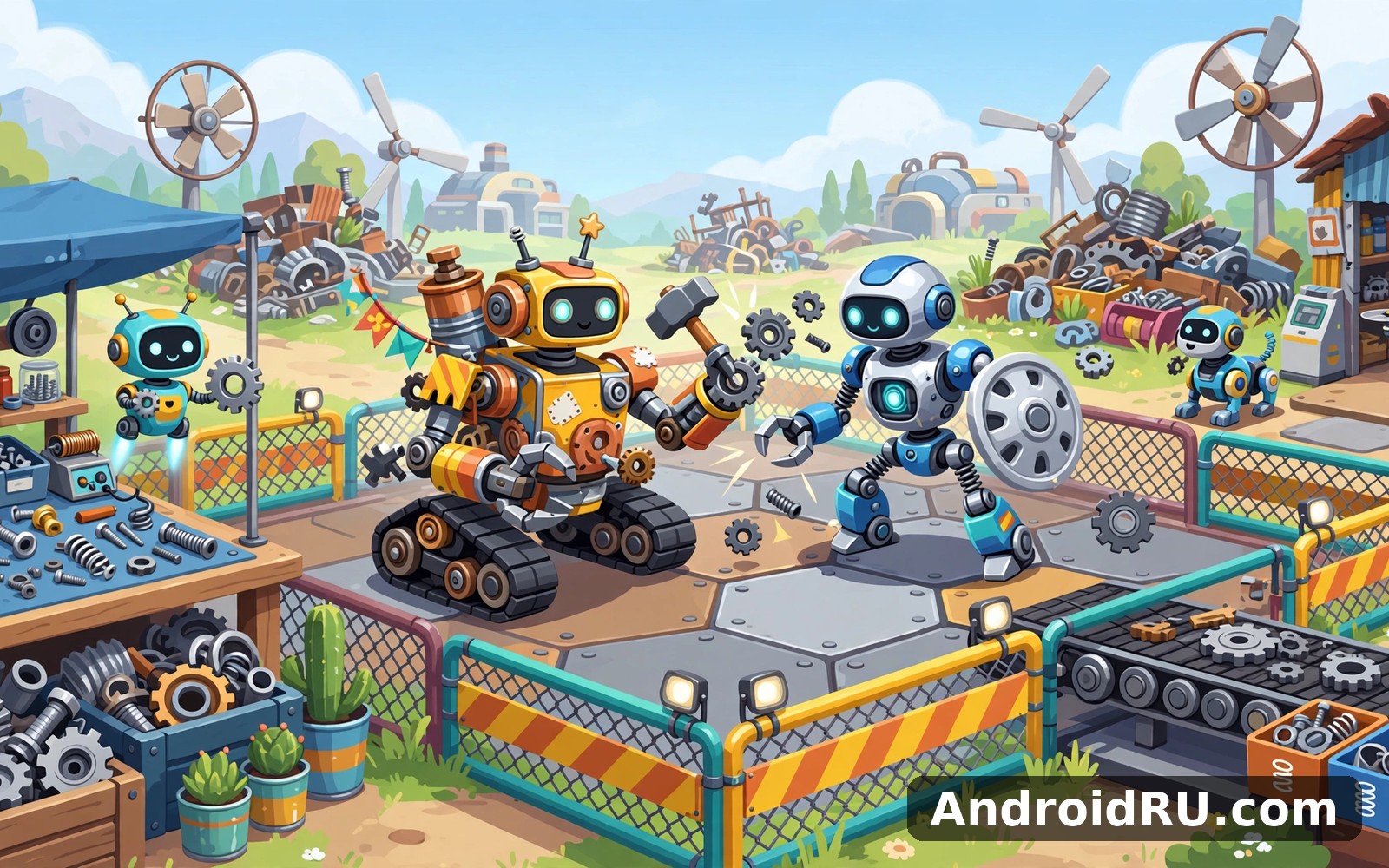
Download APK Junkineering Robot Wars RPG New Features, Real-World Use & Honest Review
I opened Junkineering Robot Wars RPG on a Tuesday morning while my phone was still on charge. I had ten minutes before I needed to leave the house, and the first screen felt calm. I did not have to hunt for the main feature, and that small start made me want to stay a little longer. A week later it had become part of my morning routine, sitting next to my coffee, and I kept coming back to it in the gaps between other things.
This review covers what is new in the game, how robot building and combat actually work, how it behaves in real daily use, and where it honestly falls short. Junkineering is a robot-building role-playing game where you bolt together machines from scrap parts and send them into arena battles. It is a simple loop on the surface, and the depth comes from the choices you make about parts, weight, and tactics. If you like games that reward tinkering more than reflexes, read on.
What Junkineering Robot Wars RPG is and how robot building works
Junkineering Robot Wars RPG is a mobile RPG built around one idea: your robot is only as good as the parts you bolt onto it. You start with a basic frame and a handful of scrap components, then you fight, earn more parts, and rebuild. Every part changes something real. A heavier chassis adds armour but slows you down. A bigger weapon hits harder but drains more energy. A better motor moves you faster but leaves less room for plating. The game never hides these trade-offs, and learning them is half the fun.
The building screen is where most of the thinking happens. You see your robot as a set of slots — head, torso, arms, legs or wheels, and weapon mounts — and each slot accepts parts you have collected. Parts come in grades, from rusty scrap that barely holds together to rare components with clear bonuses. I spent my first evening just swapping parts and watching the stat numbers move, and that quiet experimentation taught me more about the game than the first three battles did.
Battles themselves are turn-based arena fights. You pick an action, your robot acts, and the enemy replies. Positioning, weapon range, and energy management matter more than raw power, which means a clever build can beat a stronger one. That is the hook that keeps the game interesting past the first hour: you lose a fight, you go back to the workshop, you change one part, and you try again with a plan instead of a hope.
How the daily rhythm feels in Junkineering Robot Wars RPG
The game fits into short gaps in a day. A battle takes a few minutes, a workshop visit takes a few more, and you can stop anywhere without losing progress. I played while waiting for a kettle to boil and while sitting in a parked car, and those small moments added up without turning into a chore. The layout stays simple even when you return after a gap. You do not need to relearn the game each week, and your progress and recent activity are easy to spot.
Start small on day one. Pick one feature and use it well before you try everything. That habit helped me learn faster than jumping between menus, and by day three I knew where everything lived. Customisation is present but it does not take over the experience. You can adjust a few settings to suit your taste, and the defaults work well for most people. I changed only two settings in my first week, and I never felt the need to chase the rest.
Parts, grades and what each slot really does
Every slot on your robot answers a different question. The chassis decides how much damage you can take. The motor decides how fast you move and how often you act. Weapons decide your damage and your range. Utility parts add the extras: better sensors, energy cells, repair kits, and shields that absorb a hit. A balanced build beats a lopsided one in most fights, because a robot that hits hard but falls apart in two turns rarely finishes the job.
Reading part stats without getting lost
Each part shows a small set of numbers, and only three of them matter for most decisions: the main bonus it gives, the weight it adds, and the energy it costs. If a part gives a big bonus but costs more energy than your reactor can supply, it will sit idle in a fight. Check the energy line first, the weight second, and the bonus third. That order keeps you from building a robot that looks powerful on paper and stalls in the arena.
When to sell scrap and when to keep it
Low-grade duplicates are safe to sell for currency, because you will find better versions quickly. Keep any part with an unusual bonus, even if its numbers look weak, because odd bonuses combine in surprising ways later. Keep one spare motor and one spare weapon at all times, so a bad experiment never leaves your robot unusable. A small stock of spares turns a failed test into a shrug instead of a setback.
Junkineering Robot Wars RPG new features in the latest version
Recent updates to Junkineering Robot Wars RPG have added the things players asked for most: more parts to find, more reasons to replay old arenas, and smoother performance on the phones people actually own. The part pool has grown with new weapon types and utility components, which gives builders more combinations to test. A few older parts have been rebalanced too, so builds that used to dominate now share the arena with alternatives, and that keeps the workshop interesting.
Quality-of-life changes matter just as much. Loading between the workshop and the arena feels quicker, the battle log is easier to read, and the game handles interruptions more gracefully — a phone call mid-battle no longer feels like a disaster. Visual touches have been tidied as well, with clearer icons for part grades and a cleaner look for the arena itself. None of this reinvents the game, and that is a good thing. The core loop was already solid, and the updates sharpen it instead of replacing it.
As with any live game, the exact contents of an update can vary by version, so check the version notes on the app page after an update lands. If a part you relied on behaves differently, the notes usually explain why. I make a habit of playing one easy arena fight after every update, just to confirm my main build still works the way I expect before I take it into a harder fight.
New parts and balance changes worth knowing about
The most useful additions are the mid-tier utility parts, because they give new players a bridge between scrap builds and rare gear. A decent energy cell or a basic repair module can change a fight more than a slightly bigger gun, and those parts are now easier to find early. Balance changes have also trimmed the worst extremes: the most overpowered early weapon no longer trivialises the opening arenas, and a few weak parts now have a reason to exist. The result is a game where more builds are viable, which is exactly what a building game needs.
Combat, parts and upgrades: how battles actually play
A battle in Junkineering Robot Wars RPG plays out in turns. You look at the enemy, you look at your energy, and you choose. Attack with your main weapon, move to a better range, use a repair or shield, or hold energy for a bigger move next turn. The enemy does the same, and the fight becomes a small puzzle: spend energy now for damage, or save it for defence and strike later. There is no twitch timing and no need for fast thumbs, which makes the game friendly to play on a bus or in a waiting room.
Upgrades follow a clear path. You earn currency and parts from wins, you spend them in the workshop, and your robot gets stronger in the direction you chose. There is no single correct build. A fast skirmisher that hits and moves can win. A slow tank that absorbs punishment and grinds the enemy down can win too. The game rewards you for committing to a plan and tuning it, rather than for copying one perfect answer.
That said, the early game can feel slow if you try to do everything at once. Pick one idea — speed, armour, or damage — and build toward it for your first dozen fights. Once that build feels solid, start experimenting with a second idea. Players who spread their upgrades across every stat at once end up with a robot that is average at everything and good at nothing, and that is the most common reason a new player stalls.
A beginner battle plan that actually works
- Enter the arena with a balanced build: one solid weapon, basic armour, and a motor you can afford to run.
- On turn one, watch what the enemy does before you spend all your energy.
- Attack when you have a clear shot, and save at least a little energy for defence.
- If your health drops below half, use a repair or shield instead of chasing one more hit.
- After the fight, win or lose, note which part let you down and change exactly one thing.
- Replay the same arena with the changed build before moving to a harder one.
Energy management: the skill that separates wins from losses
Energy is the real resource in every fight. Weapons, movement, and shields all draw from the same pool, and running dry at the wrong moment loses fights that you were winning. The fix is simple to say and harder to practise: never spend everything on turn one. Keep a reserve, learn how much your main weapon costs, and count the turns until your reactor refills enough for another big move. After a few fights this counting becomes automatic, and that is the moment the game clicks.
Three mistakes new players make in the arena
First, spending all energy on the opening attack and having nothing left to defend. Second, ignoring range, so a short-range weapon never gets to fire. Third, rebuilding the whole robot after one loss instead of changing a single part. Fix those three and your win rate climbs fast, because most early losses come from those habits rather than from weak parts.
Junkineering Robot Wars RPG vs similar RPG games comparison
Junkineering sits in a busy corner of mobile RPGs, and it helps to see how it stacks up against games that scratch a similar itch. The comparison below looks at the games the original article pointed readers toward, because those are the ones a Junkineering player is most likely to try next. Each has a different answer to the same question: what should a short session feel like?
If you enjoy games and play, then Onebit Adventure Roguelite RPG is a natural next app to try. It offers a different angle on the same kind of activity, with runs that reset and a pixel-art world that rewards quick decisions. When you want a change of pace, then Triple Fantasy Card RPG covers that need neatly, trading robot parts for card decks and arena fights for card duels. And for a third option, Domination Dynasty Turn Based is worth a look as well, for players who want their tactics on a bigger strategic map.
| Game | Core loop | Session length | Best for |
|---|---|---|---|
| Junkineering Robot Wars RPG | Build robots from scrap, turn-based arena battles | A few minutes per battle | Players who love tinkering with builds |
| Onebit Adventure Roguelite RPG | Roguelite runs with permadeath-style restarts | Short runs, high replay value | Players who enjoy fresh runs each time |
| Triple Fantasy Card RPG | Collect cards, build decks, duel opponents | Quick duels, deck tweaking between | Players who like card strategy |
| Domination Dynasty Turn Based | Turn-based strategy on a larger map | Longer, slower sessions | Players who want big-picture tactics |
No side wins for everyone here. Junkineering is the pick when you want to build and tune a machine and see your choices fight. Onebit is the pick when you want every run to feel different. Triple Fantasy is the pick when deck-building appeals more than part-hunting. Domination Dynasty is the pick when you want a campaign that unfolds over days rather than minutes. I still came back to Junkineering for my daily routine, because its simple loop fit the gaps in my day better than the others, but the other games are useful and they each do their own thing well.
Real-world use: short sessions, offline play, battery and data
In real use, Junkineering Robot Wars RPG behaves like a good commuter game. Sessions are short, progress saves constantly, and you can stop mid-session without losing anything. I played it at home and on the move and in a quiet cafe, and each setting showed a different strength. At home I explored the workshop more deeply. On the move I used only the quick features: one battle, one upgrade, done. That flexibility is why it stayed on my phone.
Battery use is modest for a game. Short battles and a mostly static workshop screen do not push the phone hard, and a ten-minute session barely moves the battery gauge. Longer evening sessions will drain more, as with any game, so keep a charger nearby if you settle in for an hour. Data use is light too once the game is installed, because most of the action happens on your device. Do the install and any big update over Wi-Fi, and the day-to-day play will not trouble a small data plan.
The game also handles a return visit after a few days away with grace. It does not scold you or reset your progress. It simply shows you where you left off and lets you continue. That gentle welcome made returning easy, and I have deleted games that punished a gap far more harshly. A visible spot on the home screen helps as well. Out of sight meant out of mind for me in the first week, and once I moved it to a visible spot I opened it far more often.
Playing Junkineering Robot Wars RPG with friends and family
The game works well as a conversation piece. I tried it with a friend who is less confident with phones, and they managed the main features without my help, which told me more than any feature list could. Showing someone your robot, explaining why you picked a certain motor, and then watching a battle together is a fun way to share it. If you miss a day, just restart the next morning without a guilt spiral. The habit carries itself once the sessions are short and rewarding.
Notifications and reminders: keep only the helpful ones
Notifications deserve a quick look in week one. Turn on only the ones that actually help you, such as a reminder for a daily reward or an event you care about. I kept morning reminders and switched off the rest, and that balance made the game feel helpful rather than noisy. A reminder that arrives at a busy hour will get ignored and then resented, so move it to a calm slot and the whole habit feels easier.
Pros and cons: an honest Junkineering Robot Wars RPG review
My overall review is positive, and it comes from daily use rather than a quick glance. The game feels honest about what it does. It does not promise more than it can deliver, and that honesty is rare enough to value. The clear strength is consistency: the game makes showing up easy, it rewards small effort in a visible way, and sessions stay short while the interface stays calm even after a gap. I never felt punished for missing a day, and that balance between encouragement and pressure feels well judged.
The honest strain is depth for advanced players. Short sessions can only carry you so far before you want longer material, deeper story, or harder endgame content. That is not a failure of the game. It is a sign that you have outgrown the beginner loop, and I see this game as a strong daily base rather than a complete school for the genre. Here is the balance in full.
Pros of Junkineering Robot Wars RPG
- Satisfying build loop: swapping parts and seeing the result in battle is genuinely fun, not just busywork.
- Short, honest sessions: a battle takes minutes, progress saves constantly, and stopping is painless.
- Calm, clear interface: you always know where you are, even after a week away from the game.
- Tactical depth without reflexes: turn-based combat rewards planning, so anyone can compete.
- Gentle return: no punishment for missing days, and your robot is exactly where you left it.
Cons of Junkineering Robot Wars RPG
- Thin story: the game is about building and battling, and players who want a rich narrative will find little of it.
- Early grind: the first hours can feel slow while you collect enough parts to build freely.
- Shallow endgame for veterans: advanced players may run out of new challenges sooner than they would like.
- Small-screen workshop: comparing many parts at once feels cramped on compact phones.
Who Junkineering Robot Wars RPG is for
This game is for players who enjoy tinkering, short daily sessions, and turn-based tactics without time pressure. It suits beginners to the genre, busy players who game in gaps, and anyone who likes the idea of building a machine and watching it fight. It is less suited to players who want a story-driven epic, fast action combat, or endless endgame content. If the building loop sounds fun to you, it probably is, and a week of short sessions will confirm it.
Tips to build a stronger robot without wasting parts
The workshop rewards patience more than spending. Before you buy or fuse anything, fight five battles with your current build and write down what actually failed. Was it damage, speed, or survival? Spend only on the weakness you observed, not on the shiny part that caught your eye. That one habit saves more currency than any other tip in this guide, because most wasted spending comes from fixing problems you never had.
Upgrade in small steps. Improve one part at a time and test it in an arena you have already beaten, so you can feel the difference cleanly. A robot that changes five parts at once teaches you nothing about which change helped. Keep a spare build too: a second, simpler robot that you can fall back on when an experiment goes wrong. That safety net makes bold experiments cheap, and bold experiments are how you find the builds that surprise you.
Where to spend currency first as a new player
Spend first on a reliable motor and a decent energy cell, because speed and energy shape every fight you play. Spend second on armour for your torso, because surviving one more hit matters more than dealing one more point of damage early on. Spend third on a weapon upgrade, once the rest of the build can support it. Players who buy the biggest weapon first usually end up with a robot that cannot move or fire it properly, and that is a frustrating way to learn the energy rules.
Daily habits that keep progress moving
- Play one arena battle a day, even on busy days, to keep parts and currency flowing.
- Check the workshop after every few battles, not after every single one, so upgrades stay deliberate.
- Keep a short note of which build beat which arena, so you can reuse what worked.
- Back up any important progress or save when the game offers that option, and check save options in week one.
- Tie your session to something you already do each day, like morning coffee, so the habit anchors itself.
Frequently asked questions about Junkineering Robot Wars RPG
Is Junkineering Robot Wars RPG free to play?
The game is free to install and play, with optional purchases inside for players who want to speed up progress. The core loop — building robots, fighting arena battles, and earning parts — works without spending. Check the current listing for the latest details on what is included and what is optional, because offers change over time.
Can I play Junkineering Robot Wars RPG offline?
Yes, the main single-player content works offline once the game is installed, including battles and workshop building. That makes it a solid choice for travel and for places with weak signal. Any online events or leaderboards will need a connection, but the daily loop does not depend on one.
Does Junkineering Robot Wars RPG work on older phones?
Yes, the game is light on resources and runs well on older mid-range phones, because battles are turn-based and the graphics are modest. If the game feels slow, close background apps and check that you have free space for updates. A quick restart after an update clears most performance hiccups.
What is the best starter robot build in Junkineering Robot Wars RPG?
Start balanced: a solid motor, basic torso armour, one reliable mid-range weapon, and an energy cell that covers your costs. Do not chase a single huge weapon early. Play a dozen fights with that build, note what fails, and upgrade the weak spot first. A balanced starter teaches you the game faster than any extreme build.
Why did my robot lose a fight it should have won?
Check energy first, then range, then armour. Most surprise losses come from running out of energy at the wrong moment, a weapon that could not reach, or a build that dealt damage but could not take a hit. Change one part, replay the same arena, and see if the result flips. One careful change beats a full rebuild almost every time.
When you are ready to give it a proper try, use the link below. It takes you straight to the Junkineering Robot Wars RPG page on AndroidRU. I suggest trying it for a full week before you judge it, because a week of short sessions shows the real character of a game. Click here to download the Junkineering Robot Wars RPG app. A similar game is worth a quick look too: Click here to download the Onebit Adventure Roguelite RPG app. For a second option, Click here to download the Triple Fantasy Card RPG app. After a few weeks of use I still open Junkineering without thinking hard about it, and that unthinking return is high praise for any game. It fits a busy life, it keeps progress visible, and it does its job with patience and charm.

