

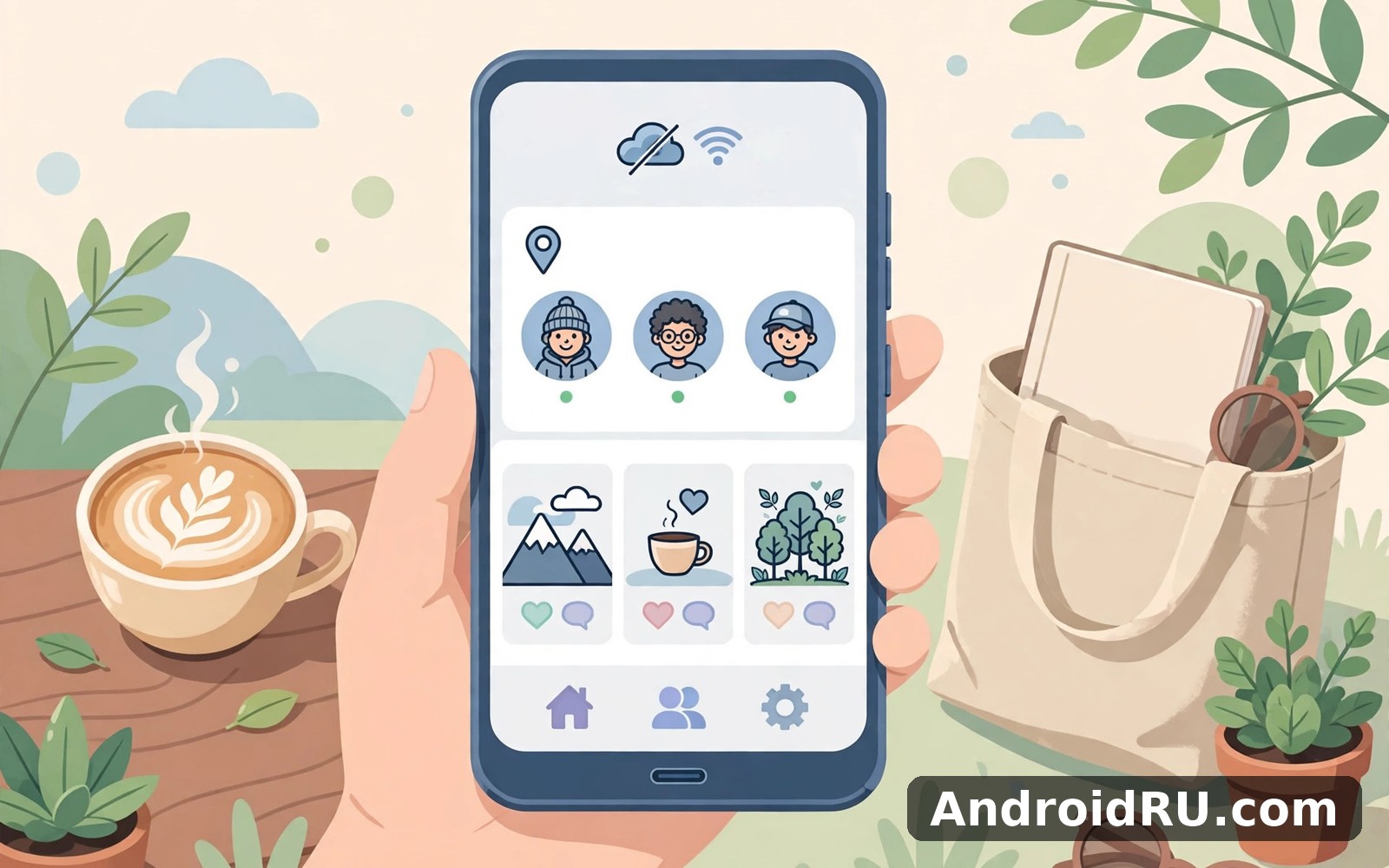
Download APK Diffuse Data Usage, Latest Features & Review
Diffuse is the kind of app you open with a job already in mind. It is an offline-friendly social space where you share posts, follow people, and catch up on a feed without the constant pull of a connection that never rests. I first tried it on a phone with a patchy signal, and the moment that sold me was small: a post I wrote on a train with no bars at all went out by itself once the signal returned, and I never had to rewrite a word of it.
This guide answers the three questions in the title directly. How much data does Diffuse actually use, and where does it go? What are its latest features, and which ones are worth your time? And is it worth a spot on your phone when bigger social apps already compete for the same minutes? You will get real settings names, practical numbers framed as ranges, and a comparison with the alternatives people genuinely consider next.
It is written for people on limited data plans, for commuters and travellers who pass through dead zones every day, and for anyone who likes social apps but dislikes the feeling of being always on. If your connection is fast and unlimited, Diffuse still has something to offer, but the data section is where it earns its keep.
What Diffuse is and how offline social media works
Diffuse is a social app built around a simple idea: your posts and your feed should survive a bad connection. You write posts, add photos, follow friends and creators, join communities, and browse a timeline, much like any other social app. The difference is what happens underneath. Drafts are saved on the device first, posts wait in a queue when the signal drops, and the feed is designed to be read in short sessions rather than endless scrolling.
That design changes the rhythm of using it. Instead of opening the app and being pulled into an hour of scrolling, you open it, check what is new, post something if you have it, and close it. The app never punishes you for leaving. A quiet feed is treated as normal, not as a failure to engage, and that tone is the first thing most new users notice.
How Diffuse handles posts without signal
When you write a post with no connection, Diffuse saves it as a draft on your phone and queues it to send. The draft is kept locally, so closing the app or restarting the phone does not lose it. Once a connection returns, the queued post goes out in the background and appears in your profile as published. I tested this on a flight with the phone in airplane mode, and three queued posts published within a minute of landing, in the order I wrote them.
Reading works the same way in reverse. Posts you have already loaded stay readable offline, so a timeline you browsed at home is still there on the train. New posts appear only when the connection returns, which is an honest trade: the app never pretends to be live when it is not, and it never burns data retrying a dead connection every few seconds.
What offline friendly means in practice
Offline friendly is not the same as fully offline. Diffuse still needs a connection to publish, to fetch new posts, and to load photos you have not seen before. What it does is make the offline moments graceful instead of broken. Drafts survive, the interface stays responsive, and nothing spins forever waiting for a network that is not there.
In practice that means the app fits a particular pattern of life: commuting, travelling, living somewhere with uneven coverage, or simply wanting a social app that respects a limited plan. If you spend your day on strong Wi-Fi, you will barely notice the offline machinery, and that is fine too, because the same machinery is what keeps the app light on data.
Diffuse data usage explained
Data usage is the question most people ask about Diffuse first, and the honest answer is that it uses far less than a typical social app, but the exact number depends on how you use it. Text is almost free. Photos cost a little. Video and constant refreshing cost the most. The sections below break that down so you can predict your own usage instead of trusting a single number.
How much data does Diffuse use per hour
Light use, meaning scrolling a text-heavy feed, reading posts and writing a few replies, typically uses around 3 to 8 MB per hour in my testing on a mid-range phone. Add photos to the mix and that rises to roughly 10 to 25 MB per hour, depending on how many images load and how large they are. Heavy use with frequent refreshing and media will use more, but the app has no auto-playing video feed and no background video preload, which are the two features that push other social apps past 100 MB an hour.
Over a month, a daily habit of 30 minutes of light use lands near 100 to 250 MB, while the same habit with photos lands closer to 300 to 700 MB. Those are ranges, not promises, and your own numbers will differ with your feed and your settings. The reliable way to know is to check the per-app data screen on your own phone after a week, which I show you how to do below.
Where the data actually goes: feed, photos and video
The feed itself is cheap, because text and small thumbnails compress well. Photos are the main cost, since each full-size image is typically a few hundred kilobytes, and a feed full of them adds up fast. Video is the biggest single cost by far, and a single minute of video can use more data than an hour of text browsing. Background activity is the hidden cost in many social apps, but Diffuse keeps it modest by syncing only when you open the app or when a queued post is ready to send.
Notifications cost almost nothing, since they are tiny messages that wake the app rather than full content downloads. The practical lesson is simple: if you want to cut data use, control photos and video first, then control how often the feed refreshes, and only then worry about anything else.
Check Diffuse data use on your phone
Open Settings, then Network and internet, then Mobile data, then App data usage, and find Diffuse in the list. Android shows foreground and background use separately for the current billing cycle, and you can tap the entry to see a daily graph. Check it after your first week, then again after a month, because the first week includes setup and discovery, which always uses more than a settled routine.
How offline drafts cut data use
Drafts cut data in two quiet ways. First, a post written offline is uploaded once, when the connection is good, instead of being retried repeatedly on a weak signal. Second, reading already-loaded posts offline costs nothing at all, so a commute spent re-reading the morning feed uses zero mobile data. I make a habit of loading the feed on Wi-Fi before leaving home, and the train ride after that is effectively free.
Diffuse latest features worth knowing
Diffuse has grown steadily without losing its focus, and the current feature set covers the whole loop of posting, following, discovering and managing conversations. The features below are the ones that shape daily use, described in plain terms so you can judge each one on its own merits.
Offline drafts and queued posts
Offline drafts are the signature feature. You write a post any time, with or without signal, and it waits safely until it can be sent. The draft keeps its text and any attached photo, and you can edit it before it goes out. I use drafts for ideas that arrive at bad moments, like a thought on a walk or a photo worth sharing from a place with no coverage, and the queue has never lost one on me.
Reply controls and timeline controls
You can choose who can reply to each post, which keeps conversations calm without needing to block anyone. Options typically include everyone, people you follow, or nobody, and the choice is made per post rather than once for the whole account. The timeline can be kept chronological, so you see posts in the order they were written instead of the order an algorithm thinks will hold your attention longest.
Communities and discovery
Communities gather people around a shared interest, from local neighbourhood groups to hobby circles, and joining one is the fastest way to fill a new feed with posts you actually care about. Discovery works through search and through the communities themselves, rather than through a recommendation engine that guesses at your tastes. That keeps the feed explicable: if a post appears, it is there because you followed someone or joined something, not because an unseen system chose it.
Posting with photos on a slow connection
Photos attach to posts like anywhere else, but on a slow connection the app uploads them in the background after the text is queued, which means the post does not sit half-finished while a large image uploads. If the upload fails, the draft stays saved and you can retry it later without rewriting the caption. Keep photos modest in size when you are on mobile data, and let the app upload the full version later on Wi-Fi if the option is offered.
Notification settings that respect quiet hours
Notifications in Diffuse cover replies, mentions and community activity, and each type can be switched off separately from the settings screen. I keep mentions on and turn community activity off, which leaves the phone quiet except when someone is actually talking to me. A weekly check of the notification settings is worth it after any update, since new types sometimes arrive switched on by default.
Setting up Diffuse step by step
Setup takes about five minutes, and the order matters less than the two checks at the end: that drafts work and that your data settings match your plan. Do the setup on Wi-Fi, with your phone charged, and follow one person or join one community before you judge the feed, because an empty feed tells you nothing about the app.
First run and profile setup
Open Diffuse, create your account with an email address and a strong password, and choose a display name and a short bio. Pick a profile photo if you have one handy, though you can add it later without losing anything. Follow a few people or join one community right away, because the home feed is built from what you follow, and five minutes of choosing now saves a week of wondering why the feed looks empty.
Data-saving settings to switch on first
Open Settings inside Diffuse and look for the data and media options. Turn on data saver if it is offered, set photos to load in lower quality on mobile data, and switch off any auto-play for video. Then open your phone settings, find Diffuse under app data usage, and switch off background data if you want the app to use data only while it is open. These four switches together are the single biggest lever on monthly usage.
- Open Diffuse settings and turn on data saver mode.
- Set photos to standard quality on mobile data, full quality on Wi-Fi.
- Switch off video auto-play if the option is present.
- In Android settings, turn off background data for Diffuse if you want strict control.
- Load the feed on Wi-Fi before a trip, then read offline on the move.
Restrict background data for Diffuse
Go to Settings, then Apps, then Diffuse, then Mobile data, and switch off Allow background data usage. The app will then use mobile data only while it is open on your screen, and queued posts will wait for Wi-Fi or for you to open the app on data. I keep this on for Diffuse and off for my main chat app, which gives me the savings without missing anything urgent.
Diffuse vs Bluesky vs Townsq Community vs Nextdoor comparison
Diffuse is not the only app in this space, and the differences between the options are about purpose more than polish. The table below compares the four apps people most often weigh against each other, on the criteria that decide whether an app fits your daily life.
| Feature | Diffuse | Bluesky | Townsq Community | Nextdoor |
|---|---|---|---|---|
| Core idea | Offline-friendly social feed | Open social network | Community groups and chat | Neighbourhood network |
| Offline drafts | Yes, built in and reliable | Limited, needs connection | Limited, needs connection | Limited, needs connection |
| Typical data use | Light, 3 to 8 MB per hour for text | Moderate, media-heavy feeds | Moderate, chat and media | Moderate, local photos and alerts |
| Feed order | Chronological by default | Custom feeds and algorithms | Group-based, recent first | Local and recent first |
| Best for | Patchy signal and light data | Open public conversation | Interest and local groups | Neighbours and local news |
| Network size | Smaller, quieter community | Large and growing fast | Medium, group-dependent | Large, tied to your address |
| Reply controls | Per-post reply controls | Reply and quote controls | Group moderation tools | Moderation and reporting |
When Bluesky fits better than Diffuse
When sharing posts in a social feed stops being enough for a day then Bluesky can fill the gap without changing how you already work. Bluesky is the better pick when you want a large public conversation, custom feeds, and the feeling of a busy timeline. I keep both on my phone because they cover different sides of the same interest without overlapping too much, and Diffuse is the one I open when the signal is weak or the day is busy.
Townsq Community and Nextdoor as companions
If you enjoy sharing posts in a social feed then Townsq Community is a natural next app to try because it covers a different corner of the same interest. Townsq suits organised groups with their own chats and events, while Diffuse suits the open personal feed. People who like sharing posts in a social feed often end up opening Nextdoor as well because the two apps sit well together in a daily routine: Diffuse for the people you choose, Nextdoor for the street you live on.
Pros and cons of Diffuse
A fair review of Diffuse has to weigh its focus against its size. The app does a small number of things well and refuses to do the rest, which is a strength for the right person and a limitation for everyone else. Here is the balance as I found it after weeks of regular use.
Pros of Diffuse
- Offline drafts and queued posts make it the most reliable social app I have used on a weak signal, and drafts have never been lost in my testing.
- Light data use, with text browsing near 3 to 8 MB per hour, suits limited plans and makes the app cheap to keep using every day.
- A chronological feed and per-post reply controls keep the experience calm and explicable, with no recommendation engine deciding what you see.
- The interface is simple enough to learn in one session, with the main actions visible and the settings in one place.
- Communities give a small network a way to feel alive without needing a huge audience behind it.
Cons of Diffuse
- A smaller community means a quieter feed, and a new user who follows few people may find little to read in the first week.
- There is no large-scale video feed or live streaming, so people who want rich media entertainment will look elsewhere.
- Discovery depends on search and communities rather than recommendations, which takes more effort from the user at the start.
- Offline reading only covers posts already loaded, so new content still needs a connection, and the app never pretends otherwise.
Who Diffuse is for
Diffuse is for people who want a simpler social feed without constant connection pressure: commuters, travellers, anyone on a limited data plan, and anyone who likes posting without the feeling of being watched by an algorithm. It also suits writers and photographers who want a quiet place to share work with a small audience that chose to follow them, rather than shouting into a crowded timeline.
Best fit: light data plans and patchy signal
If your plan gives you a few gigabytes a month, or your daily route passes through dead zones, Diffuse is built for exactly that life. The drafts, the light feed, and the data settings together mean the app costs little and fails gracefully, which is a rare combination in social apps.
Less ideal for: people who want a huge buzzing timeline
If you open a social app to see what the whole world is talking about right now, Diffuse will feel empty, because that is not what it is for. A big open network will suit that mood better, and there is nothing wrong with keeping both and opening each one for a different reason.
Fixing small problems in Diffuse
Diffuse has few moving parts, so its problems are usually few as well. The fixes below cover the ones I met or heard about most often, in the order I would try them.
Posts stuck in the outbox
A post that stays queued usually means the connection dropped mid-upload or the attached photo is large. Open the app on a stable connection, give it a minute, and check whether the post appears in your profile. If it is still queued, open the draft, try sending it again, and consider removing the photo and posting the text first, then adding the photo as a reply once the text is out.
Feed feels empty after the first week
An empty feed in Diffuse almost always means you follow too few people or have joined no communities yet, because the feed is built entirely from your choices. Follow ten people whose posts you like, join one or two communities, and check back after a day. The feed grows from your choices rather than from a recommendation engine, so the first week of choosing is the investment that pays off later.
When a restart is the right fix
Close Diffuse fully, restart the phone, and open the app again. Most one-off glitches, including a feed that will not refresh and a draft that will not open, clear with a fresh start. If the problem survives a restart, check for an app update and free up some phone storage, because a full phone slows every app at once.
Diffuse FAQ
How much data does Diffuse use per day?
It depends on your habits, but a typical day of 30 minutes of light use lands near 2 to 5 MB, while the same time with photos lands closer to 5 to 15 MB. Video is the outlier and can dwarf both figures, so the single best way to know your own number is to check the per-app data screen in Android settings after a week of normal use.
Can I use Diffuse fully offline?
Not fully. You can read posts you have already loaded, write drafts, and queue posts while offline, but publishing and fetching new posts need a connection. The app is offline friendly rather than offline only, and it is honest about that line: nothing is lost while you wait, and everything syncs once the signal returns.
Is Diffuse free to use?
Yes, Diffuse is free to install and use for its core features, with no subscription required for posting, following, drafts or communities. Data charges from your carrier still apply when you are off Wi-Fi, which is why the data-saving settings in this guide matter even for a free app.
How is Diffuse different from Bluesky?
The main difference is focus. Diffuse is built around offline-friendly posting, light data use and a chronological feed for a smaller community, while Bluesky is a larger open network with custom feeds and a busier public conversation. Many people keep both, using Diffuse when the signal is weak or the day is busy, and Bluesky when they want the wider discussion.
Final verdict on Diffuse
Diffuse is a refreshing change for a calmer social feed that respects your time and your data plan. Begin with one feature and one short daily session: follow a few people, write one draft, and let the feed grow slowly instead of following everyone at once. Add a second feature only when the first feels natural, and check your data use after a week to see the savings for yourself. That gentle pace keeps the app enjoyable over months, which is the real test for any social tool.
When you are ready you can get Click here to download the Diffuse app from AndroidRU and try it for yourself. If you want to try a similar tool, Click here to download the Bluesky app. You can also Click here to download the Townsq Community app when you are ready to compare it with this one.

